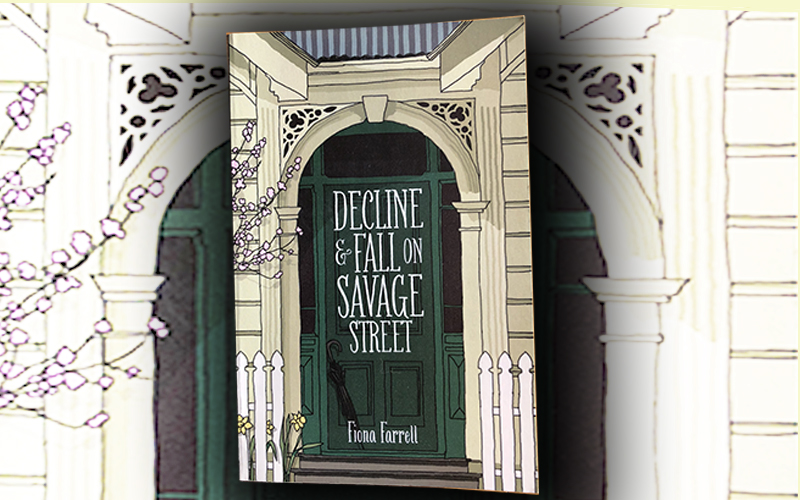
A lot happens. It says this in the blurb.
So don’t go thinking you can just whizz through this as you would a normal novel. You need to go in with the right attitude, with a predisposition to enjoy Fiona Farrell (I do!) and a realisation that some novels don’t have obvious characters you get to know and love and follow on a journey.
The character on a journey in Farrell’s Decline & Fall on Savage Street is a house. It took me a while to understand this, (and apparently she has written a non-fiction book about this house so perhaps I should have come better prepared) so for a while I floundered around with characters disappearing just as I got interested and a whole new set of people coming in. It reads more like a set of short stories, chronologically spanning 100 years, with each story bringing characters who live in the same house with their personalities and tribulations – from our perspective we see a house, but of course for every new arrival it is their home, they move their baggage in and own it.
As a collection of short stories this book is very rewarding and the format works really well, I love the fact that we get to know the house better than the characters themselves because we’ve been inhabiting it, along with all the former tenants, since it was built.
But she’s clever, Fiona Farrell, and this is also a story of another character that lives under the bank of the river, undisturbed (mostly) by the turmoil of change and war and earthquakes. In contrast to the lot that happens to the humans above, nothing happens to the eel for a very, very long time. Or if something happens, it is the drop of a leaf onto the water. We feel her ageing not in the time it takes to read the pages, but in the span of frantic, scrabbling activity that happens ashore. Her story made me feel old. But every story has a climax, and even for the eel, eventually something happens.
Each human chapter starts and ends with a missing line which drove me mad. I guess it is to show we are dipping in and out of a story, but this is a book for intelligent readers and we know that. A kind editor should have said, let’s not do this.
I wont specifically remember any of the characters in this story, they passed by too fast, but the house and the eel will stay with me forever.
Also by Fiona Farrell, if you love good New Zealand writing, is:
Mr Allbones’ Ferrets – Book Review


