
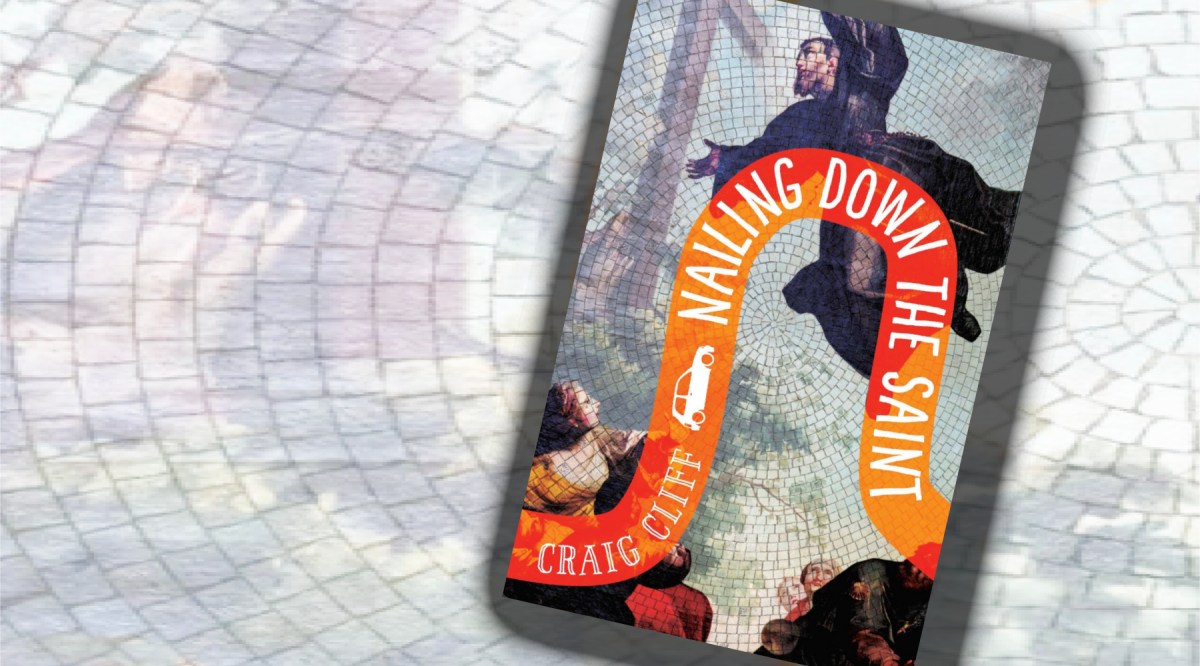
Craig Cliff’s The Mannequin Makers was such a hit for me recently, I thought I’d give another of his books a whirl. Nailing Down the Saint sounded suitably quirky and it is, indeed, a very odd book. Lots of it I just didn’t get. So much of the detail – music, film, cultural – was out of my frame of reference so the nuances skipped past me. Wet Sprocket and heavy metal TOÄD, anyone? George Costanza’s answering-machine message? I didn’t look any of this stuff up, though it might be funny. And the story rambled on for a very long time without me ever really understanding whether the protagonist was winning, whether he was a genius or a sad weirdo, what the point of the story was. But you know what? I loved it. It felt authentic, in a way even the best New Zealand books seldom do.
Duncan’s a filmmaker down on his luck, waiting tables in a pretty shitty restaurant in the States. It’s a down-beat start to a novel, a mood that never really improves. We hang out with this grumpy bugger as he embarrasses himself in front of his in-laws, struggles with his relationship with wife and son and takes off on an Italian roadie with an old friend. It’s a film job, of sorts, scouting locations for a production about a levitating saint. Hold that thought.
Duncan is a kiwi, living in America. I could see no reason why the New Zealand connection was necessary other than to wave a flag to a kiwi audience. Which is fine, we like to be included. He felt pretty American to me, “He’d flown back and forth between California and New Zealand a bunch”. He roadie companion is a school friend (female). They’d kept in touch over the years and their relationship is key to the story. She’s pretty hard case. “He turned to see Mack in a long tan leather coat — if it was black she’d have looked like a stunt double from the set of The Matrix — over a tight-fitting seafoam-green dress.” Duncan’s wife knows Mack has joined him on the road; most nights they share a room, at least one occasion a bed, but he describes the relationship as platonic. I was always wondering what both the wife and Mack’s take on their long friendship is. Would things have been different if he had asked her to the school ball all those years ago? But we’re in Duncan’s head and the women’s thoughts are not there, though occasional insights peep through.
Occasionally Duncan is so self aware that he plays his life as a movie. “Perhaps it hadn’t just started, this framing. Perhaps these films had begun to act on him before he’d even left LA. Perhaps that was why he hadn’t stopped Mack from coming. A subconscious gesture of genre fulfilment.” I found his view of the world through a lens a great hook. Kept waiting for the showdown, the set pieces of a car rolling off a cliff or the police chase through city streets, but the days passed disappointingly with everyday niggles – the guides didn’t show, locations sub par, some places inaccessible. He gets some shots with good lighting but doubts the director would use them well.
OK, back to the saint. He is Joseph of Copertino. Like our story, the saint’s life has a depressing start. “You could even start the movie with the door to the convent being shut in his face, his departure from Martina Franca and his walk of shame back to Copertino. Tell the story of the birth in the stable, the bed-ridden child, the witless student in flashback — if at all. Start with motion. At his lowest point. One of his lowest points. The film could be a string of lows — expulsion from the Capuchins and reproach at home, being called out by a jealous friar and sent before the Inquisition in Naples, his spiritual dryness in Assisi — culminating in his ascension to a more permanent state of bliss.” Joseph is not inspiring in any particular way, he’s shunned, a bit dim and has no luck. But, miraculously, when in a state of ecstasy, he levitates. This supernatural behaviour, according to Catholic lore, was seen multiple times by a number of witnesses. Right you are, then.
Duncan has dreams of levitation. Perhaps sometimes it’s hard to know when his dreams start and reality begins. As I say, it’s an odd story.
I quite like the non-ending. Life doesn’t fall in neat chapters and the randomness of this ties to the authentic feel I mentioned. I don’t know what the future holds for Duncan, but that’s OK. I didn’t like him very much, anyway.
Would I recommend this? I certainly enjoyed the weirdness of it, but I’m in a strange place right now. I’m sure there are others out there who will rave about it with me. I just don’t know where they hang out.


