
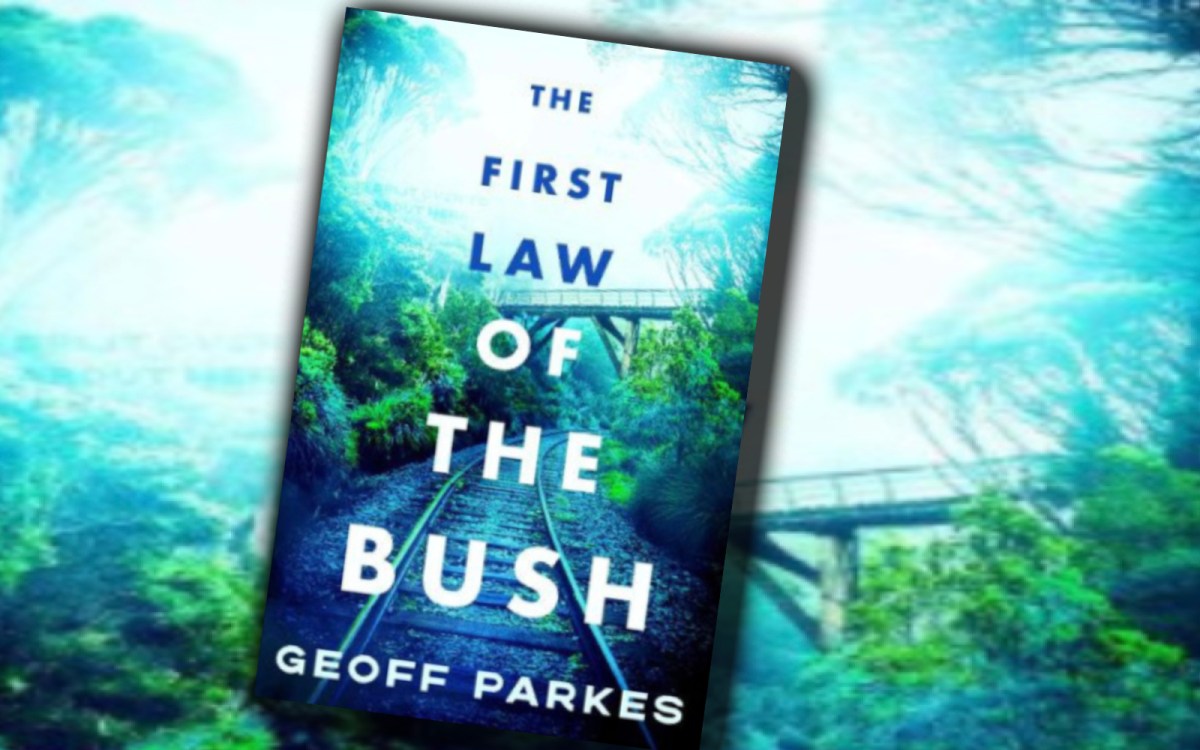
I asked my book guru for a book with plot. I’m writing the outline of a potential novel which needs a properly complicated sub-plot – the sort where a bloke does one little thing that he shouldn’t and things snowball dramatically to a killer twist at the end. Not my usual type of writing, or reading for that matter.
“Read The First Law of the Bush,” said Phil. So I did.
Plot-focused stories like mystery and crime seem to be about characters getting the wrong end of the stick and withholding secrets, where nothing is quite as it seems, but with just enough hints being dropped so at the end the mislead reader sees the trail was there all along. Not an easy trick to pull. I was properly duped here, watching the action rather than the sleight of hand on the side. There were plenty of red flags. I just wasn’t looking. Clever. Geoff Parkes’ plot structure taught me a lot of things I didn’t learn in writing school.
I didn’t love the book – crime/mystery is still so not my thing. There’s a lot of talking heads and not much getting inside those heads, and the editor could have done the story a big favour with a few red lines through some of the clunkier phrases. The rap on the door was so heavy the whole flat shook on its foundations, and It was three days since the explosion, and Ryan hadn’t slept a minute. But this book has no pretensions to poetical writing. It’s about telling a good story. Plot.
“Don’t rely on the law and the police and the courts. Let people sort things out for themselves, how they’re supposed to be sorted.” That’s the first law of the bush, and obviously an indicator as to why things went so wrong in this little town to the west of nowhere, mid-North Island. The town was built around the railway but now the yards are empty, workers bussed in from big centres and only a few locals left maintaining the track. One worker mysteriously falls from the railway viaduct. His wife sets out to find out why.
The wife is joined in the role call of characters by a rookie lawyer, his girlfriend, a police constable and his sergeant, a couple of railway workers, a withdrawn schoolgirl, a baker, some drug runners and an Auckland gang of clichéd baddies. It’s quite a crowd and the introductions take a while. The blokes are all very blokey. Poor old Carol, whose husband has died: “Clearly, she had once been a very attractive woman – still was – but any superficial appeal had since been impinged upon by the ravages of grief.” Hang on, is it a thumbs up or down for Carol, then? And no rugby player is able to cook his own dinner: “Practice over, showered and dressed, the fortunate ones – those coupled or still living at home – had hot dinners to hasten off to. The single lads were headed to the takeaways.” If they can’t cook dinner it’s no wonder they’re single.
The mystery of the man falling from the bridge is almost sidelined by the other goings on in the town, and I was pulled along, trying to link it all together. The twist at the end made sense of it all and was cleverly done. However, I have my usual gripe. Parkes uses a nasty punch to the vulnerable to give us an emotional hit and the upshot is clumsy and handled in a trite little explanation with no sensitivity. As I say, all a bit blokey.
So verdict: a well plotted and engaging book, but not one for me.

 Cristina Sanders' blog