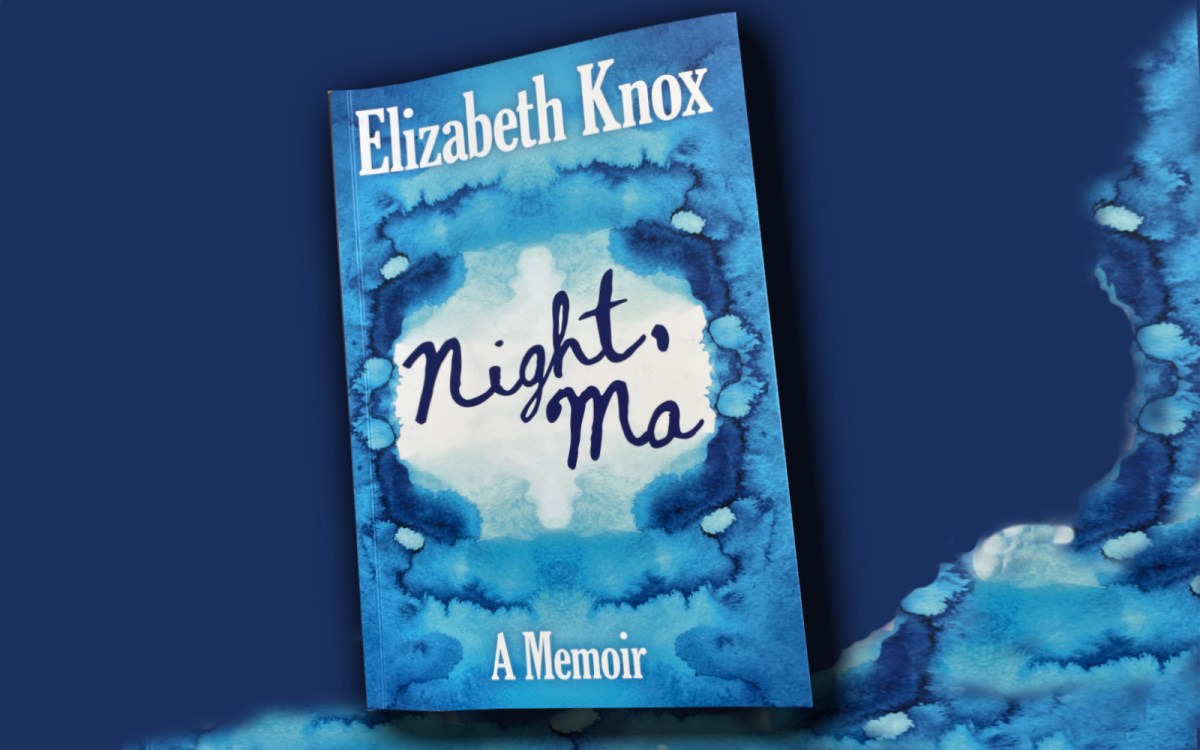
I had bought Night, Ma and left it on my table for a while, wondering if I really wanted to go there when there were nice, frivolous, bouncy books still on the pile to read. I finally opened it with trepidation, still bewildered as to why writers turn themselves inside out to offer up all their innermost vulnerabilities. I’m a late-comer to the intimacy of memoir. Now of course I recognise it is this very vulnerability that makes the genre so compelling. Human nature recognises and engages with truth, and truth is at the heart of every great story. Perhaps we connect with memoir in a more primal way than fiction and feel every scene, every touch, with far more intensity because it’s not just made up out of some frivolous author’s head, or some AI bot. Here’s the truth, as one woman sees it. Night, Ma comes alive through Elizabeth Knox’s almost subcutaneous observations of the people closest to her. And that’s fascinating.
Of course, Knox is a story-teller from way back, a writer of immense creativity, and here we see that emerging from a childhood spent roaming unchecked through the no-man’s-land along a river bank, imagining the world through her own lens, encouraged by her older sister’s night-time stories created from ‘charmingly misapprehended information’. Some of these stories are recreated here for us: a psychiatrist’s wife who turns the local postman into ‘congealing fat in the roasting pan’, another in which Thundy the brontosaurus uncovers angels behaving badly in heaven with gruesome repercussions – all detailed and complicated tales of evil and redemption. ‘Cannibalism was a big theme, but so was social embarrassment’. Both best avoided. Twisted reality, crazily inventive and well restructured all these years later. If a writer has kept such weirdness in her head all this time there’s no knowing what she’ll do.
The narrative is novelesque, with historical reveals drip-fed so our understanding builds and builds (the sisters’ backstories, abuse), counterbalanced with sudden shocks (a hit and run, mother’s illness), and the dynamic and confusing relationships that grow and change. I wouldn’t call any of the relationships love/hate, but this is real life and we have protection/betrayal; compassion/frustration; neglect/forgiveness, all at once and overlapping like these things do. There is also staunch loyalty which gives heart to the whole thing.
There are some lovely, lovely encounters in this book, particularly of the recognition of Knox for her mother. Descriptions of women looking back and seeing their mothers often takes an entire book (Grand by Noelle McCarthy is a cracker, Mother Mary Comes to Me, by Arundhati Roy another). There’s a scene when Knox is a student riding the train home with her mother after work and she captures the essence of this in a sentence. ‘Those Friday evenings on the train to Paramata were the beginning of a kind of romance – the romance that we have with our parents if we’re lucky enough to still have parents when we first become adults.’ For those of us who, as adults, missed our mothers, this stuff can be quite raw. How does she know this?
As her mother’s health fails she looks back. ‘Her diction, warm, with a Southlander’s burr on certain words. I remember the sorts of things she’d say, how graceful her passing conversation was’. Knox is a sensory writer and we are with her: hearing her mother’s voice as it disappears, smelling her sister’s unclean room, feeling the comfort of cats with their ‘warm fur and disporting self-delight’ to take the edge off loneliness.
There are a few cats in the story, bringing domestic detail and telling us about their owners. The long-haired ginger cat who would wait by her mother at breakfast for the ritual of the shared butter, cats needing care, the way the family understand, without out it ever being said, that Cheeky needs to be treated as an appendage of Knox’s mother.
So what’s the story about? An inordinate amount of tough stuff happens to Elizabeth and her family in these few, very difficult years. Every reader I’ve spoken to seems to take something different away. For one, it’s about mental illness, for others it’s about sibling dynamics; it’s about childhood abuse shaping a future life; it’s about trust and love; it’s about the incomprehension of a sudden death and the strain of a court case; it’s about health crises and looking after yourself. Maybe everyone finds something about themselves here. For me it was about the long vigil of care while watching someone die.
Doesn’t matter how you come at it or what you take away from this story. It’s about one thing. He tangata, he tangata, he tangata.
Bloody good.


