The Naturalist – book review

The naturalist, by Thom Conroy (more fan fiction than book review!)

I feel a bit cheeky writing a review of Thom Conroy because he is a teacher of writing and I am a student (different institutions and I’ve never met him), but also because he’s writing about my blokes. Or I’m writing about his.

It’s something you do need to come to terms with, when you write historical fiction, that your characters are not, in fact, your blokes. Thom Conroy’s book, The Naturalist, is the story of Ernst Dieffenbach, who was a member of the New Zealand Company’s 1839 colonial expedition.  He sailed on the Tory with The Colonel and Jerningham Wakefield, Charles Heaphy, Captain Chaffers and their gang.

They’re all historical characters (and my goodness, they are characters) and Thom Conroy has written a wonderful fictional account of how they all got along together. Which is not very well, most of the time, except for the rather gracious Charles Heaphy, who got along with everybody.

I’m a student this year, of creative writing, and I’m writing a book about the above mentioned Jerningham Wakefield, one of the more outrageous characters in Conroy’s tale. I have my first draft of 100,000 words and Jerningham has romped through them, heartily pissing off Dieffenbach, the Colonel, Captain Chaffers and even the mild mannered Heaphy. (No one, anywhere, has ever written a bad word about Heaphy. He’s one of God’s good men, everyone says so, and every story needs one good man.)

But I am writing about Jerningham and I love him very much, in the way a mother loves her son; with indulgence and exasperation and a hope that he will, one day, grow out of the booze.  Conroy doesn’t love him so much. I’m glad I wrote my book before reading Conroy’s, because I formed my judgement first and when you meet a new bloke, first impressions count.

They’re up for grabs, these characters, and I’m starting to realise that using historical people in a novel is a bit like writing fan fiction.  There’s no copyright, they’re been dead well over 100 years and any author can take them anywhere.  Dieffenbach, Jerningham, Heaphy and co. all wrote compelling journals so there is plenty of source material, and once you get gripped by the Victorian character of these extraordinary men a kind of magic takes place – they come alive, start arguing with one another and acting up.  I know Jerningham comes down at night and raids my booze cupboard.

Thank you, Thom Conroy. Reading The Naturalist makes me feel we’ve met through mutual friends, and you’ve told me a story about them in a new way, and added to my understanding of the lives of these tenacious, complex men.
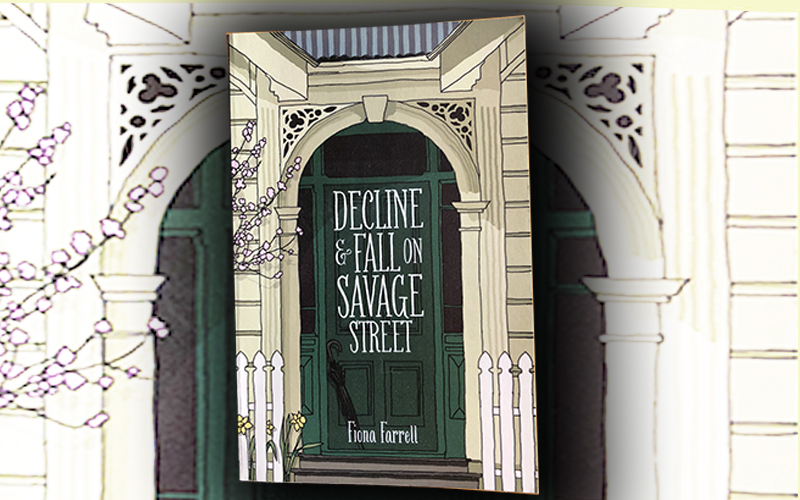
Decline & Fall on Savage Street – book review

Decline & Fall on Savage Street, by Fiona Farrell

A lot happens. It says this in the blurb.

So don’t go thinking you can just whizz through this as you would a normal novel. You need to go in with the right attitude, with a predisposition to enjoy Fiona Farrell (I do!) and a realisation that some novels don’t have obvious characters you get to know and love and follow on a journey.

The character on a journey in Farrell’s Decline & Fall on Savage Street is a house.  It took me a while to understand this, (and apparently she has written a non-fiction book about this house so perhaps I should have come better prepared) so for a while I floundered around with characters disappearing just as I got interested and a whole new set of people coming in. It reads more like a set of short stories, chronologically spanning 100 years, with each story bringing characters who live in the same house with their personalities and tribulations – from our perspective we see a house, but of course for every new arrival it is their home, they move their baggage in and own it.

As a collection of short stories this book is very rewarding and the format works really well, I love the fact that we get to know the house better than the characters themselves because we’ve been inhabiting it, along with all the former tenants, since it was built.

But she’s clever, Fiona Farrell, and this is also a story of another character that lives under the bank of the river, undisturbed (mostly) by the turmoil of change and war and earthquakes. In contrast to the lot that happens to the humans above, nothing happens to the eel for a very, very long time. Or if something happens, it is the drop of a leaf onto the water. We feel her ageing not in the time it takes to read the pages, but in the span of frantic, scrabbling activity that happens ashore. Her story made me feel old. But every story has a climax, and even for the eel, eventually something happens.

Each human chapter starts and ends with a missing line which drove me mad. I guess it is to show we are dipping in and out of a story, but this is a book for intelligent readers and we know that. A kind editor should have said, let’s not do this.

I wont specifically remember any of the characters in this story, they passed by too fast,  but the house and the eel will stay with me forever.

Also by Fiona Farrell, if you love good New Zealand writing, is:
Mr Allbones’ Ferrets – Book Review

Sticking with Pigs – Book review

Sticking with pigs, by Mary-anne Scott

A fourteen year old boy, wrapped lovingly in cotton wool, goes out into the New Zealand bush with his uncle on a hunting expedition.

His parents have good cause to worry. The boy’s named Wolf, so you know they’re not precious by nature (named for Wolfgang Mozart, but sounds like his parents love a rough diamond to me). But Wolf has a chronically sick brother whose illness, as it would, dominates every safety decision and going hunting is not a walk in the park.

Lots of kids say they’d like to go hunting. I’ve never hunted, but I have friends who say they’d like to come tramping with me – a shadow version of a hunt but involving going bush with plenty of frightening-lite experiences. Mostly the friends are all talk and no trousers; when you start describing the hill tracks and the bare huts and the long-drops the enthusiasm wanes.

To Wolf’s credit, he trains up and off he goes with his uncle Jem and the dogs and the knife (no rifle, because to appease Wolf’s gun-shy parents, as the title says, they’re sticking with pigs), up the long haul to the ridge line, deep into the NZ bush. Scott doesn’t give a location, could be anywhere, but feels like the Ruahines to me.

If a kid can learn instinct, this is where he learns it.

There are wasps and pig shit, steeper and steeper hills, gullies, water and bush. I won’t give the story away but yes, there’s a pig. Then the trouble starts and Wolf gets his coming-of-age challenge slammed down on top of him, as raw and as kiwi as you like.

There’s a girl and a man’s mate at the edge of the story. I recognise both these characters. She’s an outdoor chick, handy with a GPS and long treks up the hills, practical, good in a crisis. I can see why Wolf fancies her. Uncle Jem’s mate has a pre-packed rescue kit and will walk through the night, no question, not much conversation. Everyone needs a mate like him.

Sticking with Pigs is probably aimed at reluctant young teen readers. But it’s also great entertainment for avid middle aged story-gobblers.