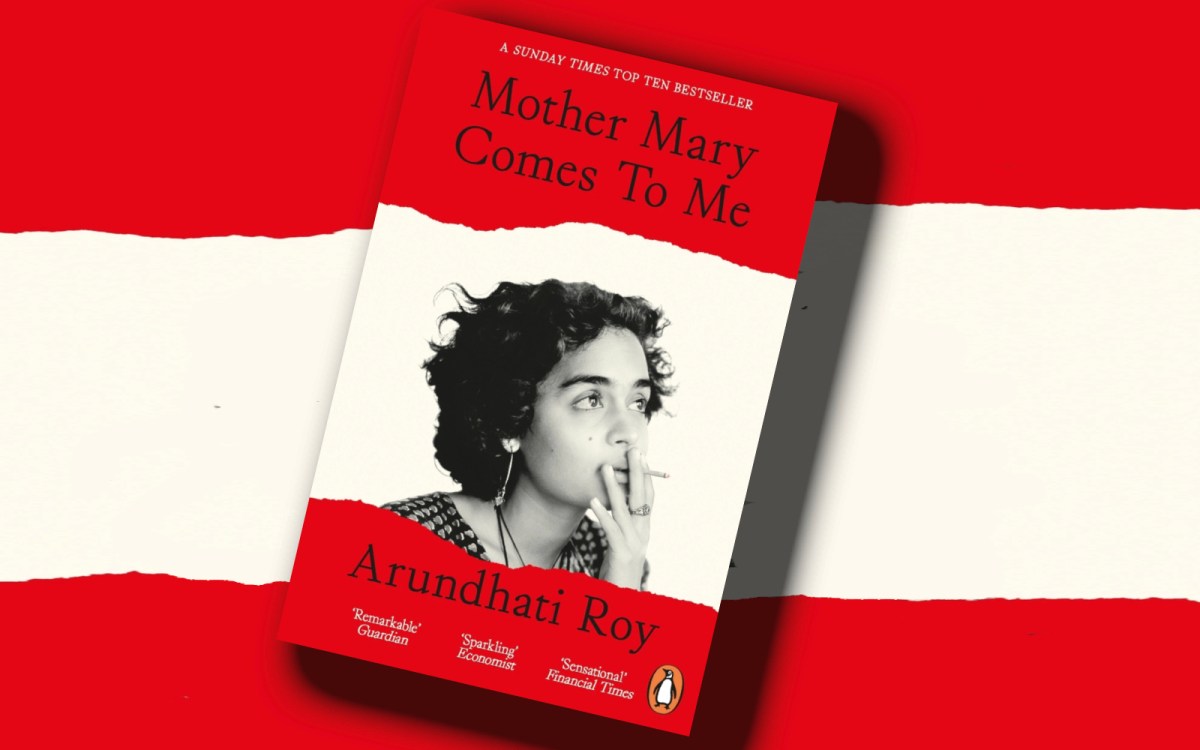
Anyone who fell in love with The God of Small Things, by Arundhati Roy, will be drawn to Mother Mary Comes to Me, to understand how she could write such an extraordinary novel. This is her memoir, and just as bold and in-your-face as fiction, with the drama of Indian life, the outsized personalities, the confusion, the heat, the colour, the overwhelming sense of chaos that seems to define life on the subcontinent. The feeling that your life isn’t yours to own – just by being a woman in India you are liable for so much to so many.
In Roy’s case the overwhelming suffocating feeling of debt is to her mother. Bloody hell. Mothers!
Mary Roy is a single mother, a mover and shaker, a fire-cracking, get-ahead woman who demands attention and adoration. From a humble start, she grows from teacher to influential educator and owns a large school, she challenges local authorities and sticks it to the man. She’s a force. In Mary Roy v. State of Kerala she wins a case that sets a precedent for women’s inheritance rights, but the years of litigation for her father’s estate against her brother leave her poorer. Disappointments hit hard. She hits hard. She’s charismatic as a leader of women in a difficult place and time. Not much of a success as a mother, though.
We are living in Arundhati’s shoes. She has a classic love/hate relationship with her mother. Frankly, I can’t really see where the love part comes from, if not obligation and the tenet to love thy mother. Her mother is abusive and cruel. Drops her out of the car in the middle of nowhere. Calls her ‘Bitch’ in front of an audience. Barely acknowledges her most of the time. Arundhati calls her a narcissist. I hate that word as a label generally, so often used as a throwaway to discredit an ex-, or often enough, a mother who’s a bit selfish and not offering unconditional love. But in this case the term narcissist seems apt.
I often wish to hear the other side of such relationship stories, but we never do. We can damn our mothers but they don’t often get the right of reply. Here it might trigger a fight to annihilation.
Mary undermines Arundhati over and over but still plays the deserted mother when her daughter finally leaves her, eventually pulling her back in to punish her for lack of love. It’s grim.
During her time away Arundhati struggles to live free of her mother, but she has little money or support and it’s a hard life out in the slums. She lives in squalor in Delhi while trying to study architecture. During these years she writes articles, becomes an activist for human rights, environmentalism, anti-military. She stands up for the poor and the marginalised. Gets work writing movie scripts and eventually, writes the novel that sets the world on fire. The God of Small Things gives her world-wide success and great wealth. Her mother allows her home and still belittles her.
As always, with memoirs about mothers, (and two beauties here: Night Ma, from Elizabeth Knox, and Grand, from Noelle McCarthy) I’m interested in why a woman would not only dig so deep into this most difficult of relationships, but also share it. Here’s what Arundhati Roy says:
‘To bridge the chasm between the legacy of love she left for those whose lives she touched, and the thorns she set down for me, like little floaters in my bloodstream – fish hooks that still catch on soft tissue as my blood makes its way to and from my heart – is why I write this book.’
I had a tutor who would have described such a phrase as phenomenological. I would read a whole book for something like that. She really describes the whole relationship with her mother in seven words:
thorns floaters bloodstream fish hooks soft tissue
This is the kind of book that will open your eyes and change your life. Excellent for book clubs.


