
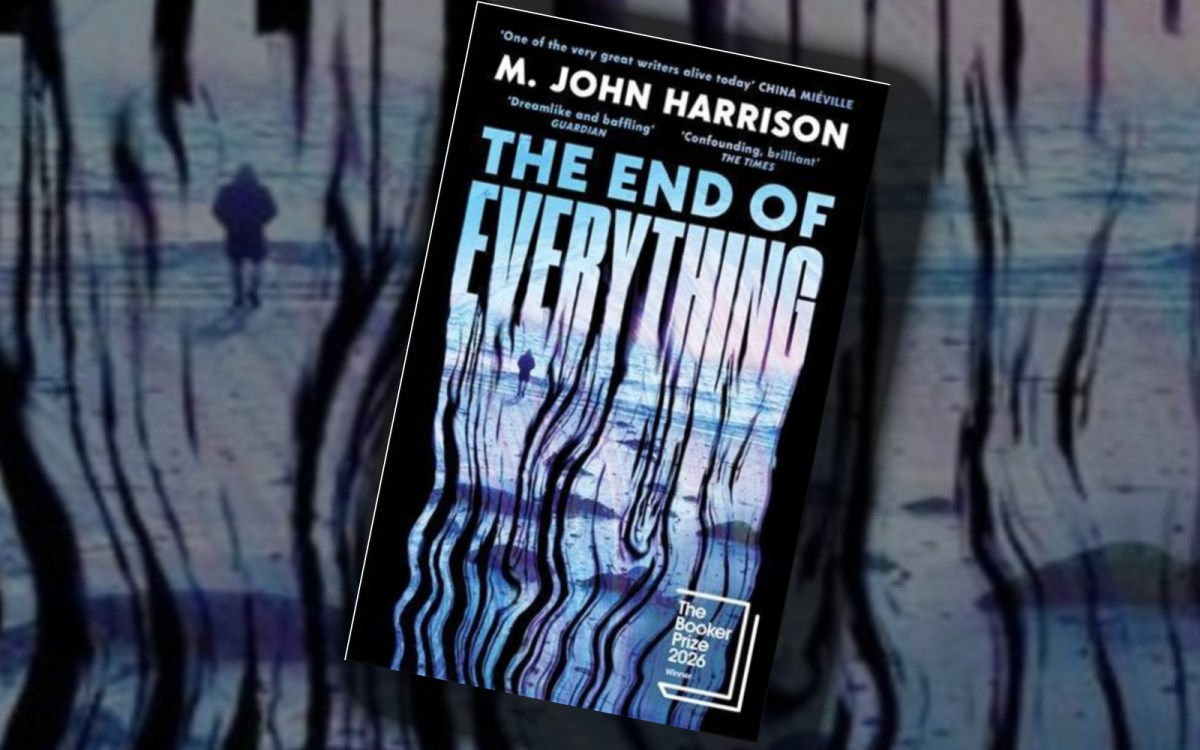
And what a sad, dysfunctional end it is. Not heading towards the apocalypse with a few plucky young people fighting to save the world from the last battle (as we’ve been doing fictionally forever) but just human failing, a few smears of space jelly and some pretty fucked-up individuals getting insouciantly gruesome. It’s a shocking book, but it is a Booker winner. You should expect it to be difficult, and it is. It’s a really tough read.
There’s no way I’m going to summarise the plot here. There’s barely a plot. A few things happen, a bloke called Philip walks around on a beach, visits his aunt Marnie who’s sweet old dear who might have come straight out of Tarantino’s head. She has a bit of bother with a neighbour (which I tried to describe to a friend who I don’t think will ever forgive me).
She went and talked to the boy’s father, who lived a couple of doors down. They sorted things out between them, and the father sent someone to lever his dead son out of her extension roof.
Can’t really say things go downhill after that because we’re at rock bottom throughout the book, but I guess casual cannibalism of an ‘artifact’, which presents as human, is a step down? Hard to tell, when any sense of morality left the story long before it began.
We are in post apocalyptic England on the Kent coast, and ‘boat people’ are heading out with little chance of arriving in a better place. They don’t seem to know what’s out there. They are insular, these remaining humans, and the rest of the world, perhaps, is no longer on their radar, though there are vestiges of a functioning world. People still drive their cars to the coast for a seaside holiday and there is no explanation of this juxtaposition. There is no explanation for anything, really; this is very much a “show, don’t tell” story.
The sea is full of jetsam and jelly, and Philip and the beachcombers drag prizes from disquiet waters, a serious item from the ocean referred to as a ‘ticket’, which made me think of homeward bounders at the goldmines, though there is no home for anyone to return to. I got stuck on Philip’s view of the sea for a long time: ‘… a flat track of moonlight lay on its surface, parallel to the beach and about five hundred yards out, sometimes swelling and broadening in an oily fashion as if some large object had suddenly changed course beneath.’ There’s lots to unpick there, but I couldn’t get past the moon’s track being all wrong. Surely the moon always tracks to the viewer’s eye? How is it running parallel to the beach if he’s standing there? Whose eyes are we looking through? It’s not only the perspectives that don’t really add up here, but the people themselves who are creepily turning into something else.
This book’s win of the Booker has its critics. Too bleak, too fantastical, too much unresolved, too weird… though the latter seems to rule it in rather than out. The Booker is all about stretch. It does leave the reader feeling a bit sick. I can’t say I’m a fan but I do think it is brilliant, a book born of the times when we seem incapable of taking our foot off the pedal but we don’t like where we’re going (or where we are being taken against our will).
And YES, by all means take it to your book club. You don’t need to make sense of it, just embrace the weird and see where it leaves you.


