
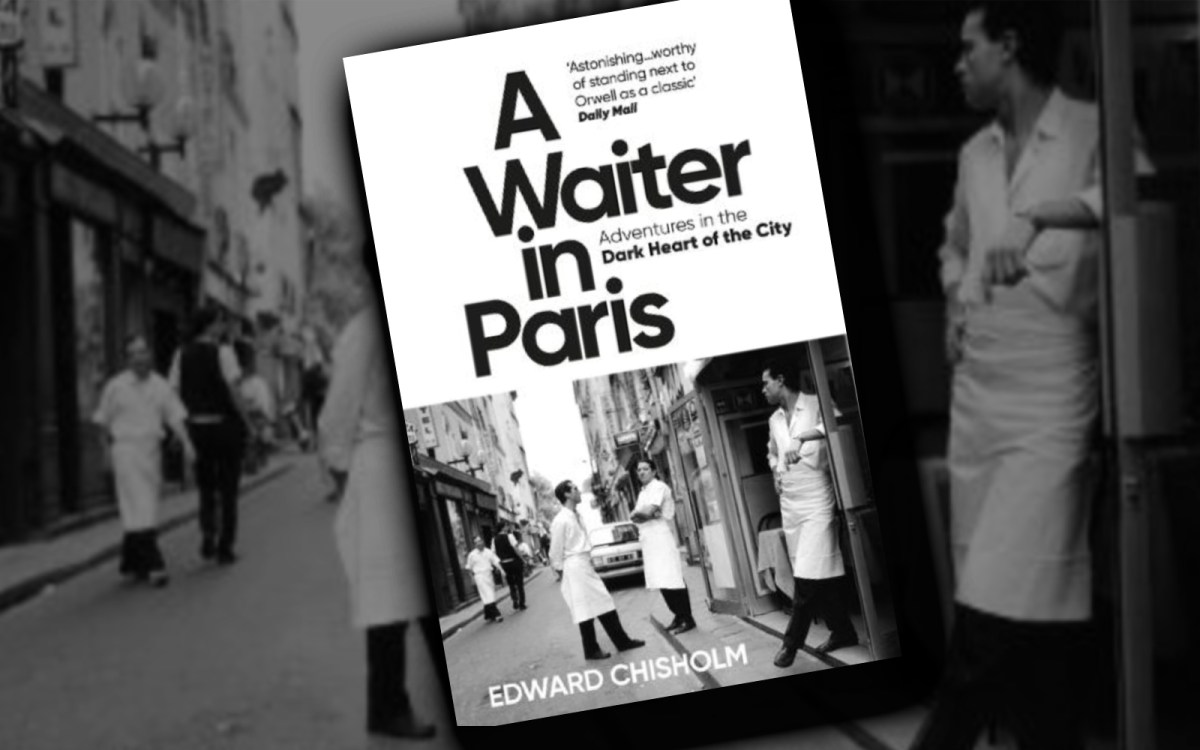
Paris is a city of illusion, according to Chisholm in his brilliant memoir, A Waiter in Paris. He dives into its dark side. Nonetheless, he does the city no harm at all. The long hours, grim streets and all-night bars throw a bohemian romance over all the misery as if the behind-the-scenes exploitation and squalor he describes are a necessary background patina to the bright lights above. Think Moulin Rouge and the painted girls dying of consumption. What’s a star without night?
I love the writing here. The prose is sparse and to the point. He makes us look smell and hear Paris, often a very grim Paris, but because our narrator is an outsider the writing never feels depressing. It’s a temporary thing. Like George Orwell in Down and Out in Paris and London, Chisholm is gathering impressions to feed his ambition to become a writer. These horrors will pass.
‘At the next station, Château Rouge, a man with a hollowed face wearing ripped trousers tied at the waist with string stumbles on without looking up. The carriage is filled with the smell of his still-lit cigarette and the musty, ammonia-tinged odour of a man who hasn’t washed for some time’.
Chisholm is called L’Anglais, in a racist slur for the lowest of the servers in ‘Le Bistrot de la Seine’. Spat out by the global financial crisis in London and left in Paris after a girlfriend moved on, he’s broke and about to be homeless. But he’s young, educated, and, having read Orwell, decides there is a challenge – an honour almost – in getting down and out in Paris and joining the underbelly of a restaurant. He will become a waiter. It will give his future writing grit and authenticity.
Restaurants in Paris are full of illusions, Chisholm discovers. The sparkling glasses, perfect plates, seamless service all come from a place of extraordinary dysfunction and danger behind the swinging doors. Thwop thwop. ‘Because, if a waiter is doing his job correctly, he will be manipulating your perception of reality. He is, to all intents and purposes, an illusionist and his job is to deceive you. He wants you to believe that all is calm and luxurious, because on the other side of the wall, beyond that door, is hell. He is, in effect, the living example of the façade.’
Nearly a century has passed since Orwell wrote his experiences highlighting the flip-side horror of Parisian restaurants, and despite France’s 1978 Living Wage Law – introducing Service compris to ensure waiters receive minimum wage, healthcare, paid vacation, etc – it seems little has changed. Chisholm in 2011 still gets no contract, enforced overtime, demoralising working conditions with bullying, coercion and no breaks. The place thrives on the desperation of foreign labour. He’s starving in a restaurant. Orwellian conditions still prevail.
In the beginning, his French is limited. He has memorised a few stock phrases to get the job, but for the first weeks has little idea what is going on. There is no training. We suffer this with him as Chisholm offers only sketchy translations and some words thrown at him he blanks out ‘“L’Anglais, come. _______. C’est l’heure”. Time for what?’ No one explains. The other waiters bully him into the role. He carries their plates, clears tables. He has to beg for a share of the tips which are not forthcoming. His co-workers are mostly a pack of hard bastards.
But he keeps coming back. He has nothing else. He goes from living in a prostitution hostel to a bug ridden maid’s room and rides the metro: ‘It operates like a dark vascular system, pumping people to where they’re needed so that the city may live.’ He works ridiculously long hours without breaks. He gets a foothold, learns how to be useful, learns the rules of the game, how the staff play one off against the other, divide and rule, steal plates, come to work drunk and stoned, rat on their colleagues. And slowly, slowly, tripping and fumbling, he finds a way into the life of a waiter in Paris, becomes one of the fraternity.
He makes it sound like the biggest achievement of his life. And certainly after the publication of this marvellous book, A Waiter in Paris, I hope Edward Chisholm is comfortably seated on the glamourous side of the restaurant. I hope he looks the waiter in the eye leaves great tips.


