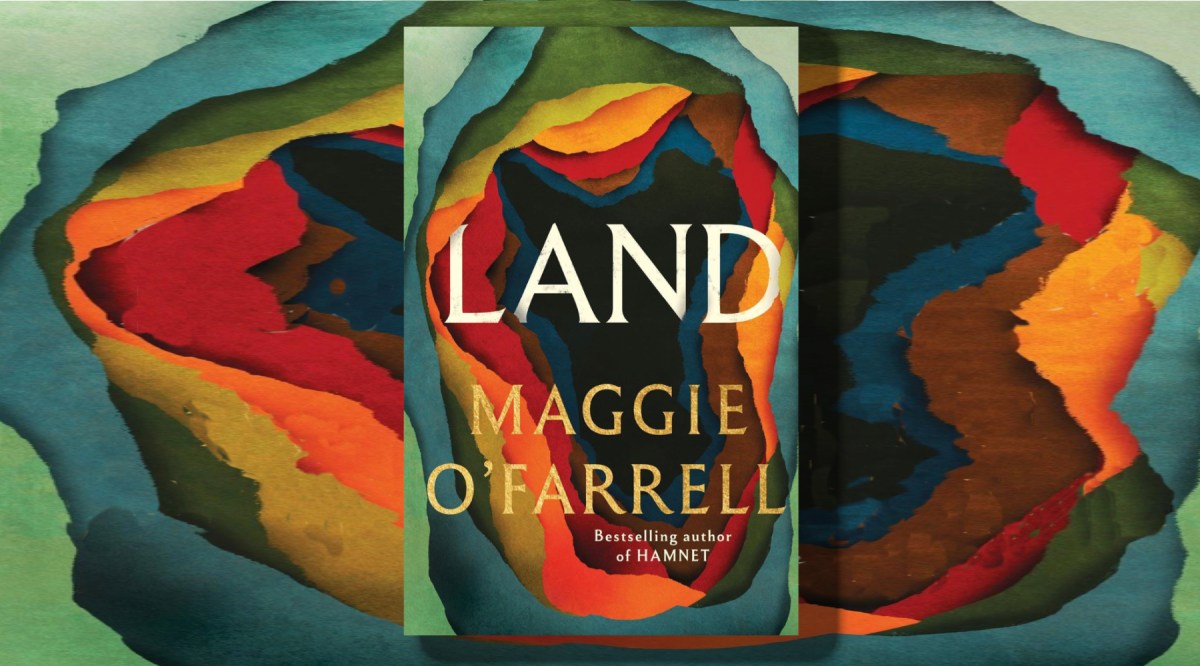
Firstly, what an incredibly beautiful cover! The colours of rich earth and moody sky and deep wells in the Irish landscape that a reader might fall into and never find their way back as happened to several characters in this book, though we’ll never really know why. This is a novel dripping with the mist of superstitions, damp with hidden meanings, fractured with the bones of ancestors lying under the soil. A worthy successor to Hamnet, then, and absolutely ripe for those happy to believe in the hocus pocus of sacred springs and gollum-like fish. Judging by book sales, that’s a great many of us. ‘Give me the ring, it says’ (the fish).
To be sure throughout all histories there have been superstitions and religious indoctrination, belief in ghosts and a tendency to anthropomorphise. I am all for characters believing in sacred springs and whatnot. I think where O’Farrell loses me (as she did with Hamnet) is the authorial voice persuading us this is real, which gives a childishness to the story it would be much more powerful without. But other than this odd passing woo-woo shudder, the rest of the book made interesting reading.
I’ve recently being glued to David Olusoga’s BBC documentary series Union, which offers a great background to the history O’Farrell covers in Land. Olusoga tells us what happened – this grievous and terrible colonisation of the land – and O’Farrell tells us how it felt. My God, what a story.
The story begins and ends on a strip of land on a peninsula on the west of Ireland, and goes back and forward and round about in the middle, including a confusing witchey middle-age (which could have been trimmed, IMHO). We start in 1865 and a cartographer, Tomàs – who we later learn as a child watched his family starve in the famine – is meticulously mapping the territory for the colonisers. He is useful to the English as he is not only an excellent draftsman (and cheaper than one of their own and they sign their names to his work) but he speaks the local dialect and helps the redcoats plan their appropriation. Whole villages and an old way of life are literally wiped off the map. Tomàs leaves his son, Liam, in the rain on the hill holding a measuring chain, disappears into a hidden wood, where he drinks from a spring and comes back either raving mad or enlightened.
We circle this point in time with this man and boy with snatches of memory, things erased, a future shattered by the broken past. Lives rebuilt and unsustainable, beliefs beaten out of the nonconformists. Sometimes it’s hard to put the story together, which of course is the point. The new map is a background metaphor for colonialism: the land overwritten and erased. ‘The landscape of his home, its fields and pastures and trees and paths, the memory of his home’s hearth or doorstep or rafters or bedding: vanished without trace. All he has is the recollection of a long, frost-shirred road rolling out before him, and his name. The latter had been sewn, in a looping black script, into the breast pocket of a jacket he was wearing on the day he was brought to the workhouse.’
The story focuses on Liam for a while as the family struggles physically and spiritually, horribly. His mother Phina is another workhouse graduate, saved from deportation by Tomàs, and his sisters are clever and beautiful, Edna and Rose respectively. Liam goes into the church, Edna has a neat transformation and goes travelling and Rose copes with the help of a magic dog who keeps the men-hounds at bay. Both sisters have interesting stories. There is an ancestor (I think?) Brith – a human sacrifice from the ancient times who is buried below with bones occasionally disturbed, and a younger brother, Eugene, who eventually brings the story to an end on the same peninsula where we began, not far from the spring in the hidden wood. How does a wood remain hidden all these years? You may well ask.
Land is a lush and expansive story, very visual in scope, surely written with an easy step to the cinema in mind. From the little boy left in the rain on a hillside to the domesticity of the home-life, the screenplay is ready.
‘Rose does her best. She gets up early, coaxes the fire into flame; she pours out the flour from the jar; she scatters in the soda so that the bread will be ready. She milks the cow, she collects the eggs, she looks after Eugene, she takes a needle and thread and she tries to mend their clothes, she really tries. Somehow, though, whatever she does isn’t enough: her darning unravels, her stitches aren’t strong enough, the tears and rents show through.’
This story of Ireland is contained here mostly on a tiny imaginary point on a map. The horrors of history are personal and brutal, but they shed little light on the bigger picture. OK, so not all historical fiction has to teach the reader something, but I think I want a bit more why with my what. For that it’s back to David Olusoga for a history lesson.


