
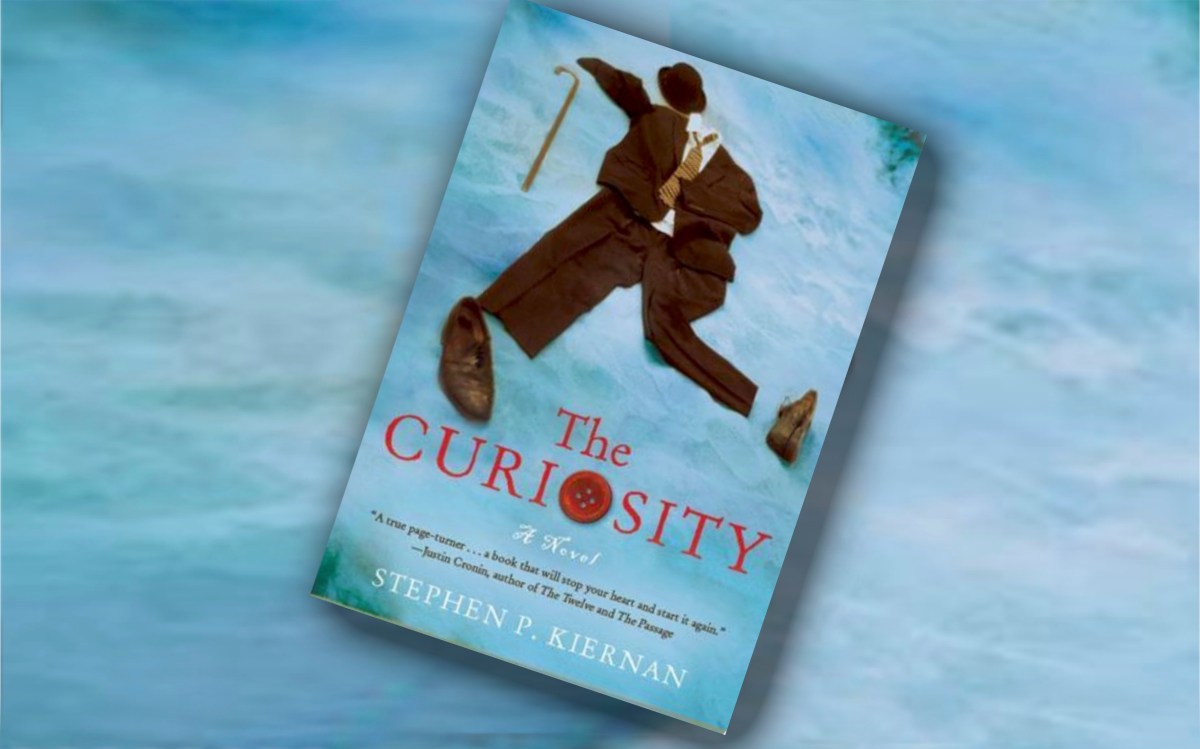
I’m going to give a bookie suggestion right up front. If you’re keen on reading a great story where we bring a man back to life from history, Kaliane Bradley’s The Ministry of Time is the one. It was one of my favourite books of 2024. Stephan Kiernan’s The Curiosity was published a decade earlier, same sort of story, with a modern woman falling for a reanimated gent with all his old-fashioned charms, but it has none of the raunchy chemistry that makes Bradley’s book such a hit. The Curiosity is interesting in parts, but…
Much of the story is told by Kate, a scientist who, when called to the research vessel’s ops deck the middle of the night, still takes the opportunity to let us know ‘I am slender to a fault, almost no hips at all, breasts so small Chloe says I never really developed. The only way I have a shape is if wear something around my waist…One glance in the mirror, I decided to throw a yellow T-shirt over the whole thing‘. This is a woman’s first person pov and nice to know she’s the sort of professional who is concerned that she looks shapely to her shipmates on night watch. The next chapter is written by a seedy male journalist and he begins with ‘I can’t help mentioning she had an ass on her like to break your heart. Not a man alive could help noticing‘. There are lots of examples like this where I feel the author is not really reading his room.
Kiernan dwells a bit pedantically on the mechanics of resurrection, which of course is ridiculous and there’s nothing wrong with ridiculous in speculative fiction, but if you’re writing whacky why not have a bit more fun? Anyway, these scientists are researching for krill and little fish caught in fast-developing block ice, for resurrection by a tech genius who is a clichéd character: fabulously wealthy and unscrupulous and bearing a name that shouts privilege. Erastus Carthage. Oh, come on. The scientists find what they think is a seal within the ice, turns out to be a man who fell off a ship. It’s a bit of a leap, you’d think, from the reanimation of shrimp to bringing a long dead frozen man back to life. The world watches.
The next part of the story is the resurrected man’s adaptation to the modern world and there are two hooks that pull this along: how long will he survive and will he/won’t he with Kate? He’s not the most charismatic of blokes – an all American family man, a judge, an observer on the ship from which he falls. I didn’t really get any feeling of the blossoming chemistry with Kate; there’s no suggestive writing-between-the-lines. She says ‘There we were, facing one another, silent, streetlight through the trees streaking his face, this incredible man’. Then she kisses him. I want something sexier than ‘incredible’. The author is clumsy in writing woman’s emotions – here’s a classic from Kate: ‘Between a man and a woman, everything can be changed by one kiss. Touch, intimate information, the admission that each person yearns for the other. Some would say intercourse is the alteration, and that’s true, but there is no denying the barriers that fall after one heartfelt kiss. Sure as night follows day…’ Ugh.
Again, it is unfair to compare this with Ministry of Time where the sexual attraction between the historic man and modern woman gives the whole book the panting hot shivers.
The judge gives us his opinions of the modern era. ‘It was thrilling to see people of every shape and color socializing together.’ Doubt it. A prudish American white man from 1906 would be very uncomfortable by that mix. At one time he thanks Kate for ‘sharing your story with me’, and later tells her, ‘I imagine that very few people reach the end of their lives and regret having spent too many hours relaxing beside the ocean’, both of seem modern clangers to me.
As well as the judge and Kate, the evil mastermind Erastus Carthage takes a turn narrating – all in confusing second person, perhaps to show his dominance? – but the worst narrator is the seedy journalist who, rather than oogling Kate for the entire story, goes ‘window-shopping Dr Kate’s personal merchandise’. Yuck again.
There is the start of a side story of the judge’s descendants. If I were to be reincarnated, I think descendants would be top of my mind. ‘There was a girl, she had fiery hair and ran toward me.’ What? Who? Why give a girl the cliché of fiery hair and then drop her? Our protagonists move on, unfazed.
Kiernan sets up a few ethical debates in this story, so potentially a good read for a book club: what does the present owe a reanimated man; is he a research subject and what are his rights; is Kate breaking any moral rules with her behaviour; is he an abomination, do we need consent to resurrect someone?
Verdict: my kind of story, but not my kind of writing.

 Cristina Sanders' blog
What a fab review Cris, thank you. Snappy, concise, and so well informed. I always love how you bring your insider knowledge of a writer’s craft to your appraisals – brilliant stuff!
>
LikeLike