
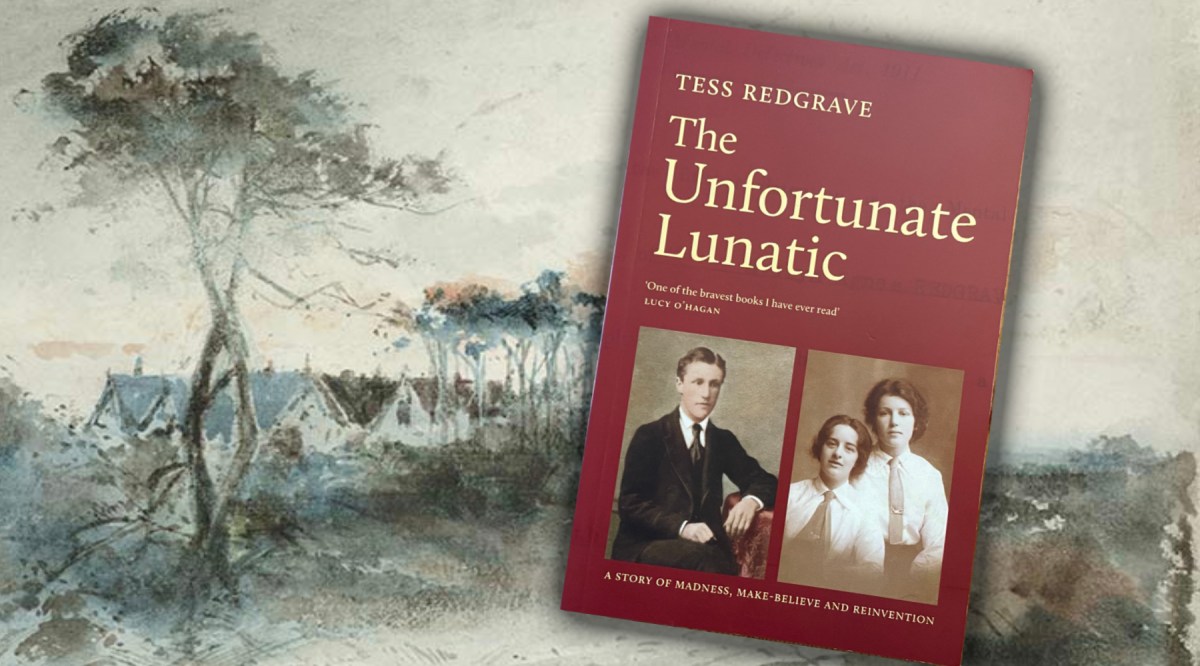
The Unfortunate Lunatic was Tess Redgrave’s paternal great grandfather. He wasn’t always known by that name, of course. He was Christopher Macalister, chemist of Christchurch, a husband and father, sandy-haired with ‘ruddy cheeks and soft blue eyes’. He suffered from ill health and died in 1893, ‘at the early age of thirty-three’. Tess knew nothing about him. Her paternal grandmother she did know personally, knew her troubles and the whispers of madness. Tess herself had bouts of the black dog occasionally, given blue pills, ‘mother’s little helpers’, for anxiety at school. Then, in her mid-thirties and suffering clinical depression, she began to wonder about the possibility of an inherited aspect to her mental condition. With her journalist’s nose for getting to the bottom of things, she went in search of her ancestors.
It’s this search that forms the base of this story, and it is woven into a beautiful memoir of Tess’s life as she travels up and down the motu, Waiheke Island to Wanaka, the streets of Wellington to Auckland, always circling back and around Hawke’s Bay where she grew up and now lives. Along the way she learns how her great grandfather earned his newspaper epitaph of ‘Unfortunate Lunatic’, when he took his life in a private asylum called Ashburn Hall. It’s near Dunedin, and she goes to visit. It’s a peaceful place, now. Later she finds a suggestions that two of Macalister’s brothers were insane and at least one of them had also died by suicide.
Tess learns to meditate, she learns self-care, she researches mental illness and works with the doctors to keep herself on an even keel. Her marriage disintegrates and she considers her sexuality. It’s a process that drops in and out of these memories, one thing triggering another, incidents revealing patterns that dovetail with her travels and the unraveling of family stories.
The story of Tess’s grandmother blossoms all through the book. To begin with she’s a ‘funny woman hiding behind the curtain’ in childhood memory. Tess’s father tells Tess and her sister over the phone: ‘‘Don’t come down to your grandmother’s funeral…It’ll just be small and private. Your grandmother had a miserable life.’’
Tess contacts the Porirua Hospital Museum, where, as the ‘The Porirua Lunatic Asylum’, her grandmother was a frequent inmate. She receives a print-out of a file spanning more than twenty-five years. ‘Its size shocked me. But as a journalist, I was instantly fascinated at the repository of details about my grandmother’s repeated hospital admissions from her late twenties: handwritten letters from her mother, a brother and sister, and most from her husband; her own letters, doctors’ notes, voluntary and compulsory admission forms, and by the 1940s, permission for electric shock treatment. As I turned a few pages at the back of the file, my fingers quickly landed on a copy of a handwritten letter.’
And so her journey into her grandmother’s real life begins. Notes from the asylum say she enjoys playing tennis, speaks intelligently, writes letters. She often pleads to go home, saying she is well now and wants to look after the household. Other times she comes across as quite mad. One rather beautifully genteel letter reads:
Sir, As I wish arrangements to be made for my home-going, will you kindly grant the necessary word and so prevent any further bother. Thanking you and your staff, also the matron and nurses and accept regrets for my apparent lax of good morals—may there be an improvement is the wish for myself. We are all great sinners it ill behoves any one of us to talk of the rest of us. Evelyn A. Redgrave
Tess finds this letter shockingly branded with a red hospital stamp: NO ACTION NECESSARY.
As well as unfolding stories – some real and some imagined – of the ancestors, and the slow revealing of Tess’s own history, there is also plenty of well researched history about mental health in New Zealand. We certainly haven’t been shy about locking people up here. Tess reports there is a new Mental Health Act likely to come into place in 2027 recognising the need for a shift toward recovery and well-being in our approach to care.
I think Tess has hit the zeitgeist with her book. I first read it a few months ago and began chatting to people about this idea of family members who were institutionalised, or hidden away. I remember a couple of family friends whose relatives seemed to disappear, and other friends have admitted to this in their families. With genetics beginning to reveal more about the ancestral legacy we carry around with us, perhaps the time is right, as a society, to open the proverbial cupboards (or historic asylums) and recognise our own hidden ancestors with compassion and understanding.
Well done, Tess. The Unfortunate Lunatic is an excellent and thought-provoking read. It’s also, despite the occasionally dark subject matter, wryly funny in parts and always uplifting.


