Whangaroa: running with ghosts

Vibrations of the Boyd Massacre

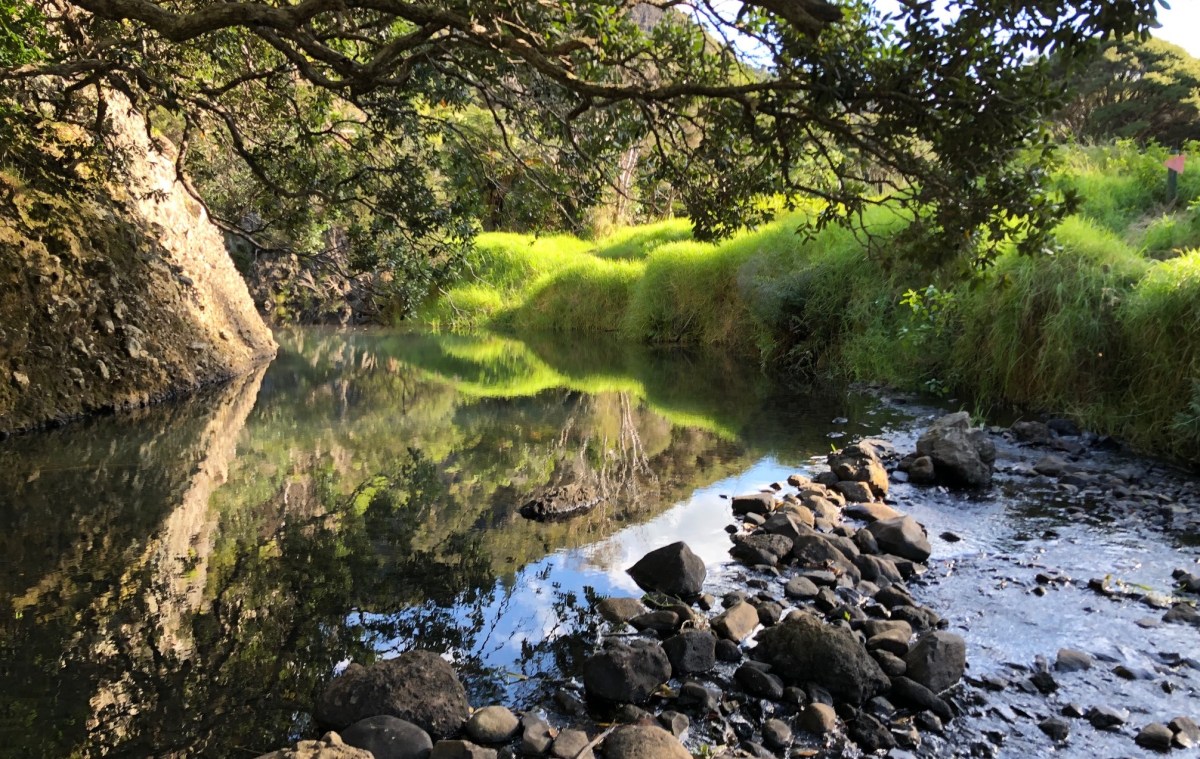
A man on a boat told me to run the Wairakau Stream to the Duke’s Nose, which sounded my type of thing. I took my friend M with me, a Spanish lady who was staying at the YHA, who is so intimidatingly spiritual she talks of her body as a separate person. She listens to her body, and does what it tells her. It told her to come with me into the forest, so off we went.

Continue reading “Whangaroa: running with ghosts”

Running the Oromahoe Traverse

and killing characters on the run

I’m on a bit of a roll with my running around Paihia series. Here’s a good, one way, one hour run. The Oromahoe is a ridge-line run through the Opua Forest which ends in Paihia. It’s a little over 6km one way, with a few short, sharp ups and downs. You can’t get lost.

I went early for a gorgeous start to the morning. There are a few glimpses of view through the trees, but no real lookouts to the spectacular Bay of Islands, tantalisingly out of sight below. Continue reading “Running the Oromahoe Traverse”

Running in Mangroves

If you find yourself in Paihia when the tide is going out, you have a spare couple of hours and happen to have your running shoes on you, here’s a thing.

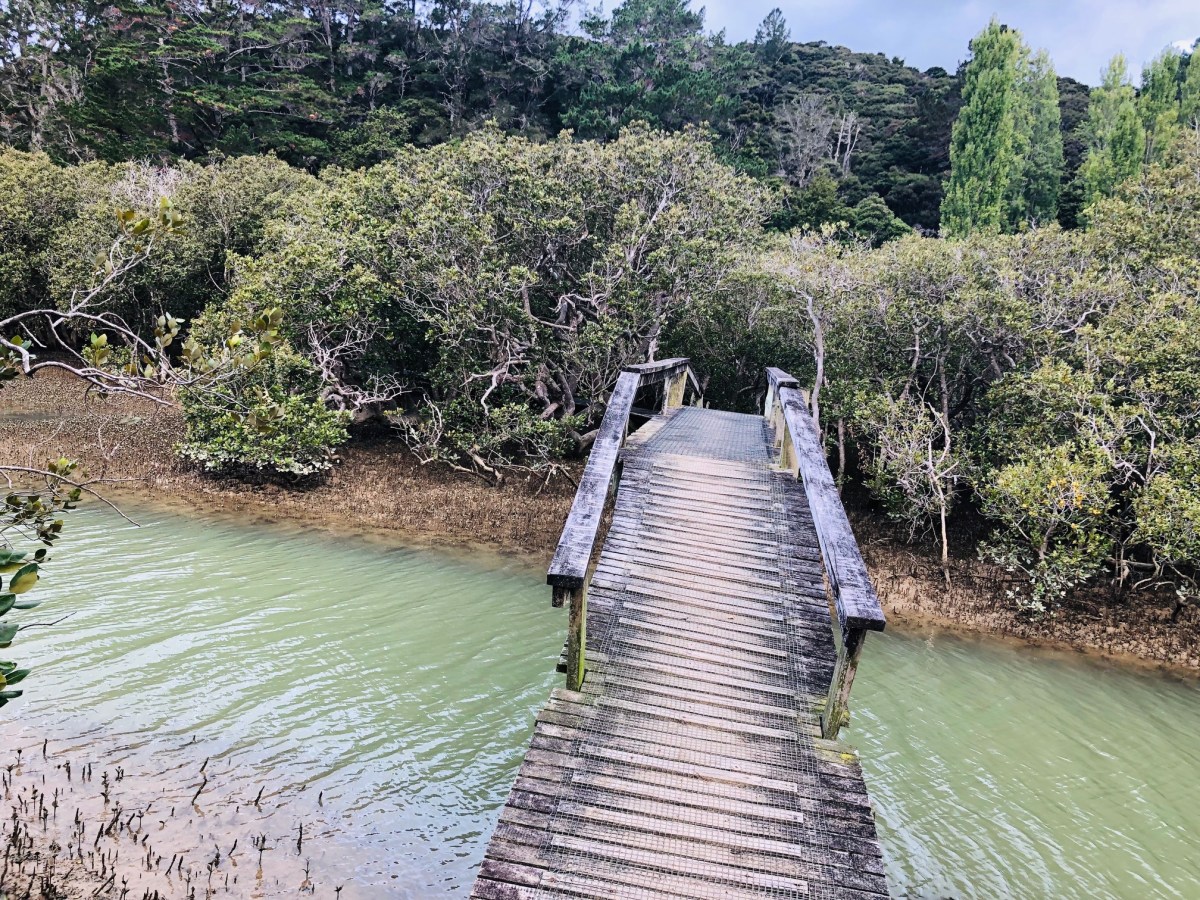
There’s a run that is so varied you have no chance to get tired. It starts on the rocks at the south end of Paihia beach. Continue reading “Running in Mangroves”

Tramping the Abel Tasman

Packing for tramping feedback, what worked?

Well, everything worked, really.

The Abel Tasman is one of New Zealand’s Great Walks, and one thing we do well in New Zealand is walking. The National Park was nearly at full capacity, and while there are day trippers you’re not exactly tripping over them. There is plenty of space to breathe, a 60 kilometre trail winding through the bush. I tramp in a bit of a trance usually,  wandering along in my subconscious. Continue reading “Tramping the Abel Tasman”

Packing for tramping

What to pack for a 5 day hike

Packing for a multi-day tramp is all about balance. Mainly so you don’t fall over. We’re walking the Abel Tasman National Park, staying in tents, 6 days, 5 nights and it’s going to rain. I tried to get the pack under 10kg which I like for tramping, but with the tent and mattress this comes in at 12kg. I could leave out one bag of muesli and the mattress? Yeah, nah. Continue reading “Packing for tramping”

Edward Jerningham Wakefield

Died 140 years ago today

Dear fellow Wellingtonians

Here is a celebration of Jerningham Wakefield, a founding colonist of Wellington. He died 140 years ago today, aged 58, penniless and alone, in an alms-house in Ashburton.  But before the drink got him, in his early twenties, he had been an extraordinary young man, a journalist, a rip roaring adventurer, the Wellington wild boy of his time. Continue reading “Edward Jerningham Wakefield”

The rafting fallout (yes, we did)

White water rafting truths

  • Wear a helmet. You will fall in. There will be rocks.
  • Not all dry bags are equal. Pay for quality.
  • When a water-tight barrel explodes open in a rapid, dry things get wet.
  • Securely tied items can do a Houdini and wave goodbye as you’re clinging to the upside-down raft.
  • If you lose your heavy camp stove at the bottom of a river and a waif dives for it, it will miraculously light first click.
  • Chilly bins need to be tied shut.
  • Waterlogged bagels are inedible.
  • Sunnies should be tied on. What did I tell them?
  • A cairn piled on a rock on the side of the river may indicate a ledge wide enough to pitch camp. Stop!
  • Memories of past trips are rose tinted. Add an extra few hours and serious amounts of fear to any memory. I would argue (and did) that a rafting trip is nothing at all like giving birth, but it is true you soon forget the pain and turn around and do it all over again.

Continue reading “The rafting fallout (yes, we did)”

Packing list for rafting

Summer camping on the river

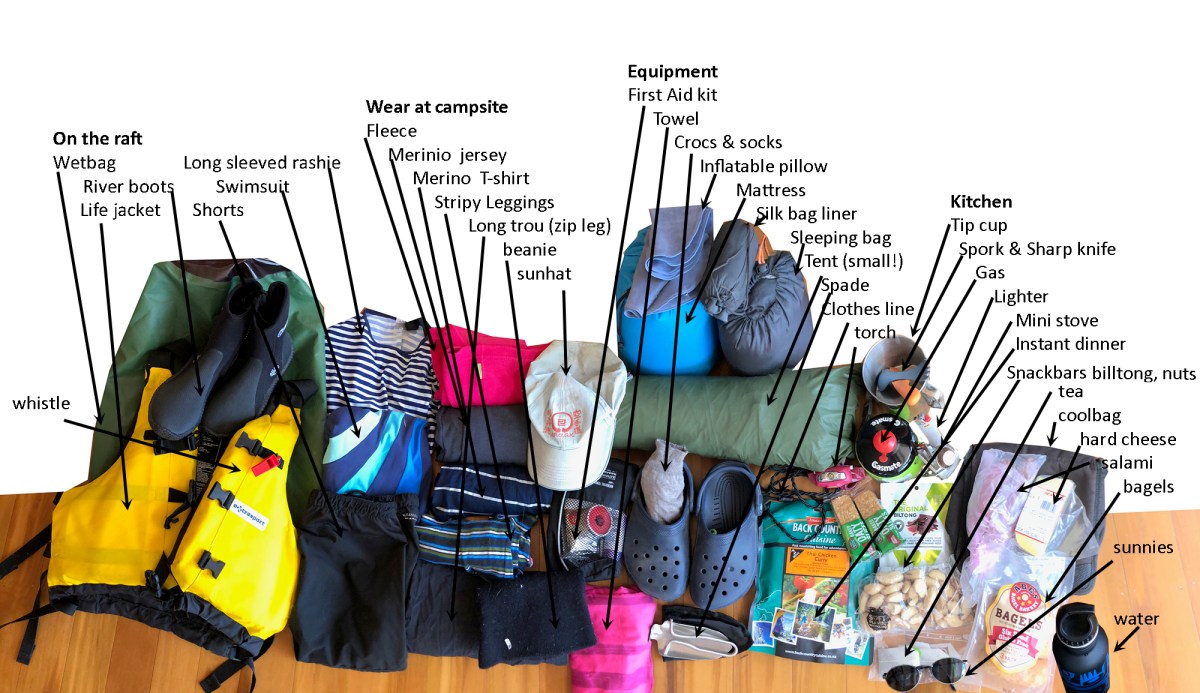
Here’s my packing list for an overnight rafting trip. (There’s no rain forecast and someone else is looking after the raft!) Off down the Ngaruroro river tomorrow.

Newbies often asked what to pack for a multi-day rafting trip. You need to be fairly tight, to fit in on the raft, but weight is not as issue like it is for a tramp. Continue reading “Packing list for rafting”

Sticking with Pigs – Book review

Sticking with pigs, by Mary-anne Scott

A fourteen year old boy, wrapped lovingly in cotton wool, goes out into the New Zealand bush with his uncle on a hunting expedition.

His parents have good cause to worry. The boy’s named Wolf, so you know they’re not precious by nature (named for Wolfgang Mozart, but sounds like his parents love a rough diamond to me). But Wolf has a chronically sick brother whose illness, as it would, dominates every safety decision and going hunting is not a walk in the park.

Lots of kids say they’d like to go hunting. I’ve never hunted, but I have friends who say they’d like to come tramping with me – a shadow version of a hunt but involving going bush with plenty of frightening-lite experiences. Mostly the friends are all talk and no trousers; when you start describing the hill tracks and the bare huts and the long-drops the enthusiasm wanes.

To Wolf’s credit, he trains up and off he goes with his uncle Jem and the dogs and the knife (no rifle, because to appease Wolf’s gun-shy parents, as the title says, they’re sticking with pigs), up the long haul to the ridge line, deep into the NZ bush. Scott doesn’t give a location, could be anywhere, but feels like the Ruahines to me.

If a kid can learn instinct, this is where he learns it.

There are wasps and pig shit, steeper and steeper hills, gullies, water and bush. I won’t give the story away but yes, there’s a pig. Then the trouble starts and Wolf gets his coming-of-age challenge slammed down on top of him, as raw and as kiwi as you like.

There’s a girl and a man’s mate at the edge of the story. I recognise both these characters. She’s an outdoor chick, handy with a GPS and long treks up the hills, practical, good in a crisis. I can see why Wolf fancies her. Uncle Jem’s mate has a pre-packed rescue kit and will walk through the night, no question, not much conversation. Everyone needs a mate like him.

Sticking with Pigs is probably aimed at reluctant young teen readers. But it’s also great entertainment for avid middle aged story-gobblers.



Biking the Rimutaka Rail Trail

Where historical research takes you

We put our trail bikes on the 11.01 from Featherston. It’s an old fashioned station, where they hand write the tickets and the guard helps lifts the bikes aboard (and he’s as cheerful as they come).  We get off through the tunnel at Maymorn Station and are back 5 hours later after a glorious day cycling the historic Rimutaka Rail Trail. This is the track the railway took before they cut the tunnel through the hill in 1955. It’s a fairly easy ride with lots of stops, packed with bush and mountain scenery and haunted with history.

There was once a steam railway here, linking the Wairarapa and Wellington.

Completed in 1878, the Rimutaka Incline on the Wairarapa side is famous for the Fell Engines that chugged up the hill for 55 years, negotiating the steep 1:15 gradient, clenched to a third, middle rail. The line was built and maintained by a remarkable group of engineers, navvies and gangers.  It’s the ghosts of the gangers I’ve come to find.

I’m writing a novel set in 1878 and one of my characters, Lars, works on the Incline.  He walks in from Kaitoke one day with a companion and doesn’t come back. It is blowing a gale on the tops and the mud slides down over the track, leaving ugly scars of exposed greywacke on the unstable slopes.

I rode alongside Lars’s ghost up through the lush Pakaratahi Valley over his 1870s bridges and culverts to the Summit, where we stopped, as he did, for water and a sandwich. When Lars sheltered from my imaginary wild storm of ’78 there was the beginnings of a settlement bursting with pioneering potential. Not for us – we walked among the rusty remains of long abandoned steam engines, discarded over the years and left to decompose in splendid ruin on the peaceful plateau.

In the icy Summit tunnel the third rail begins and the track descends steeply towards Cross Creek. Here I checked the logistics of my story, imagining the danger of exposure on the stretch they call Siberia where the winds (later, in 1880) were so strong they blew a passenger carriage and goods vans off the rails and down into the valley below.

For us on our bikes, it was an unusually still day. Half of my head was tripping along the raised rail with the gangers battling an historic gale, the other half enjoying a calm bike ride, almost 140 years later, stopping in the sunshine to read the old stories on the plaques posted along the route.

Ladle Bend creek bridge
Ladle Bend creek bridge on the Rimutaka Trail, c1891

“My father occasionally took my sister and me for a ride on a three-wheel railway jigger. As we all sat on one side of the jigger, it had a tendancy to upturn when passing around the many curves … I was always frightened going over Ladle Bend Creek Bridge as it was rather high and had no sides.” Ron Mitchell, child at Summit 1933-40