
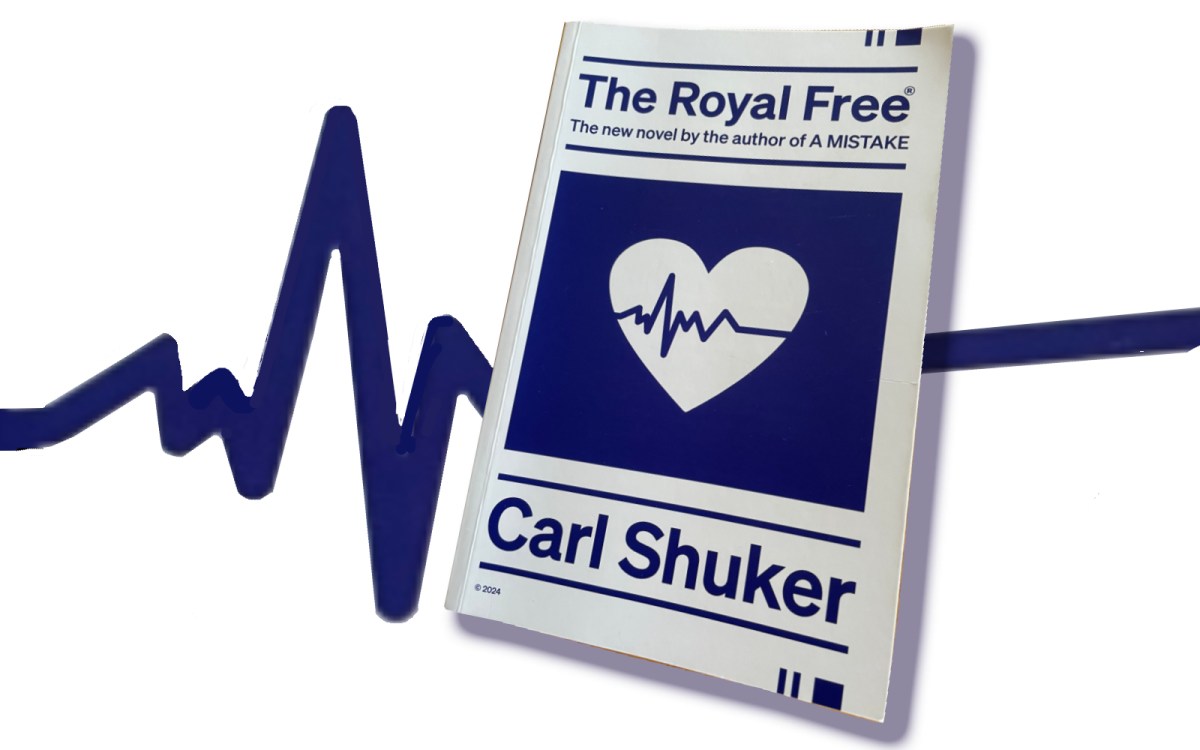
OK, so don’t shoot me for asking the question, but is this book even a finished novel? What is Carl Shuker trying to do here and why doesn’t he just tell the story? I know why his editors let him do it – because it is clever and edgy and wildly confusing in a way that makes you think it’s your problem for not getting it, not the fact that the book is so disjointed you could have it served up for dinner with no idea what beast it was. It’s experimental, for sure. There are literary nods and references, clever but incidental. So why is it on my list of books I love?
The basic plot, such that it is, goes along the lines that James’ wife has died and left him with a baby daughter and he still has to go to work every day at an insanely pernickety job as a medical editor, juggle the babysitter and dodge the thugs who live in his estate with their threatening dog. That’s quite a good plot. But I don’t think Carl Shuker does ‘quite’ good. He has dissected this story and he lays it out for us on a bench, leaving us to decide how to reassemble the carcass, what is important, what parts go together and what to do with the left over titbits that don’t seem to fit in anywhere. Some of it is obvious, the bruised heart and the lungs of it, but there are interesting dangling entrails. It’s a mess. And there lies the genius. The reader has to put the story together themselves, and by doing so, becomes complicit.
I spent a good while looking for the instruction sheet. Who are all these named characters at the start and is it important to know them right now, before any plot has started? All the colleagues that James can see from his well-situated desk and all the extracurriculars on their screens, their proclivities, will they join together to make a cohesive plot? James sums them up: “They were all, at the Royal, somewhat derailed.” A lot of education went into those commas.
There are pages of editorial pedantry, plenty from the Royal’s style bible:
Fahrenheit (F) Do not use. Convert values to degrees. Celsius (C)
failure of the right heart is correct
falciparum malaria (roman)
fall off two words: to deteriorate; to become detached and fall. A noun: deterioration
fallopian
We skip to Dr al-Rayess, Ibrahim, very tall and thin and the father of two daughters, ages six and eleven, neither of whom he has seen in two years. We stay with Ibrahim over pages and pages as he shops in “the twin Meccas of English tailoring excellence, Saville Row and Jermyn Street.” After the endless frippery of crimson silk knots, chalk stripes on charcoal and a wallet by “Swaine Adeney Brigg, pigskin and bridle”, we learn why he hasn’t seen his daughters in a while. In an uploaded horrible video his youngest daughter’s top-knotted ponytail is visible at the bottom of the frame. Ibrahim is one of James’ colleagues.
Susan is the “rickety chair” of the office, she might be one let go as the mag goes online. She, too, has an advantageous desk and watches James watching the atrium and the terrace, seeing who is led outside for a talk. Susan wonders: where is James’ wife? No one seems to know she is dead. Colleague Annabel takes the story forward in an intimate and threatening bus ride around a London riot, both city and girl fed up to breaking point. There’s a scene that will stay with you forever.
James’ babysitter and his prostitute (same girl) is a 23 year old Lithuanian. Bit of a cliché, perhaps, but probably true. We get a pinch of her story. She’s holding the baby when the shit goes down with the thugs, who lurk uncomfortably in the shadows of the text not quite knowing if they’re coming or going. The riots in the inner city burbs intensify. People should stay home, stay off the streets. James, on the other hand, goes out running in the park in the dark, leaving the baby home, alone. Jesus, is he nuts?
None of these stories is shared between colleagues who work so closely together. You get the feeling the Royal Free is a dysfunctional place.
There are snatches of stories here to which you must add your own conclusions: where does the water come from that floods the room in the night? What’s with the dog sitting watch over the baby? The key to the whole thing appears toward the end when we meet a pregnant woman, I’m guessing James’ wife, on a glorious Greek holiday, probably with James. This is where the story starts. I have a real need for at least one thread to wrap around this whole unstructured and brilliant mess of crossed lives. But for all the technical editorial genius of the Royal Free and the strict adherence to the style guide, there is no clarity of meaning at all. A few staccato beats at the end and we’re guessing.
I’m left with a headful of – I wont call them characters because they seem more real than that – a headful of people I find myself caring about. Where do they go once Carl Shuker has tossed them out for us to pick up? I find myself joining and clarifying where he leaves off. Adding endings. I need to get them home safely, to give them all a bit of respite, a chance at happiness. See James and the baby through the worst of it. And I can’t leave Ibrahim like that. So, to answer my question: it is a finished novel? More a kit-set, I think. If you’re handy with literary DIY and have a bit of imagination you can have an absolutely cracking time with The Royal Free. But you have to do the work.
An initially unsatisfying but ultimately brilliant book. This is only for your lit friends. Don’t foist it on your book club.


