
Biking the Rimutaka Rail Trail

Where historical research takes you

We put our trail bikes on the 11.01 from Featherston. It’s an old fashioned station, where they hand write the tickets and the guard helps lifts the bikes aboard (and he’s as cheerful as they come).  We get off through the tunnel at Maymorn Station and are back 5 hours later after a glorious day cycling the historic Rimutaka Rail Trail. This is the track the railway took before they cut the tunnel through the hill in 1955. It’s a fairly easy ride with lots of stops, packed with bush and mountain scenery and haunted with history.

There was once a steam railway here, linking the Wairarapa and Wellington.

Completed in 1878, the Rimutaka Incline on the Wairarapa side is famous for the Fell Engines that chugged up the hill for 55 years, negotiating the steep 1:15 gradient, clenched to a third, middle rail. The line was built and maintained by a remarkable group of engineers, navvies and gangers.  It’s the ghosts of the gangers I’ve come to find.

I’m writing a novel set in 1878 and one of my characters, Lars, works on the Incline.  He walks in from Kaitoke one day with a companion and doesn’t come back. It is blowing a gale on the tops and the mud slides down over the track, leaving ugly scars of exposed greywacke on the unstable slopes.

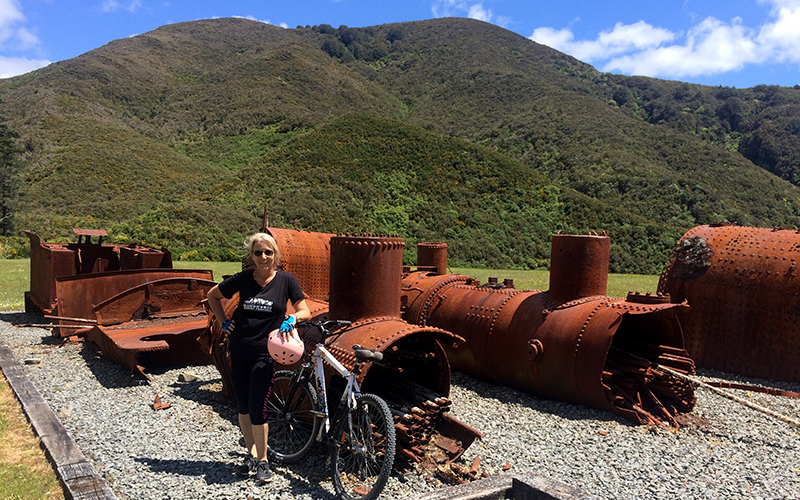
I rode alongside Lars’s ghost up through the lush Pakaratahi Valley over his 1870s bridges and culverts to the Summit, where we stopped, as he did, for water and a sandwich. When Lars sheltered from my imaginary wild storm of ’78 there was the beginnings of a settlement bursting with pioneering potential. Not for us – we walked among the rusty remains of long abandoned steam engines, discarded over the years and left to decompose in splendid ruin on the peaceful plateau.

In the icy Summit tunnel the third rail begins and the track descends steeply towards Cross Creek. Here I checked the logistics of my story, imagining the danger of exposure on the stretch they call Siberia where the winds (later, in 1880) were so strong they blew a passenger carriage and goods vans off the rails and down into the valley below.

For us on our bikes, it was an unusually still day. Half of my head was tripping along the raised rail with the gangers battling an historic gale, the other half enjoying a calm bike ride, almost 140 years later, stopping in the sunshine to read the old stories on the plaques posted along the route.

Ladle Bend creek bridge
Ladle Bend creek bridge on the Rimutaka Trail, c1891

“My father occasionally took my sister and me for a ride on a three-wheel railway jigger. As we all sat on one side of the jigger, it had a tendancy to upturn when passing around the many curves … I was always frightened going over Ladle Bend Creek Bridge as it was rather high and had no sides.” Ron Mitchell, child at Summit 1933-40
Ferry gliding – rafting the Mohaka

And ferry gliding old New Zealand style

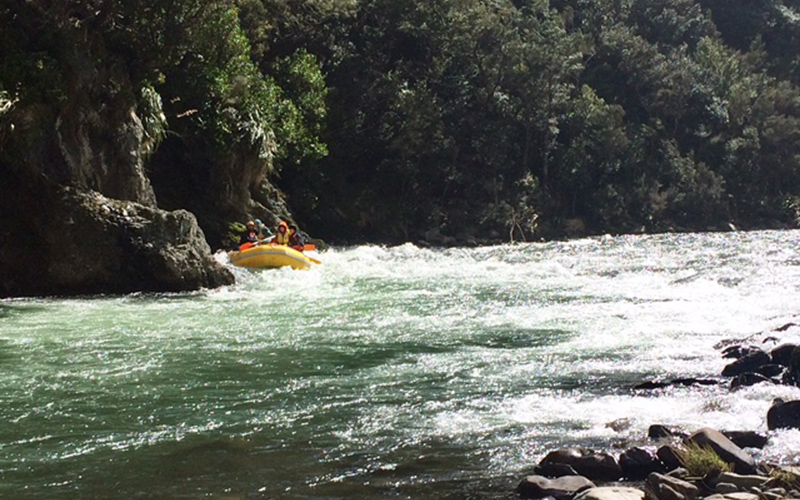
Rafting the Mohaka river is one of my great joys. Even on the cold and wet days, there’s a chance of a hot pool at a campsite.  On a good day, there’s sparkling water and picnics on the banks,  pirates and cliff jumping. And it’s always an education.

Last trip I battled against a new captain (sorry Barry!) for half a day before one of the other paddlers told me to relax and follow orders. Barry was “ferry gliding”, a technique I hadn’t seen before.

Rather than head the raft down the current, he kept the raft on an angle and let the power of the water push the boat across the flow from one eddy to another, crossing bank to bank with very smooth control.

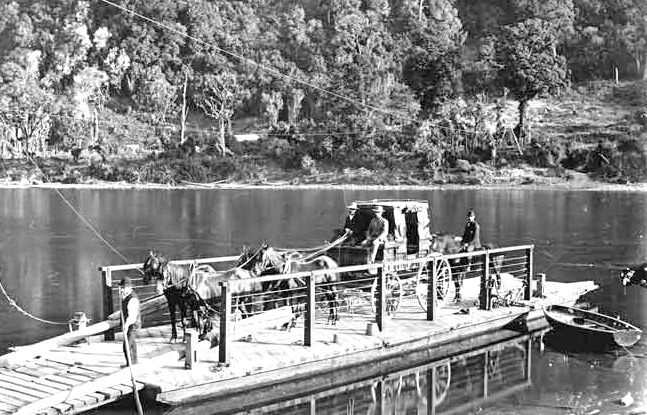
Barry told us ferry gliding was a technique used extensively in colonial days for ferry crossings (hence the name). In the 1800s New Zealand rivers were crossed – in order of sophistication – on foot, on horseback, by canoe, by punt or a larger ferry and very occasionally by a bridge. Early colonial bridges were often pretty makeshift and were regularly washed away.

The punts were attached by a pully wire to a high cable hung across a river, and, as with our ferry gliding across the Mohaka, the flow of the river (or the pull of the tide) worked with the angle of the ferry punt to push passengers across the water.

Ferry punt on Buller River
Horse and carriage crossing the Buller River, South Island New Zealand in the 1880s

We willingly throw ourselves down the rapids in an inflatable raft with our life jackets, helmets, wetsuits, PLBs, maps & compass, the car and the trailer parked up at the end with a change of clothes, a thermos of hot tea and a comfortable ride home.   And we call ourselves adventurers.

Here’s an evocative extract from Wanganui Herald, Volume I, Issue 177, 26 December 1867, Page 2. It’s typical reading from the period!

An inquest was held this morning in the Exchange Hotel [Wanganui], before H. J. Perham, Esq., Coroner, and a jury of twelve, on the body of John CONROY, who was drowned off a punt on Friday morning. James HORNE said I am a soldier on leave I belong to the Royal Artillery; the last time I saw the deceased was on Friday morning about 7 o’clock on a punt going up to Waipakaka; when we got to Walker’s, at Aramaho, the deceased and I went ashore; I got a bottle of rum and we went aboard again, we then started up the river; we had got about thirty chains from Walker’s; Conroy said, boys, we’ll have a jolly dinner to-day. Conroy was at the bow of the boat; I was lighting my pipe, and had my back to him, when I heard a splash in the water; I rose to my feet, and saw Conroy about the length of the punt behind we then tried to back the punt, but he drifted faster than we could in about two minutes he went down with his arms up.