Chappy – book review

Chappy, by Patricia Grace

Chappy, by Patricia Grace, is a domestic story of a community whose relationships are entwined and confusing in the way real life is confusing.

“I told you that Aki was your uncle by double adoption. That first adoption was when Dorothea became mother to Moana-Rose and me, and we became his sisters.”  The timeline jumps around and the narrators switch about, it’s a rambling story that could be told by mates sitting around on old sofas with a few beers, interrupting each other and backtracking. Some incidents feel honest and factual, others edited with the retelling. This is the way family histories are, and there is truth in both.

The catalyst for the story being told is the (dare I say, Gen-Y) crisis of young Daniel in Switzerland, of New Zealand descent, wanting to find himself. He is the investigative reporter, if you like. I think the discovery of his family helps to heal him. I like to think so, anyway, although the story is not about him. “There’s a much more interesting story than one of a spoilt brat with his own bank account who had to try and kill himself…”

For me, the breadline living of the whanau that Daniel finds back home is a pretty typical mid-century NZ story, Māori or Pakeha. Rural life was precarious: a lot of self sufficiency, some number 8 wire, generosity and sharing, the value of a storyteller to an introverted community, both the welcoming and the fear of strangers. The necessity of going away and how grounded you feel when you make it back.

Chappy Star is a stranger, a Japanese stowaway on a ship. Māori seaman Aki stumbles across him and takes him home to the marae, where he finds kindred spirits. The differences between ghost-like Chappy and the warm and candid Oriwa, with whom he falls in love, are made to appear superficial – language, culture, nationality are nothing beside their attachment. Their love survives years of racially induced separation and misunderstandings. Oriwa understands this as she disentangles her family stories for Daniel. Maybe we all need to tell our lives as stories to understand them.

The novel is about roots and coming home – from Hawaii, where Aki washes up, from Switzerland where Daniel is born, and the confusion that ensues when home means two or more places. Chappy weaves between his cultural home in Japan, his adopted home in Hawaii and his spiritual home with Oriwa in New Zealand.

The story of Moonface made me cry. There is a lost child in many stories, but none so poignantly as here.  Moonface is Aki’s adored little brother.  At the end of one long afternoon, Moonface insists on following Aki to the spring, but he lies down in the ferns and falls asleep. Aki fills the billy, and when he turns around the boy is gone. In his mind, forever,  is “- the cold spring water, the silver tin, water silvered, the creaking birds, the pouring, the boy invisible, the unspeaking leaves, the trail of torches, the voices calling, the crying, the wailing of all the grandmothers in the world, the waiting, the ferny nest.”  It seems natural that Aki would absorb his lost brother into his soul to become his moral compass, the well of his tenderness. “Go home,” Moonface says, when Aki has been away at sea too long and needs to get his feet back on family ground.

Patricia Grace writes with lovely, sparse descriptions. Aki: “I was at the woodpile sawing stove-lengths from manuka trunks I’d brought down from the slopes. About mid-morning. There was mist soft-footing about the hills, grey like old photos.” It’s all you need, a whole scene implied from a good choice of words.

There’s a moral to Chappy, which is spelled out very clearly (in case you missed it) as Daniel sums up the story at the close.  He was born of the generation that left the home fires, and now is a wealthy outsider looking back in. “…I am who I am. I understand that now. I’m not about to chuck it all away and go barefoot, and I don’t wannabe a wannabe. So, no matter where I go or what else I undertake, I’ll continue to increase my understanding of this part of myself that I embrace with all my heart. I’ll keep in touch, work back and forth from wherever I am in the world and contribute from the depth and core of me.”

There you go, kids.

Farm Holiday

New Zealand farm stay in Mahia

I haven’t been on a farm holiday since I was a kid and Kathleen and I walked a long way across the hills and the farmer’s son gave us a lift home in the helicopter. These things stay with you.

So last week instead of our pre-Christmas family long weekend blobbed by a lake, this year I thought we’d go for some kiwi action and booked three days on a farm in Mahia and it was everything a farm holiday should be.

There was a good looking and friendly young farmer in stubbies and a rugby shirt – a bit of confusion when my son said he was saving to go the world cup next year – World cup’s not next year? Oh, soccer? The football/rugby divide. It’s real.

His most hospitable wife wandered past, with baby farmers in tow (the blondie dressed like her dad and keeping those dogs in line) to check we had everything we needed in the glampy shearers’ quarters which were spanking clean, very basic, and just perfect for a family of 6 unloading a stack of books, a football, a few board games and a well stocked chilli bin.

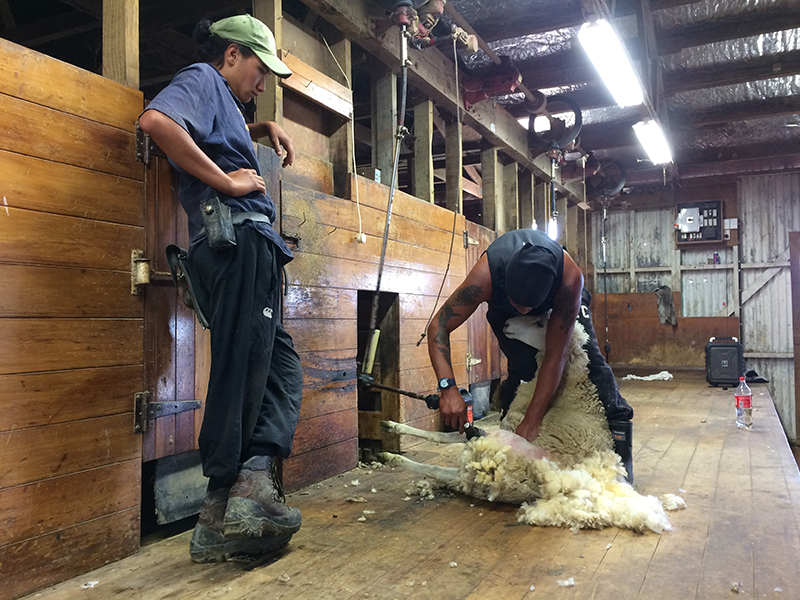
We “helped” sort and drench the lambs,  watched sheep shearing and the rounding up of the cows. There were smart dogs doing their thing at the shrill whistle of the shepherd and pet pigs, a pony. We rode trail bikes up hill tracks for breathtaking views.

The same things I did on a farm holiday as a kid and I thought nothing had changed, until our 2017 farmer explained the native bush replanting in the gullys, the erosion protection, the focus on environmental care.  I think slash and burn was still in fashion when I was young.

We had Uncle Ted along from Canada for a bit of a kiwi experience, so on the rainy day while the grass got drunk we walked the Nikau rainforest and soaked in Morere Hot Springs and the following day, with all the leaves sparkling, we walked the circuit at Kinikini, in lush native bush.

I reckon a farm holiday should be on every family’s list.  I’m a Wellington city girl and have spent limited time on farms – childhood visits, a few friends on farms growing up, an occasional horse trek, thistle pulling jobs  – but there have always been hills with dots in the background calling me closer. It comes with being a New Zealander.

Standing in the sheep sheds with the dogs and the farmers felt like finding my roots.


Sheep shearing New Zealand.jpg
Fast, expert sheep shearing on Mahia farm
Native Bush.jpg
Kinikini loop track, Mahia Peninsula scenic reserve

http://www.doc.govt.nz/parks-and-recreation/places-to-go/east-coast/places/mahia-peninsula-scenic-reserve/things-to-do/mahia-peninsula-scenic-reserve-track/


Biking the Rimutaka Rail Trail

Where historical research takes you

We put our trail bikes on the 11.01 from Featherston. It’s an old fashioned station, where they hand write the tickets and the guard helps lifts the bikes aboard (and he’s as cheerful as they come).  We get off through the tunnel at Maymorn Station and are back 5 hours later after a glorious day cycling the historic Rimutaka Rail Trail. This is the track the railway took before they cut the tunnel through the hill in 1955. It’s a fairly easy ride with lots of stops, packed with bush and mountain scenery and haunted with history.

There was once a steam railway here, linking the Wairarapa and Wellington.

Completed in 1878, the Rimutaka Incline on the Wairarapa side is famous for the Fell Engines that chugged up the hill for 55 years, negotiating the steep 1:15 gradient, clenched to a third, middle rail. The line was built and maintained by a remarkable group of engineers, navvies and gangers.  It’s the ghosts of the gangers I’ve come to find.

I’m writing a novel set in 1878 and one of my characters, Lars, works on the Incline.  He walks in from Kaitoke one day with a companion and doesn’t come back. It is blowing a gale on the tops and the mud slides down over the track, leaving ugly scars of exposed greywacke on the unstable slopes.

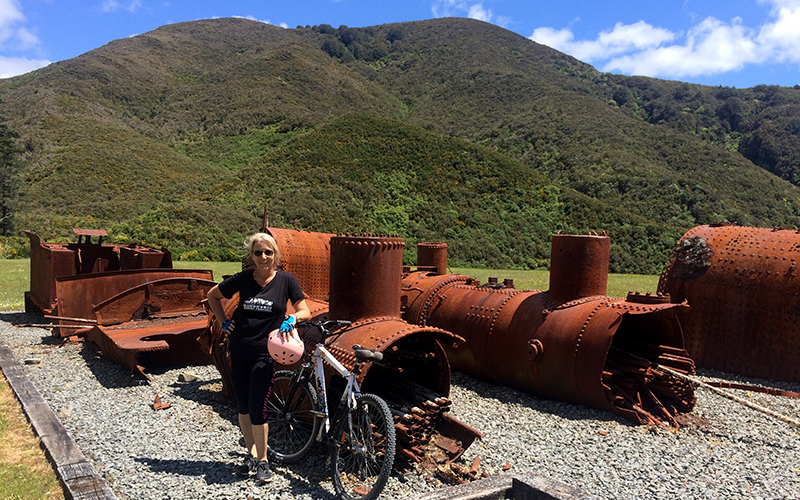
I rode alongside Lars’s ghost up through the lush Pakaratahi Valley over his 1870s bridges and culverts to the Summit, where we stopped, as he did, for water and a sandwich. When Lars sheltered from my imaginary wild storm of ’78 there was the beginnings of a settlement bursting with pioneering potential. Not for us – we walked among the rusty remains of long abandoned steam engines, discarded over the years and left to decompose in splendid ruin on the peaceful plateau.

In the icy Summit tunnel the third rail begins and the track descends steeply towards Cross Creek. Here I checked the logistics of my story, imagining the danger of exposure on the stretch they call Siberia where the winds (later, in 1880) were so strong they blew a passenger carriage and goods vans off the rails and down into the valley below.

For us on our bikes, it was an unusually still day. Half of my head was tripping along the raised rail with the gangers battling an historic gale, the other half enjoying a calm bike ride, almost 140 years later, stopping in the sunshine to read the old stories on the plaques posted along the route.

Ladle Bend creek bridge
Ladle Bend creek bridge on the Rimutaka Trail, c1891

“My father occasionally took my sister and me for a ride on a three-wheel railway jigger. As we all sat on one side of the jigger, it had a tendancy to upturn when passing around the many curves … I was always frightened going over Ladle Bend Creek Bridge as it was rather high and had no sides.” Ron Mitchell, child at Summit 1933-40

Ferry gliding – rafting the Mohaka

And ferry gliding old New Zealand style

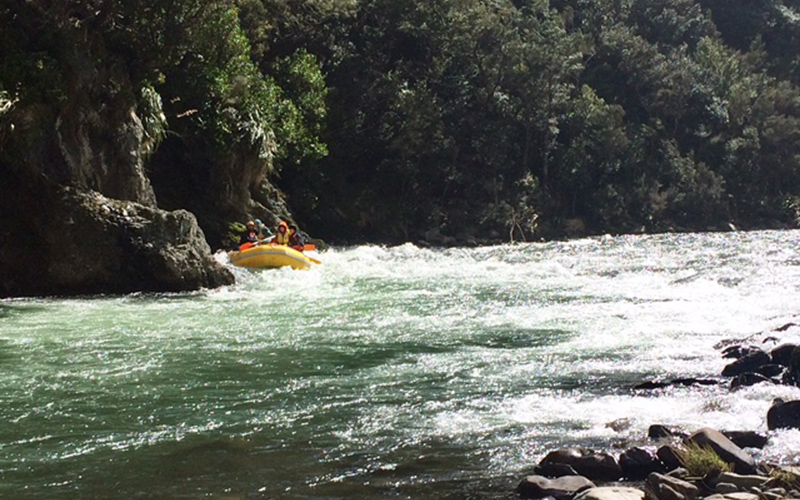
Rafting the Mohaka river is one of my great joys. Even on the cold and wet days, there’s a chance of a hot pool at a campsite.  On a good day, there’s sparkling water and picnics on the banks,  pirates and cliff jumping. And it’s always an education.

Last trip I battled against a new captain (sorry Barry!) for half a day before one of the other paddlers told me to relax and follow orders. Barry was “ferry gliding”, a technique I hadn’t seen before.

Rather than head the raft down the current, he kept the raft on an angle and let the power of the water push the boat across the flow from one eddy to another, crossing bank to bank with very smooth control.

Barry told us ferry gliding was a technique used extensively in colonial days for ferry crossings (hence the name). In the 1800s New Zealand rivers were crossed – in order of sophistication – on foot, on horseback, by canoe, by punt or a larger ferry and very occasionally by a bridge. Early colonial bridges were often pretty makeshift and were regularly washed away.

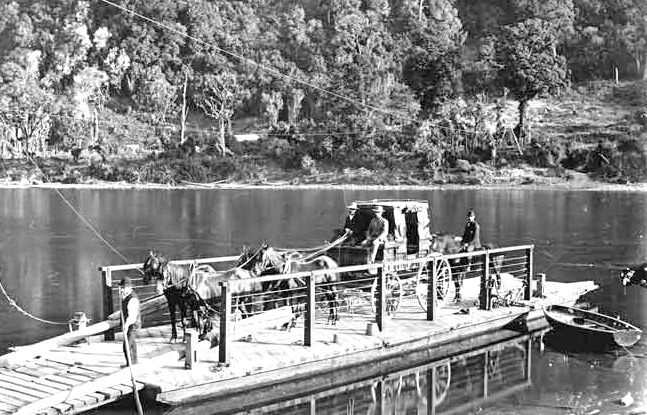
The punts were attached by a pully wire to a high cable hung across a river, and, as with our ferry gliding across the Mohaka, the flow of the river (or the pull of the tide) worked with the angle of the ferry punt to push passengers across the water.

Ferry punt on Buller River
Horse and carriage crossing the Buller River, South Island New Zealand in the 1880s

We willingly throw ourselves down the rapids in an inflatable raft with our life jackets, helmets, wetsuits, PLBs, maps & compass, the car and the trailer parked up at the end with a change of clothes, a thermos of hot tea and a comfortable ride home.   And we call ourselves adventurers.

Here’s an evocative extract from Wanganui Herald, Volume I, Issue 177, 26 December 1867, Page 2. It’s typical reading from the period!

An inquest was held this morning in the Exchange Hotel [Wanganui], before H. J. Perham, Esq., Coroner, and a jury of twelve, on the body of John CONROY, who was drowned off a punt on Friday morning. James HORNE said I am a soldier on leave I belong to the Royal Artillery; the last time I saw the deceased was on Friday morning about 7 o’clock on a punt going up to Waipakaka; when we got to Walker’s, at Aramaho, the deceased and I went ashore; I got a bottle of rum and we went aboard again, we then started up the river; we had got about thirty chains from Walker’s; Conroy said, boys, we’ll have a jolly dinner to-day. Conroy was at the bow of the boat; I was lighting my pipe, and had my back to him, when I heard a splash in the water; I rose to my feet, and saw Conroy about the length of the punt behind we then tried to back the punt, but he drifted faster than we could in about two minutes he went down with his arms up.