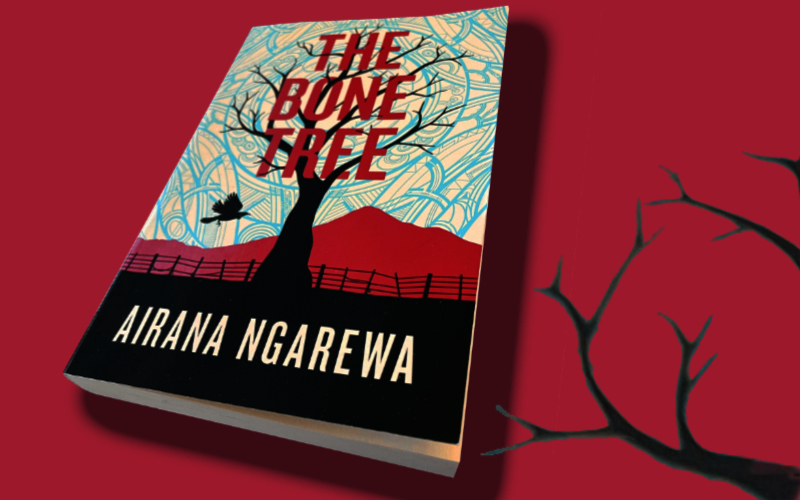
The Bone Tree – book review

The Bone Tree, by Airana Ngarewa

I met Airana at a book festival. He’s a presence – full of youth and energy and a willingness to be in the moment. He speaks the reo in a voice that carries across an audience and compels you to listen. No wonder his debut book is so gripping. I reckon when this guy has a story, you’ll want to sit up and listen.

The Bone Tree is, yes, another story of a dysfunctional Māori family living on the edge. In this case, they’re toppling over. There is little relief and no laughs; it’s the story of the misery of a good kid – I was going to say ‘who deserves better’, but of course all kids deserve better than this. The Bone Tree is narrated by Kauri, also called Cody by fat-tongued white folk, the implication being that his name is never written down. He lives in a totally dilapidated house on a bit of land in the ‘wopwops’. When his mum dies, dad carries her body out to bury her somewhere on the land, and later the kids do the same for the dad. Kauri’s dad, a violent alcoholic, has left him with a bad shoulder and a scar under his right eye, and maybe the boy’s life will be better without him. When the little brother, Black, gets sick, Kauri is the sole caregiver with no sense of how to save him. His main focus is to hide the fact the the kids are alone, to prevent CYPS from taking Black into care. This fear of the authorities underlies the whole story and it is malignant and irrational and yet, for this child, is the bedrock of his belief. He eventually walks to the city and is given food and Māori medicine, and his brother continues to decline.

Continue reading “The Bone Tree – book review”

Violet Black–book review

Violet Black, by Eileen Merriman

This is Merriman doing what she does so well, pacy adventure writing for young adults. Violet Black is a story that begins in the near future of Auckland with two late teens – Violet and Ethan – hospitalised with M-fever, a measles derivative that makes Covid seem like a runny nose. This virus targets teenagers. Ten percent of those infected with M-fever will develop encephalitis. Ninety five percent of those with encephalitis will die. Wow. Kids, this is fiction, OK? Ignore the fact that it is written by a doctor who we generally trust to tell us the truth about medical matters and that the whole scenario sounds pretty convincing at the beginning. If you feel your stress levels going up while reading, take several deep breaths. This nightmarish stuff–pandemics, sinister government organisations, anti-vax terrorism–is all imaginary.

Continue reading “Violet Black–book review”

The New Ships—book review

The New Ships, by Kate Duignan

Stripped bare, this is a book a story about a man stripped bare.

Peter is confronted by a portrait painted by his wife. It’s a naked man, sitting on a chair. Nothing else. He is not even sure it is him. He wife has died of cancer, Peter is in mourning and he finds the painting in a shed at their Castlepoint bach, a exposed place he wants to sell. Even the bach is not what he thought; the field he believed was his actually belongs to a neighbour.

This is a mid-life crisis story if ever there was one. Every concept Peter uses to define himself is stripped away on the turning point of his wife’s death.

Continue reading “The New Ships—book review”

Waitapu—book review

Waitapu, by Helen Waaka

I read Waitapu over a couple of leisurely evenings and loved it. It’s a beautiful book, elegantly written and so evocative of every small town in New Zealand that we know from a drive past, or a dip into when we visit a grandparent. I remember going with a Wellington friend home to small town NZ and this takes me back there, the interconnected community, the talk across the fence, the visits. There was a sort of pride that everyone knew each other but an embarrassment, too. My friend couldn’t wait to be away again.

Continue reading “Waitapu—book review”

Ribbons of Grace – Book review

Ribbons of Grace by Maxine Alterio

Early this morning the sun rose round as an orange and hot as the fires of love, warming the already dust-dry ground outside Con-Lan’s schist cottage, while inside the whitewashed walls gleamed like skin on a pail of milk.’

Maxine Alterio’s writing is transporting. I copied phrases of this evocative elegance onto scraps of paper and peppered my desk with them. How’s this to set your mind soaring?

In the gorge the ice-heavy river resembles a mass of broken glass. On either side poppy seeds, dropped from the soles of boots worn by miners from California, germinate in pockets of dirt and shingle. Soon they will flower again and hang like coloured lanterns from the cliffs.’

Continue reading “Ribbons of Grace – Book review”

This pākehā life — book review

This pakeha life — an unsettled memior, by Alison Jones

What does it mean to be Pākehā?

There are hundreds of answers, all of them right. I am Pākehā. I know it, I feel it, though I wouldn’t presume to categorise anyone else, and I stand to be corrected at any time. To me, being Pākehā assumes some kind of relationship with Māori (even as simple as not-Māori) without necessarily defining what that relationship is.

Continue reading “This pākehā life — book review”

Jerningham Wakefield, 200 today

Happy birthday, scoundrel

Colonial Wellington’s original wild boy, Jerningham Wakefield, was born 200 years ago today. The son of New Zealand Company founder Edward Gibbon Wakefield, Jerningham was a member of the advance party of the Wellington colony, arriving in Port Nicholson on the Tory in September 1839. He was nineteen years old and sent away from England by his father to keep him out of mischief. It was a mistake Edward Gibbon probably came to regret.

Continue reading “Jerningham Wakefield, 200 today”

Jerningham, a novel

Jerningham Wakefield and the first colonial settlement of Wellington

I walked into a bookshop yesterday and my book was on the counter. Does an author ever get used to that? Felt like the first day out with a new baby. They cooed over me in the shop and asked me to sign the copies.

That was a pretty exciting day.

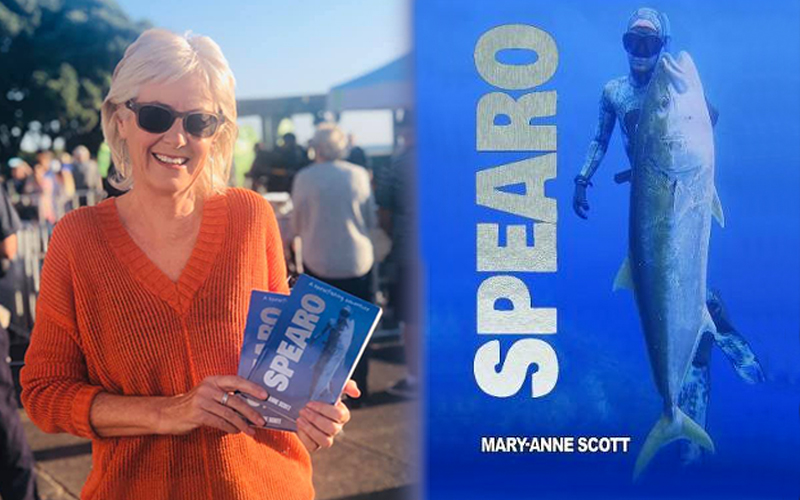
Spearo – book review

Spearo, by Mary-anne Scott

If you’re a kiwi and you go to the beach, here’s a tip: read this story and learn about spear fishing. I had no idea it was a thing. I thought fishing at sea involved sitting passively for hours on a boat until a tug on the line left you dealing with whatever Neptune sent you. But a “spearo” goes beneath the surface, free diving, and gets to know the fish in their own environment. This is not someone sitting comfortably on a boat having a random tug of war with some poor fish they may not even want. A spearo goes out to get dinner. Continue reading “Spearo – book review”

The Adventures of Tupaia – book review

The Adventures of Tupaia, by Courtney Sina Meredith and Mat Tait

Tupaia has shot to fame these last months as the pin-up boy of our history. Neither Māori nor Pakeha, the Tahitian ‘ariori (priest) and navigator who travelled with Cook bridged two very different cultures in 1769. If we approach the study of Aotearoa/New Zealand history through his eyes we develop a fresh understanding of our first encounters.

Continue reading “The Adventures of Tupaia – book review”