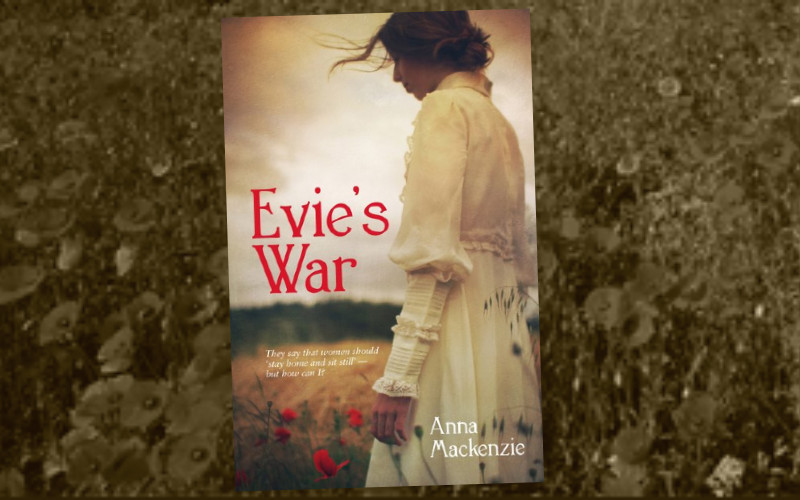
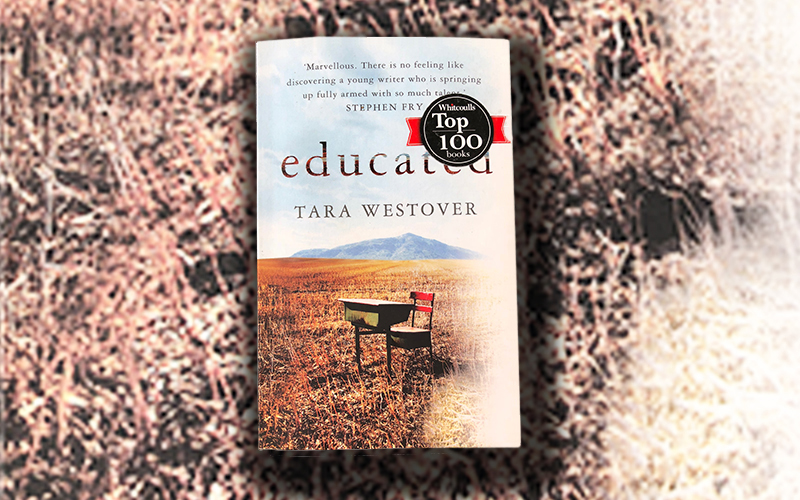
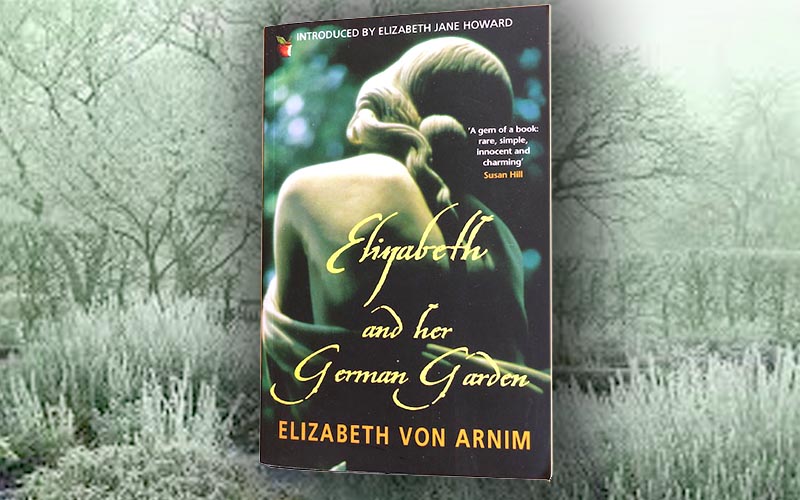
Elizabeth and her German Garden – book review

Elizabeth and her German garden, by Elizabeth Von Arnim

Here’s my pick for a Christmas gift for a woman who likes reading and gardening, and doesn’t go at things in a rush. It’s for someone who takes time over words and soil, someone who stops to look at dew on a spider’s web and who, when you drop by over Christmas, is invariably in a flowering sunny nook with a book.

It’s a turn of the Century book (20th Century, that is) in which a young English woman marries a German count and bucks established conventions, opting to leave city society and live in his country pile, where she is obsessed with being outdoors and working in the garden.

She refers to her husband as the Man of Wrath though he is a long suffering dear, who humors her and visits when he can and gives her a generous budget for her mulches and compost though appears quite bewildered by the oddball he has married. She says it must be agreeable to have an original wife, he counters that she is eccentric.  Her three daughters are the April baby, the May baby, and the June baby and are all “inoffensive and good” and are released by the nurse periodically to wander the gardens with their distracted mother.

Elizabeth, meanwhile, is learning how her garden grows. Her gardener has planted rockets right along the very front of the two borders and now the plants behind are completely hidden.  “No future gardener shall be allowed to run riot in quite so reckless a fashion.” But she is charmed by the delicate colour of the rockets and their scent, she picks them to bring inside to the room is filled with their fragrance. She experiments with planting in long grass, she puts pansies in the rose beds and makes a great bank of azeleas in front of the fir trees to brighten up a gloomy nook.

The extent of Elizabeth’s garden and obsession is far beyond what most of us consider gardening, but between monologues about over-wintering of tea roses and the planting of annual larkspurs around the privet hedge she does consider wider issues of a woman’s place in the world, the foibles of society and the benefits of me-time (my words, she calls it wintering all alone, which is disapproved of by the German matrons).  She has visits from two friends, one she likes, the other they pick on, and when the visitors get too much, Elizabeth escapes to her garden.

Elizabeth and her German Garden is a lovely read. It has a gentle pace and a spirited heroine, through she does little other than walk around her flower beds. I’m no large-scale gardener and was a bit overwhelmed by the plants and flowers she describes in all their glory and through every season, but very much enjoyed her enthusiasm and love for them all, the poetry of the writing and the fact that a woman can be so happy in her eccentricity.

Elizabeth is missing – book review

Elizabeth is missing, by Emma Healey

Maud is a great hero of mine. She’s an old lady who is losing her marbles, but she clings on to the things she does know for dear life. She remembers things long past, but not yesterday. She’ll set an alarm clocks to remind her of something, but can’t remember why she set it.

I’m not Maud yet. I do remember why I set the alarm clock, but the fact that  I feel I need to set it at all makes we wonder if I’m heading that way.

So here’s a lovely book for a book group of women rolling with a bit of a swagger through their fifties. Watch the hesitation in their eyes as they make their funny wee confessions and giggle. Forgot the name of the actor you watched last night? Bought canned peaches again, although they already form a wall in the cupboard? Swear blind you haven’t seen your husband’s keys and can’t explain how they ended up in your handbag? (Hang on, that last one might just be me…)

Elizabeth is Maud’s dear friend. Maud thinks Elizabeth is missing, but is unable make her concerns clear to her long-suffering daughter, or her carer, or Elizabeth’s difficult son, or the police, the doctor.  Maud is confused about a lot of things, and the way this confusion is handled by Healey is gentle and empathetic. We are inside her head and feeling her frustration, but can also sympathise with the way those around her react to her crumbling reality.

The missing friend obsesses Maud so piercingly because, after the war, her older sister, Sukey, also went missing.  She was never found. We go back fifty years into Maud’s clearer memories, but things get more confusing before all the unravelling begins to reform into something unexpected.

It’s hard to categorise Elizabeth is Missing. It’s a lovely character story and a well described study of a woman’s slide into dementia with all the accompanying frustrations and misunderstandings that many readers will recognise.  It’s also a sharp psychological mystery, and a ripping thriller.  There are lots of different aspects to discuss in Healey’s book (not least that it’s her first novel – how does a woman in her twenties develop such acute observation?) For sure it’s a good pick for a women’s book club if, as I say, the odd senior moment hovers around your periphery.  This will make ’em squirm.

A Gentleman in Moscow – book review

A Gentleman in Moacow, by Amor Towles

This is War & Peace-lite, set over a century later with a different kind of war. And while the original covers a huge sweep of country from Napoleon’s battlefields to the St Petersburg salons, country peasants and the exodus from Moscow, Towles’ A Gentleman in Moscow is set entirely within the walls of the Hotel Metropol in Moscow’s Theatre Square.

But there is something distinctly Tolstoyian in our hero, Count Alexander Ilyich Rostov, charming and urbane, surely a descendant of the more famous Rostovs. He is sent into house arrest by the Bolsheviks and goes willingly, considering the alternative, and for 30 years from 1922 is imprisoned in the hotel, first as an honoured guest and later as a respected waiter. We almost see this as a promotion, so conditioned are we by then to look on the positive side of life.

Rostov witnesses the momentous changes in Russia, not Tolstoy-style through the debate of powerful men and the clash on the battlefields, but in the detail of everyday life in the hotel as he quietly observes the changing guests and procedures. We are left to imagine the mentality of the new regime’s leaders who remove the labels from every bottle in the famous wine cellar so comrades receive a egalitarian pot-luck bottle with each meal. Rostov, connoisseur and master of the wine-food match, merely serves the first bottle that comes to hand.

The backing cast of the story are the workers of the Metropol who are trained for service, impeccably courteous front-of-house and a pack of real characters behind the scenes. Rostov is Rostov, his beautiful manners translate from his aristocratic youth to service without missing a beat.

There are three main women who come into Rostov’s life, each in a different context, and he is loyal, generous and playful in his love for each in a very Rostovian way. The women all have beating hearts.

He’s a lovely man. It’s an elegantly written book. Glib? Yes, perhaps. Open the book in the middle and read a few pages to see if the voice is for you. But don’t be fooled, under the light tone, we are still in 1930’s Russia.  Towles gives a menacing feel for the era, without much “proper” history at all. And the end is sublime.

I finished it and immediately recommended it to friends, particularly, but not exclusively, to those who have re-watched the BBC War & Peace series over and over and can’t quite get enough.

And if you still can’t get enough, Amor Towles writes a Q&A on A Gentleman of Moscow on his website, well worth a read to pick up some little details you may have missed.
The Sea – book review

The Sea, by John Banville

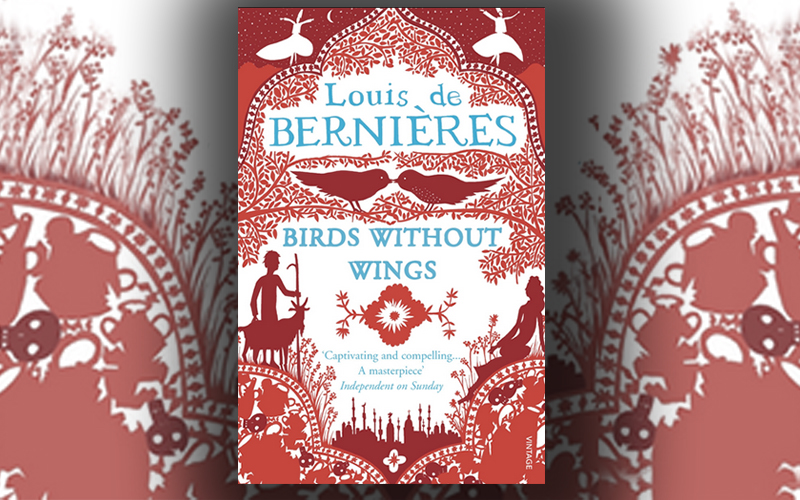
I’m a bit ambivalent about John Banville’s The Sea. I wish he’d put a plot in.

Instead, there are pages full of wistfully charming descriptions and heavily clever observations in search of something to do with themselves.

I got pretty impatient with it. There are characters, but other than the grieving narrator it’s hard to get a handle on them. It turns out it’s not really the dead wife who drives the narrative but a pair of twins our man met on a youthful holiday, or perhaps another child who I eventually figured out wasn’t a child but the nanny who turns into a later character to tie it all together, who wasn’t in love with the father but the mother and was there when the twins walked into the sea, not quite sure why – but I’ve lost you.

It’s easily done.  Even if you went back to figure it all out I’m not sure it would get any more interesting.

The thing that is interesting, that I discovered only after I’d finished it and gone – meh – is that it won the Man Booker Prize in 2005. It was a controversial choice, up against Zadie Smith, Kazuo Ishiguro, Juilan Barnes.  Banville himself implied it was a victory for high art over slick popularism. He comes across, like his character, as a bit of a prat.

But this acknowledgement of literary merit perhaps is the reason for my ambivalence and its inclusion in my list of “good reads for book clubs”. I do like a well hung sentence and I did find myself starting to enjoy snippets very much before the story wandered off somewhere else. So I guess I understand why the Booker judges found the novel classy; though classier than Ishiguro’s Never Let Me Go?  Get your book club to read both and ask yourselves what those judges were drinking!

Then again, if you’re an educated, white, middle class bloke and you have a quiet afternoon in front of you with no expectations of wild adventure or a ripping yarn and are in the mood to finding poignancy in very good prose, this thoughtful, old-fashioned read will suit you well.


The Road – book review

The Road, by Cormac McCarthy

I’m going out on a limb recommending this one.

I’ve promised here only to review books I love, and no one can love The Road. It’s grim. I had bad dreams for a week.

It’s grim in the way only Cormac McCarthy can be with his spare dialogue and relentlessly bleak landscapes. The cover is of a grey road heading into the grey distance under grey skies and surrounded by dead trees, cold and hostile. This is the book.

Here’s the opening:

When he woke in the woods in the dark and the cold of the night he’d reach out to touch the child sleeping beside him. Nights dark beyond darkness and the days more gray each one than what had gone before. Like the onset of some cold glaucoma dimming away the world.

It doesn’t get any cheerier.

But I suggest it as a good read for book clubs because sometimes a bit of raw dystopia is a change from character-full, plot-twisty, complicated, clever books. On the face of it, Cormac McCarthy’s The Road is not complicated. The complications are all in the subtext.  You can analyse the subtext for hours but you won’t find any answers in the book, and this is why I think it opens up some provoking discussions. You just need to ask two questions and the debate will outlast the wine and cheese: What do you think happened? What will happen?

All the stuff has happened in the past and you are confronted with the here and now, a man and a boy walking down a road in the fallout. It feels utterly, utterly hopeless. And yet, they walk.

That’s about it.

Don’t read it if you’re feeling miserable.

Good luck.


Mr Peacock’s Possessions – book review

Mr Peacock’s possessions, by Lydia Syson

Lydia Syson’s Mr Peacock’s Possessions sets the characters and the scene slowly – you need to understand the background before you can follow the story. So don’t be impatient, sit quietly as the curious and impulsive Kalala introduces you to his life in the Pacific, his brother, the pastor Solomona, and their small group of god fearing men who are shipped to an island where a white man and his family are struggling to settle.

Lizzie’s story comes next, she tells of family life on an isolated island, the difficulties faced by her mother and many children as they live castaway style, and the struggles of her delicate older brother, who is a disappointment to their very physical and driven father. Lizzie is her father’s favourite and she loves him unreservedly. Until she has to confront a truth that questions all she believes of him.

The family are swindled by a ship’s captain, they suffer rats and weevils and have some small successes, but there is an undercurrent of suspense growing. There are bones on the island, pigs’ bones, says Mr Peacock, as he hastily buries them.  Kalala and the Islanders arrive, Lizzie’s brother goes missing and they all spread out over the island to search for him.

Mr Peacock is a possessive man. Lydia Syson makes his frustrations seem understandable in the rough and rugged man’s world scattered around the very edges of Victoria’s imperial petticoats. Peacock had struggled for years, as many did, slowly realising through constant failures that the dream of owning colonial land was not a promise for everyone. He owned his wife and his children and when the opportunity came to buy and island he owned that, too.  Our main story begins when he brings in his “Kanaka boys,” to work his land and gradually young Lizzie and the rest of the family begin to question her father’s possessive attitudes.

Kalala and the Islanders’ story merges with Lizzie’s and a story that has gone before them on the island, and the mystery of the missing brother hangs over them all.

The reading just gets better and better and the story becomes utterly compelling.  My advice is to set aside a good chunk of time when you get near the end, there are some things that need to be finished.

Mr Peacock’s Possessions is a terrific book for a book club read, there are lots of questions around possessiveness and ownership, success and failure, compassion. You can discuss colonial attitudes to women, race, land, the power of religion. I don’t think I’m giving anything away by saying Monday Island, where the Peacock’s live, is in fact Raoul Island in the Kermadecs, and now a marine reserve and a place of extraordinary biodiversity. It featured on the migration route for early Pacific voyagers and for those of us who love islands it has a fascinating history all of its own.

Head’s up for my book club – this one is my next choice.


The Captive Wife – book review

The captive wife, by Fiona Kidman

This is a whale of a tale set in the days when a whaler could take a child bride to a remote New Zealand whaling station – when marauding war parties, cannibalism and shipwreck were common and life was fragile – and he could wonder why it all went so wrong.

Fiona Kidman’s The captive wife is a real New Zealand legend.   Jackie Guard was 40 when he married the spunky 14 year old Betty and took her from the Garrison town of Sydney to the whalers’ den of Te Awaiti in the Malborough Sounds.  Theirs is a real history and journals and letters of the time often mention them, particularly after the events recounted in this book that turn Betty into a bit of a celebrity.

Of course things often do go wrong, in a number of ways, but the main action of the story is based on a shipwreck when the Guards are returning to the station after a trip to Sydney and are smashed up on the Taranaki Coast. This is in 1834, before Governor Hobson and the Wakefields, before any kind of systematic colonisation of New Zealand or any semblance of British law, when the only force driving the foreigners in the country was exploitation.  The castaways are attacked, many killed and Betty and her children are captured by the Ngāti Ruanui Māori.

Jacky Guard is released to bring a ransom, but returns four months later on the Royal Navy’s man-o’-war Alligator from Sydney and a captain hell bent on teaching the Māori a lesson. This is England’s first armed conflict with Māori, and we are still learning from the lesson today. 

I guess you want to know what happened to Betty in those four months she spent in captivity, the book is called the captive wife, after all.  Well, first she witnessed the cannibalism of her murdered crewmen. And then she was struck by a tomahawk, which was deflected by a comb in her hair (so the legend goes, and you can view both the comb and Jacky Guard’s pistol at Te Papa) then her infant son was taken from her to be trained in Māori ways. And then … well, things changed.  She fell under the protection of a chief called Oaoiti who was kind to her and a man in extreme contrast to her rather nasty husband Jacky…

The story starts, like most stories of the time, with a male voice, and Jackie is wondering where he can lay his poker. But soon we hear Betty’s voice and female viewpoint, and later she tells her story to an older, sympathetic friend. I really like the duality of this, she and Jackie have very different eyes on the same world.

The research Fiona Kidman has done for this book is spanking and I never doubt that the fictionalised parts could well have happened in that time and place, though the telling of the story is often deliberately one-sided and told by unreliable, limited or misunderstood narrators.  The complexity of the telling sure make this a great read and I highly recommend it for an intelligent slap of New Zealand’s wild history.

If  The captive wife is a suggestion for a book club read, Elizabeth Welsh of Auckland University gives an excellent academic summary review on the themes, metaphors and perspectives here: The captive wife. But do read the book first.

The Naturalist – book review

The naturalist, by Thom Conroy (more fan fiction than book review!)

I feel a bit cheeky writing a review of Thom Conroy because he is a teacher of writing and I am a student (different institutions and I’ve never met him), but also because he’s writing about my blokes. Or I’m writing about his.

It’s something you do need to come to terms with, when you write historical fiction, that your characters are not, in fact, your blokes. Thom Conroy’s book, The Naturalist, is the story of Ernst Dieffenbach, who was a member of the New Zealand Company’s 1839 colonial expedition.  He sailed on the Tory with The Colonel and Jerningham Wakefield, Charles Heaphy, Captain Chaffers and their gang.

They’re all historical characters (and my goodness, they are characters) and Thom Conroy has written a wonderful fictional account of how they all got along together. Which is not very well, most of the time, except for the rather gracious Charles Heaphy, who got along with everybody.

I’m a student this year, of creative writing, and I’m writing a book about the above mentioned Jerningham Wakefield, one of the more outrageous characters in Conroy’s tale. I have my first draft of 100,000 words and Jerningham has romped through them, heartily pissing off Dieffenbach, the Colonel, Captain Chaffers and even the mild mannered Heaphy. (No one, anywhere, has ever written a bad word about Heaphy. He’s one of God’s good men, everyone says so, and every story needs one good man.)

But I am writing about Jerningham and I love him very much, in the way a mother loves her son; with indulgence and exasperation and a hope that he will, one day, grow out of the booze.  Conroy doesn’t love him so much. I’m glad I wrote my book before reading Conroy’s, because I formed my judgement first and when you meet a new bloke, first impressions count.

They’re up for grabs, these characters, and I’m starting to realise that using historical people in a novel is a bit like writing fan fiction.  There’s no copyright, they’re been dead well over 100 years and any author can take them anywhere.  Dieffenbach, Jerningham, Heaphy and co. all wrote compelling journals so there is plenty of source material, and once you get gripped by the Victorian character of these extraordinary men a kind of magic takes place – they come alive, start arguing with one another and acting up.  I know Jerningham comes down at night and raids my booze cupboard.

Thank you, Thom Conroy. Reading The Naturalist makes me feel we’ve met through mutual friends, and you’ve told me a story about them in a new way, and added to my understanding of the lives of these tenacious, complex men.

The Eight Mountains – book review

The Eight Mountains, by Paulo Cognetti

I’m often asked to recommend books for blokes.

While I hesitate to divide literature into shades of pink and blue, I’m going to put my neck out here and say I think there is a difference in the way men and women experience books. I could probably draw an intersection pie chart with a crossover middle bit (there is a big chunk that belongs to women alone and a smaller chunk for hard-core boys – and I don’t mean that in  top-shelf kind of way, I mean car chases and adventures and explosions).

I belong to a bloke’s book club, which is very different to the all women clubs I have belonged to where we talk about the symbolism and the metaphors and the lovely writing. The boys are a bit more nuts and bolts and they want the ideas without particularly worrying about the package.

Paulo Cognetti doesn’t wow with fancy writing here.  This is sparse prose, cleanly cut, cool and clear as the mountains (oops – a simile, cut it out!) It’s the coming of age story of a nice Italian boy called Peitro who gets irritated by his father and doesn’t seem able to find a way back to him, which is very sad but so very real, I thought.

He also loses his childhood friend during adolescence, a local peasant boy from the village where Peitro’s family holiday so his father can climb the mountains.  But he finds Bruno again and they climb over a few obstacles into an adult friendship and the kind of kinship that escaped Pietro with his dad.

Pietro’s father goes uphill and his son chooses the path of less obsession, as most teenagers would, down in the village and then out in the world. But he is his father’s son and later in life his mountain backdrop is the Himalayas.  It is Bruno who manages to meet Peitro’s father on his own terms, you can’t blame the old man for welcoming the company of the substitute son.

What a lot father and son would have had to talk about together if a) they could articulate their feelings and b) they would talk to each other. See why I think this is a bloke’s book? Blokes know this.

Later, Bruno and Peitro together build the Italian mountain equivalent of a man cave but they take turns in their isolation, the lonely setting begetting lonely lives. You know it can’t go any other way.  Don’t go there blokes, go back down to the village, don’t lose your community. Reach out. Arrgggh. Blokes!

No car chases or explosions, but plenty of adventures up mountains and into the soul.


Decline & Fall on Savage Street – book review

Decline & Fall on Savage Street, by Fiona Farrell

A lot happens. It says this in the blurb.

So don’t go thinking you can just whizz through this as you would a normal novel. You need to go in with the right attitude, with a predisposition to enjoy Fiona Farrell (I do!) and a realisation that some novels don’t have obvious characters you get to know and love and follow on a journey.

The character on a journey in Farrell’s Decline & Fall on Savage Street is a house.  It took me a while to understand this, (and apparently she has written a non-fiction book about this house so perhaps I should have come better prepared) so for a while I floundered around with characters disappearing just as I got interested and a whole new set of people coming in. It reads more like a set of short stories, chronologically spanning 100 years, with each story bringing characters who live in the same house with their personalities and tribulations – from our perspective we see a house, but of course for every new arrival it is their home, they move their baggage in and own it.

As a collection of short stories this book is very rewarding and the format works really well, I love the fact that we get to know the house better than the characters themselves because we’ve been inhabiting it, along with all the former tenants, since it was built.

But she’s clever, Fiona Farrell, and this is also a story of another character that lives under the bank of the river, undisturbed (mostly) by the turmoil of change and war and earthquakes. In contrast to the lot that happens to the humans above, nothing happens to the eel for a very, very long time. Or if something happens, it is the drop of a leaf onto the water. We feel her ageing not in the time it takes to read the pages, but in the span of frantic, scrabbling activity that happens ashore. Her story made me feel old. But every story has a climax, and even for the eel, eventually something happens.

Each human chapter starts and ends with a missing line which drove me mad. I guess it is to show we are dipping in and out of a story, but this is a book for intelligent readers and we know that. A kind editor should have said, let’s not do this.

I wont specifically remember any of the characters in this story, they passed by too fast,  but the house and the eel will stay with me forever.

Also by Fiona Farrell, if you love good New Zealand writing, is:
Mr Allbones’ Ferrets – Book Review