Wonderland – book review

Wonderland, by Tracy Farr

I really hope this book smashes the awards next year. It’s a damn good story about family dynamics and dealing with life’s ups and downs in a Wellington seaside suburb in the early 1900s. Oh, and for some reason, Tracy Farr decided to stretch belief a bit to invent a scenario where scientist Marie Curie comes to lodge with this very kiwi family. She is hiding out of the public eye as she recovers from scandal and illness. Each of these very different story-lines offers a good premise, the weird thing is to put them together. What was Farr thinking? Whatever madness caused it, we need more of it in our novels.

Continue reading “Wonderland – book review”

Jerningham Wakefield, 200 today

Happy birthday, scoundrel

Colonial Wellington’s original wild boy, Jerningham Wakefield, was born 200 years ago today. The son of New Zealand Company founder Edward Gibbon Wakefield, Jerningham was a member of the advance party of the Wellington colony, arriving in Port Nicholson on the Tory in September 1839. He was nineteen years old and sent away from England by his father to keep him out of mischief. It was a mistake Edward Gibbon probably came to regret.

Continue reading “Jerningham Wakefield, 200 today”

Jerningham, a novel

Jerningham Wakefield and the first colonial settlement of Wellington

I walked into a bookshop yesterday and my book was on the counter. Does an author ever get used to that? Felt like the first day out with a new baby. They cooed over me in the shop and asked me to sign the copies.

That was a pretty exciting day.

Jerningham extract

Extract from the first chapter

Our immigrants continued to arrive, newly ashore and land-fragile.

As I had done, they tended first to stand on solid ground and sway to an internal ocean. After months on water, the new arrivals were reluctant to lose sight of the sea. They walked up and down the long strand with packed sand underfoot, not knowing where to start or how to move on. They scowled at the high hills and dense bush and wrinkled their noses at the earthy smell, complicated and wholesome after brine and bilge water. They smiled hesitantly at fellow colonists and flinched from the inquisitive natives who ran forward to offer vigorous handshakes of welcome.

Continue reading “Jerningham extract”

Te Tiriti comes to town

Quills out for the Treaty in Poneke

180 years ago today the Treaty of Waitangi was signed in Wellington, although Wellington wouldn’t find its name until a few months later and the town was referred to as Port Nicholson. Continue reading “Te Tiriti comes to town”

Wellington’s 180th anniversary

Wellington turned 180 years old this week. Here are twelve facts about the foundation of the settlement.

  1. 22 January 1840 marks the arrival of the Aurora, the first ship carrying colonial settlers to the colony.
  2. The immigrants initially camped at Petone, a town they called Britannia. The proposed town plan was drawn by men with no local knowledge and looked very similar to London (pictured above). The Hutt River flooded. Continue reading “Wellington’s 180th anniversary”

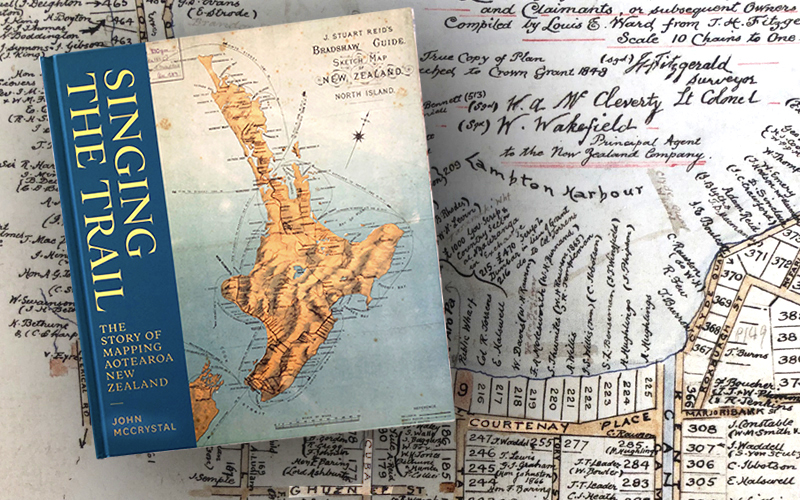
Singing the Trail – book review

The Story of Mapping Aotearoa New Zealand, by John McCrystal

I think this is the nicest book anyone has ever given me. Thanks Davie. GOD! I love old maps and here, for the first time, is a whole, beautiful book of them. They’re not of the ancient European world, either. These are New Zealand maps and they tell our (mostly colonial) history through the contemporaneous pens of the early cartographers. I love all the cartographers, too. Continue reading “Singing the Trail – book review”

Brickbat for Jerningham

For his 199th birthday

Today is Jerningham Wakefield’s 199th birthday. Happy Birthday, you old thing.

Jerningham came to Wellington with the New Zealand Company in 1839, the thin edge of the colonial wedge.  For that we can throw many brickbats. And hey, it’s his birthday! So here is my favourite Jerningham brickbat: a letter to the editor from a missionary, in reaction to Jerningham’s recently published Adventure in New Zealand.

It’s a hell of a book review. Jerningham and the missionaries never did see eye to eye Continue reading “Brickbat for Jerningham”

Edward Jerningham Wakefield

Died 140 years ago today

Dear fellow Wellingtonians

Here is a celebration of Jerningham Wakefield, a founding colonist of Wellington. He died 140 years ago today, aged 58, penniless and alone, in an alms-house in Ashburton.  But before the drink got him, in his early twenties, he had been an extraordinary young man, a journalist, a rip roaring adventurer, the Wellington wild boy of his time. Continue reading “Edward Jerningham Wakefield”

The Wakefields on Waitangi Day

Colonial characters in New Zealand

I’ve became obsessed with the Wakefields while writing a novel about a fictional family of early settlers. I spent months inventing complex characters and dramas for my story.  But marching into my research and sprawling themselves along every  plot-line came the Wakefields and I can’t keep them out: generations of reckless, debauched, manipulative, egotistical, philandering creative geniuses with the complexities of an entire ecosystem. I’ve had to dump my imaginary characters and write about the Wakefields.  They’re too good to ignore.

You can’t make this shit up.

A quick dip into Edward Gibbon Wakefield’s past, (he who invented the system of colonisation that formed the original settlements of Wellington, Wanganui, New Plymouth, Nelson and Christchurch) will tell anyone that much of his formula for colonialsation originated from Newgate Prison, where he was incarcerated for the family pastime of abducting and wedding a young girl in the hope her dad would give him a leg up in politics. He didn’t, but it was touch and go.

Edward Gibbon’ son Jerningham sailed around the world in a 382 ton barque to New Zealand in 1839, back and forward across Cook Straight and up and down the West Coast, wrangling with Te Rauparaha and drinking with Te Rangihaeata, negotiating land deals with local chiefs, staying a step ahead of Hobson and the Crown,  adventuring up rivers in waka to meet war parties, whaling and trading, all the while writing brilliant and evocative journals he turned into bestselling propaganda for the colony. Pretty swashbuckling stuff for a nineteen-year-old lad. 

William Wakefield did a lot of the early colonial leg work diligently and intelligently. He put “Wellington” on the map (owed him a political favour) and kept the missionaries from inheriting the earth, which is a plus point in my books. He was probably quite a decent man when not in thrall to brother Edward Gibbon or reining in wild young Jerningham. He seriously lost his judgement when he accepted wayward bankrupt brother Daniel into New Zealand under a false name (leaving his gambling debts and the wife he had infected with an unpleasant disease) and helped establish him as Crown Solicitor.


What have the Wakefields ever done for us?  It’s a complex question. They are mostly forgotten as we focus on the dominant role of the Treaty of Waitangi in 1840, but at the time the Wakefields were potentially far more influential than Hobson. Which is why I was astonished and delighted to open the Dominion Post today to see Wakefield’s face highlighting an opinion piece on the Treaty, with his very noble quote:

“The establishment of the same rights and same obligations can only be fair between parties who have the same power in the same field.”

It’s well said and certainly resonates on Waitangi Day, though imbalance of power obviously wasn’t top of Wakefield’s mind when he abducted 15-year-old heiress Ellen Turner.

The Wakefields were an extraordinary family, men with huge personal ambition and a genuine desire to improve the system for those without power, although their methods were often dubious and ambiguous. They all seemed to verge on insanity – and I haven’t even mentioned Felix or the father.    I both applaud them and strongly disapprove of them and never quite know what to think of them on any given day.

Love them or hate them, they make a hell of a story.