Mr Peacock’s Possessions – book review

Mr Peacock’s possessions, by Lydia Syson

Lydia Syson’s Mr Peacock’s Possessions sets the characters and the scene slowly – you need to understand the background before you can follow the story. So don’t be impatient, sit quietly as the curious and impulsive Kalala introduces you to his life in the Pacific, his brother, the pastor Solomona, and their small group of god fearing men who are shipped to an island where a white man and his family are struggling to settle.

Lizzie’s story comes next, she tells of family life on an isolated island, the difficulties faced by her mother and many children as they live castaway style, and the struggles of her delicate older brother, who is a disappointment to their very physical and driven father. Lizzie is her father’s favourite and she loves him unreservedly. Until she has to confront a truth that questions all she believes of him.

The family are swindled by a ship’s captain, they suffer rats and weevils and have some small successes, but there is an undercurrent of suspense growing. There are bones on the island, pigs’ bones, says Mr Peacock, as he hastily buries them.  Kalala and the Islanders arrive, Lizzie’s brother goes missing and they all spread out over the island to search for him.

Mr Peacock is a possessive man. Lydia Syson makes his frustrations seem understandable in the rough and rugged man’s world scattered around the very edges of Victoria’s imperial petticoats. Peacock had struggled for years, as many did, slowly realising through constant failures that the dream of owning colonial land was not a promise for everyone. He owned his wife and his children and when the opportunity came to buy and island he owned that, too.  Our main story begins when he brings in his “Kanaka boys,” to work his land and gradually young Lizzie and the rest of the family begin to question her father’s possessive attitudes.

Kalala and the Islanders’ story merges with Lizzie’s and a story that has gone before them on the island, and the mystery of the missing brother hangs over them all.

The reading just gets better and better and the story becomes utterly compelling.  My advice is to set aside a good chunk of time when you get near the end, there are some things that need to be finished.

Mr Peacock’s Possessions is a terrific book for a book club read, there are lots of questions around possessiveness and ownership, success and failure, compassion. You can discuss colonial attitudes to women, race, land, the power of religion. I don’t think I’m giving anything away by saying Monday Island, where the Peacock’s live, is in fact Raoul Island in the Kermadecs, and now a marine reserve and a place of extraordinary biodiversity. It featured on the migration route for early Pacific voyagers and for those of us who love islands it has a fascinating history all of its own.

Head’s up for my book club – this one is my next choice.
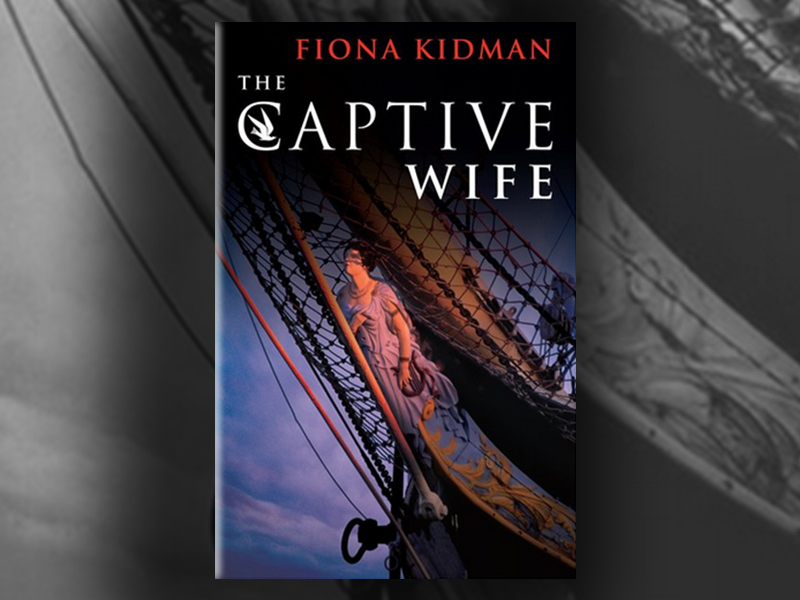
 

The Captive Wife – book review

The captive wife, by Fiona Kidman

This is a whale of a tale set in the days when a whaler could take a child bride to a remote New Zealand whaling station – when marauding war parties, cannibalism and shipwreck were common and life was fragile – and he could wonder why it all went so wrong.

Fiona Kidman’s The captive wife is a real New Zealand legend.   Jackie Guard was 40 when he married the spunky 14 year old Betty and took her from the Garrison town of Sydney to the whalers’ den of Te Awaiti in the Malborough Sounds.  Theirs is a real history and journals and letters of the time often mention them, particularly after the events recounted in this book that turn Betty into a bit of a celebrity.

Of course things often do go wrong, in a number of ways, but the main action of the story is based on a shipwreck when the Guards are returning to the station after a trip to Sydney and are smashed up on the Taranaki Coast. This is in 1834, before Governor Hobson and the Wakefields, before any kind of systematic colonisation of New Zealand or any semblance of British law, when the only force driving the foreigners in the country was exploitation.  The castaways are attacked, many killed and Betty and her children are captured by the Ngāti Ruanui Māori.

Jacky Guard is released to bring a ransom, but returns four months later on the Royal Navy’s man-o’-war Alligator from Sydney and a captain hell bent on teaching the Māori a lesson. This is England’s first armed conflict with Māori, and we are still learning from the lesson today. 

I guess you want to know what happened to Betty in those four months she spent in captivity, the book is called the captive wife, after all.  Well, first she witnessed the cannibalism of her murdered crewmen. And then she was struck by a tomahawk, which was deflected by a comb in her hair (so the legend goes, and you can view both the comb and Jacky Guard’s pistol at Te Papa) then her infant son was taken from her to be trained in Māori ways. And then … well, things changed.  She fell under the protection of a chief called Oaoiti who was kind to her and a man in extreme contrast to her rather nasty husband Jacky…

The story starts, like most stories of the time, with a male voice, and Jackie is wondering where he can lay his poker. But soon we hear Betty’s voice and female viewpoint, and later she tells her story to an older, sympathetic friend. I really like the duality of this, she and Jackie have very different eyes on the same world.

The research Fiona Kidman has done for this book is spanking and I never doubt that the fictionalised parts could well have happened in that time and place, though the telling of the story is often deliberately one-sided and told by unreliable, limited or misunderstood narrators.  The complexity of the telling sure make this a great read and I highly recommend it for an intelligent slap of New Zealand’s wild history.

If  The captive wife is a suggestion for a book club read, Elizabeth Welsh of Auckland University gives an excellent academic summary review on the themes, metaphors and perspectives here: The captive wife. But do read the book first.

The Naturalist – book review

The naturalist, by Thom Conroy (more fan fiction than book review!)

I feel a bit cheeky writing a review of Thom Conroy because he is a teacher of writing and I am a student (different institutions and I’ve never met him), but also because he’s writing about my blokes. Or I’m writing about his.

It’s something you do need to come to terms with, when you write historical fiction, that your characters are not, in fact, your blokes. Thom Conroy’s book, The Naturalist, is the story of Ernst Dieffenbach, who was a member of the New Zealand Company’s 1839 colonial expedition.  He sailed on the Tory with The Colonel and Jerningham Wakefield, Charles Heaphy, Captain Chaffers and their gang.

They’re all historical characters (and my goodness, they are characters) and Thom Conroy has written a wonderful fictional account of how they all got along together. Which is not very well, most of the time, except for the rather gracious Charles Heaphy, who got along with everybody.

I’m a student this year, of creative writing, and I’m writing a book about the above mentioned Jerningham Wakefield, one of the more outrageous characters in Conroy’s tale. I have my first draft of 100,000 words and Jerningham has romped through them, heartily pissing off Dieffenbach, the Colonel, Captain Chaffers and even the mild mannered Heaphy. (No one, anywhere, has ever written a bad word about Heaphy. He’s one of God’s good men, everyone says so, and every story needs one good man.)

But I am writing about Jerningham and I love him very much, in the way a mother loves her son; with indulgence and exasperation and a hope that he will, one day, grow out of the booze.  Conroy doesn’t love him so much. I’m glad I wrote my book before reading Conroy’s, because I formed my judgement first and when you meet a new bloke, first impressions count.

They’re up for grabs, these characters, and I’m starting to realise that using historical people in a novel is a bit like writing fan fiction.  There’s no copyright, they’re been dead well over 100 years and any author can take them anywhere.  Dieffenbach, Jerningham, Heaphy and co. all wrote compelling journals so there is plenty of source material, and once you get gripped by the Victorian character of these extraordinary men a kind of magic takes place – they come alive, start arguing with one another and acting up.  I know Jerningham comes down at night and raids my booze cupboard.

Thank you, Thom Conroy. Reading The Naturalist makes me feel we’ve met through mutual friends, and you’ve told me a story about them in a new way, and added to my understanding of the lives of these tenacious, complex men.

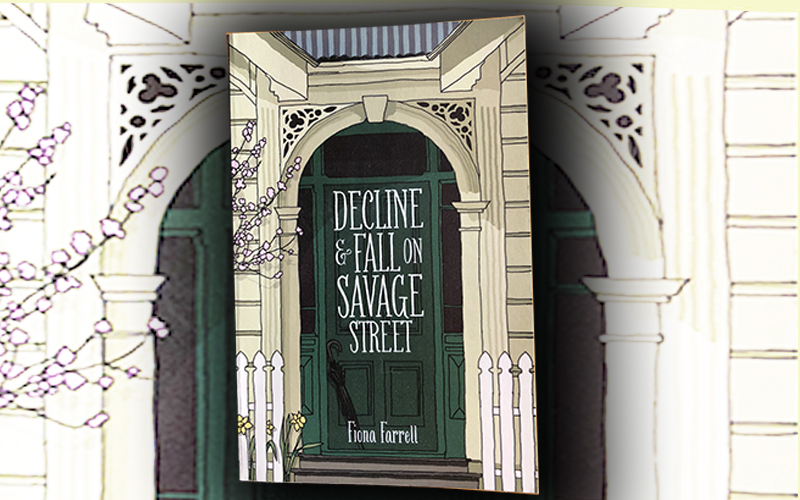
Decline & Fall on Savage Street – book review

Decline & Fall on Savage Street, by Fiona Farrell

A lot happens. It says this in the blurb.

So don’t go thinking you can just whizz through this as you would a normal novel. You need to go in with the right attitude, with a predisposition to enjoy Fiona Farrell (I do!) and a realisation that some novels don’t have obvious characters you get to know and love and follow on a journey.

The character on a journey in Farrell’s Decline & Fall on Savage Street is a house.  It took me a while to understand this, (and apparently she has written a non-fiction book about this house so perhaps I should have come better prepared) so for a while I floundered around with characters disappearing just as I got interested and a whole new set of people coming in. It reads more like a set of short stories, chronologically spanning 100 years, with each story bringing characters who live in the same house with their personalities and tribulations – from our perspective we see a house, but of course for every new arrival it is their home, they move their baggage in and own it.

As a collection of short stories this book is very rewarding and the format works really well, I love the fact that we get to know the house better than the characters themselves because we’ve been inhabiting it, along with all the former tenants, since it was built.

But she’s clever, Fiona Farrell, and this is also a story of another character that lives under the bank of the river, undisturbed (mostly) by the turmoil of change and war and earthquakes. In contrast to the lot that happens to the humans above, nothing happens to the eel for a very, very long time. Or if something happens, it is the drop of a leaf onto the water. We feel her ageing not in the time it takes to read the pages, but in the span of frantic, scrabbling activity that happens ashore. Her story made me feel old. But every story has a climax, and even for the eel, eventually something happens.

Each human chapter starts and ends with a missing line which drove me mad. I guess it is to show we are dipping in and out of a story, but this is a book for intelligent readers and we know that. A kind editor should have said, let’s not do this.

I wont specifically remember any of the characters in this story, they passed by too fast,  but the house and the eel will stay with me forever.

Also by Fiona Farrell, if you love good New Zealand writing, is:
Mr Allbones’ Ferrets – Book Review

Mr Allbones’ Ferrets – Book Review

Mr Allbones’ Ferrets, by Fiona Farrell

If you’re a library browser, pick this one up – although in the Hastings City Library you’ll have to look in the Science Fiction category (and I’m not sure whether to be the smart-arse and tell them or not).

Fiona Farrell’s Mr Allbones’ Ferrets is lovely historical fiction set in my favourite era, mid-19th Century, when those Victorians were exporting their exuberant passions all over the globe and wreaking havoc on the balance of things.

It’s a strangely paced book – all build up to the journey, and then the shock and resolution is hasty. Farrell wrote this over a decade (and many books) ago and I’ll review her latest book next (Decline and Fall on Savage Street) which is a masterpiece of pace – though again, unconventional.

There’s lots of unconventionality to enjoy in Mr Allbone. He is a young poacher and his speciality is ferrets, which he uses to flush out rabbits for the pot. He has a clutch of young ‘uns at home to feed – brothers and sisters. His mother lies beneath the wild garlic outside St Peter’s wall (a typically understated, but telling phrase). Along with the nest at home Allbones himself is ferret-like; a “skinny lad, the runt of the litter who had grown quick and cunning and able to squeeze his way though any gap or cranny, scaling soffit and drainpipe, up trees, under hedges.”

Farrell gives us lots of fascinating detail about ferret life: catching, keeping, illnesses and breeding. Lots about breeding, how to put the cob to the slut, never the other way around or he could kill her, leave them for a couple of ferocious hours and then sometimes it is necessary to drag the cob off because they don’t know when to stop. Etc.

Allbones has the job of collecting ferrets to take to the colony of New Zealand because previous settlers took rabbits. You can sing it to the tune of:  I Know an Old Lady who Swallowed a Fly.

He (of course) falls for the beautiful and enigmatic Eugenia, whose thoughts and feelings remain obscure. She is the granddaughter of Allbones’ employer and is both extremely observant of animals and beguilingly naive of people. Poor kid.

The period detail is expertly executed and full of sound and colour. Farrell is particularly evocative with her smells; the stench of 412 humans, 202 caged ferrets, 66 stoats, 82 weasels and 3200 pigeons (plus stray rats, mice, seabirds and the odd shark dissected on deck) in a tub in the tropical heat seems to be part of my memory now, as if I had been on board the Adam and Eve as she sailed south. It is as unpleasant as the story that is unexpectedly burst open as they race across the roaring 40s to New Zealand.

There’s an earlier name swap which hangs over the book and for which I expect a resolution which doesn’t happen. That’s distracting. And the whimsical, rather emotionless ending is disturbing. But the Victorians were a disturbing lot, with their twisted morality and God given authority to take what they want and rearrange the world to their liking.

And, often as not, they got away with it.

It’s a quick book, a good one as a Book Club read on the lighter side but still with lots of fascinating topics, big and small, to discuss and excellent writing from a very polished New Zealand author.

Here’s another Fiona Farrell, very different, equally good: Decline & Fall on Savage Street – book review

The Wakefields on Waitangi Day

Colonial characters in New Zealand

I’ve became obsessed with the Wakefields while writing a novel about a fictional family of early settlers. I spent months inventing complex characters and dramas for my story.  But marching into my research and sprawling themselves along every  plot-line came the Wakefields and I can’t keep them out: generations of reckless, debauched, manipulative, egotistical, philandering creative geniuses with the complexities of an entire ecosystem. I’ve had to dump my imaginary characters and write about the Wakefields.  They’re too good to ignore.

You can’t make this shit up.

A quick dip into Edward Gibbon Wakefield’s past, (he who invented the system of colonisation that formed the original settlements of Wellington, Wanganui, New Plymouth, Nelson and Christchurch) will tell anyone that much of his formula for colonialsation originated from Newgate Prison, where he was incarcerated for the family pastime of abducting and wedding a young girl in the hope her dad would give him a leg up in politics. He didn’t, but it was touch and go.

Edward Gibbon’ son Jerningham sailed around the world in a 382 ton barque to New Zealand in 1839, back and forward across Cook Straight and up and down the West Coast, wrangling with Te Rauparaha and drinking with Te Rangihaeata, negotiating land deals with local chiefs, staying a step ahead of Hobson and the Crown,  adventuring up rivers in waka to meet war parties, whaling and trading, all the while writing brilliant and evocative journals he turned into bestselling propaganda for the colony. Pretty swashbuckling stuff for a nineteen-year-old lad. 

William Wakefield did a lot of the early colonial leg work diligently and intelligently. He put “Wellington” on the map (owed him a political favour) and kept the missionaries from inheriting the earth, which is a plus point in my books. He was probably quite a decent man when not in thrall to brother Edward Gibbon or reining in wild young Jerningham. He seriously lost his judgement when he accepted wayward bankrupt brother Daniel into New Zealand under a false name (leaving his gambling debts and the wife he had infected with an unpleasant disease) and helped establish him as Crown Solicitor.


What have the Wakefields ever done for us?  It’s a complex question. They are mostly forgotten as we focus on the dominant role of the Treaty of Waitangi in 1840, but at the time the Wakefields were potentially far more influential than Hobson. Which is why I was astonished and delighted to open the Dominion Post today to see Wakefield’s face highlighting an opinion piece on the Treaty, with his very noble quote:

“The establishment of the same rights and same obligations can only be fair between parties who have the same power in the same field.”

It’s well said and certainly resonates on Waitangi Day, though imbalance of power obviously wasn’t top of Wakefield’s mind when he abducted 15-year-old heiress Ellen Turner.

The Wakefields were an extraordinary family, men with huge personal ambition and a genuine desire to improve the system for those without power, although their methods were often dubious and ambiguous. They all seemed to verge on insanity – and I haven’t even mentioned Felix or the father.    I both applaud them and strongly disapprove of them and never quite know what to think of them on any given day.

Love them or hate them, they make a hell of a story.


Chappy – book review

Chappy, by Patricia Grace

Chappy, by Patricia Grace, is a domestic story of a community whose relationships are entwined and confusing in the way real life is confusing.

“I told you that Aki was your uncle by double adoption. That first adoption was when Dorothea became mother to Moana-Rose and me, and we became his sisters.”  The timeline jumps around and the narrators switch about, it’s a rambling story that could be told by mates sitting around on old sofas with a few beers, interrupting each other and backtracking. Some incidents feel honest and factual, others edited with the retelling. This is the way family histories are, and there is truth in both.

The catalyst for the story being told is the (dare I say, Gen-Y) crisis of young Daniel in Switzerland, of New Zealand descent, wanting to find himself. He is the investigative reporter, if you like. I think the discovery of his family helps to heal him. I like to think so, anyway, although the story is not about him. “There’s a much more interesting story than one of a spoilt brat with his own bank account who had to try and kill himself…”

For me, the breadline living of the whanau that Daniel finds back home is a pretty typical mid-century NZ story, Māori or Pakeha. Rural life was precarious: a lot of self sufficiency, some number 8 wire, generosity and sharing, the value of a storyteller to an introverted community, both the welcoming and the fear of strangers. The necessity of going away and how grounded you feel when you make it back.

Chappy Star is a stranger, a Japanese stowaway on a ship. Māori seaman Aki stumbles across him and takes him home to the marae, where he finds kindred spirits. The differences between ghost-like Chappy and the warm and candid Oriwa, with whom he falls in love, are made to appear superficial – language, culture, nationality are nothing beside their attachment. Their love survives years of racially induced separation and misunderstandings. Oriwa understands this as she disentangles her family stories for Daniel. Maybe we all need to tell our lives as stories to understand them.

The novel is about roots and coming home – from Hawaii, where Aki washes up, from Switzerland where Daniel is born, and the confusion that ensues when home means two or more places. Chappy weaves between his cultural home in Japan, his adopted home in Hawaii and his spiritual home with Oriwa in New Zealand.

The story of Moonface made me cry. There is a lost child in many stories, but none so poignantly as here.  Moonface is Aki’s adored little brother.  At the end of one long afternoon, Moonface insists on following Aki to the spring, but he lies down in the ferns and falls asleep. Aki fills the billy, and when he turns around the boy is gone. In his mind, forever,  is “- the cold spring water, the silver tin, water silvered, the creaking birds, the pouring, the boy invisible, the unspeaking leaves, the trail of torches, the voices calling, the crying, the wailing of all the grandmothers in the world, the waiting, the ferny nest.”  It seems natural that Aki would absorb his lost brother into his soul to become his moral compass, the well of his tenderness. “Go home,” Moonface says, when Aki has been away at sea too long and needs to get his feet back on family ground.

Patricia Grace writes with lovely, sparse descriptions. Aki: “I was at the woodpile sawing stove-lengths from manuka trunks I’d brought down from the slopes. About mid-morning. There was mist soft-footing about the hills, grey like old photos.” It’s all you need, a whole scene implied from a good choice of words.

There’s a moral to Chappy, which is spelled out very clearly (in case you missed it) as Daniel sums up the story at the close.  He was born of the generation that left the home fires, and now is a wealthy outsider looking back in. “…I am who I am. I understand that now. I’m not about to chuck it all away and go barefoot, and I don’t wannabe a wannabe. So, no matter where I go or what else I undertake, I’ll continue to increase my understanding of this part of myself that I embrace with all my heart. I’ll keep in touch, work back and forth from wherever I am in the world and contribute from the depth and core of me.”

There you go, kids.

Farm Holiday

New Zealand farm stay in Mahia

I haven’t been on a farm holiday since I was a kid and Kathleen and I walked a long way across the hills and the farmer’s son gave us a lift home in the helicopter. These things stay with you.

So last week instead of our pre-Christmas family long weekend blobbed by a lake, this year I thought we’d go for some kiwi action and booked three days on a farm in Mahia and it was everything a farm holiday should be.

There was a good looking and friendly young farmer in stubbies and a rugby shirt – a bit of confusion when my son said he was saving to go the world cup next year – World cup’s not next year? Oh, soccer? The football/rugby divide. It’s real.

His most hospitable wife wandered past, with baby farmers in tow (the blondie dressed like her dad and keeping those dogs in line) to check we had everything we needed in the glampy shearers’ quarters which were spanking clean, very basic, and just perfect for a family of 6 unloading a stack of books, a football, a few board games and a well stocked chilli bin.

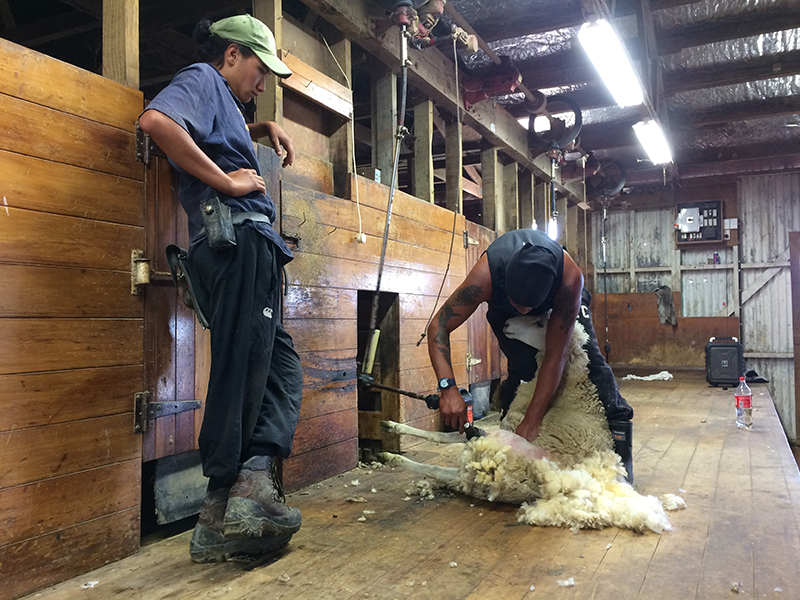
We “helped” sort and drench the lambs,  watched sheep shearing and the rounding up of the cows. There were smart dogs doing their thing at the shrill whistle of the shepherd and pet pigs, a pony. We rode trail bikes up hill tracks for breathtaking views.

The same things I did on a farm holiday as a kid and I thought nothing had changed, until our 2017 farmer explained the native bush replanting in the gullys, the erosion protection, the focus on environmental care.  I think slash and burn was still in fashion when I was young.

We had Uncle Ted along from Canada for a bit of a kiwi experience, so on the rainy day while the grass got drunk we walked the Nikau rainforest and soaked in Morere Hot Springs and the following day, with all the leaves sparkling, we walked the circuit at Kinikini, in lush native bush.

I reckon a farm holiday should be on every family’s list.  I’m a Wellington city girl and have spent limited time on farms – childhood visits, a few friends on farms growing up, an occasional horse trek, thistle pulling jobs  – but there have always been hills with dots in the background calling me closer. It comes with being a New Zealander.

Standing in the sheep sheds with the dogs and the farmers felt like finding my roots.


Sheep shearing New Zealand.jpg
Fast, expert sheep shearing on Mahia farm
Native Bush.jpg
Kinikini loop track, Mahia Peninsula scenic reserve

http://www.doc.govt.nz/parks-and-recreation/places-to-go/east-coast/places/mahia-peninsula-scenic-reserve/things-to-do/mahia-peninsula-scenic-reserve-track/


Biking the Rimutaka Rail Trail

Where historical research takes you

We put our trail bikes on the 11.01 from Featherston. It’s an old fashioned station, where they hand write the tickets and the guard helps lifts the bikes aboard (and he’s as cheerful as they come).  We get off through the tunnel at Maymorn Station and are back 5 hours later after a glorious day cycling the historic Rimutaka Rail Trail. This is the track the railway took before they cut the tunnel through the hill in 1955. It’s a fairly easy ride with lots of stops, packed with bush and mountain scenery and haunted with history.

There was once a steam railway here, linking the Wairarapa and Wellington.

Completed in 1878, the Rimutaka Incline on the Wairarapa side is famous for the Fell Engines that chugged up the hill for 55 years, negotiating the steep 1:15 gradient, clenched to a third, middle rail. The line was built and maintained by a remarkable group of engineers, navvies and gangers.  It’s the ghosts of the gangers I’ve come to find.

I’m writing a novel set in 1878 and one of my characters, Lars, works on the Incline.  He walks in from Kaitoke one day with a companion and doesn’t come back. It is blowing a gale on the tops and the mud slides down over the track, leaving ugly scars of exposed greywacke on the unstable slopes.

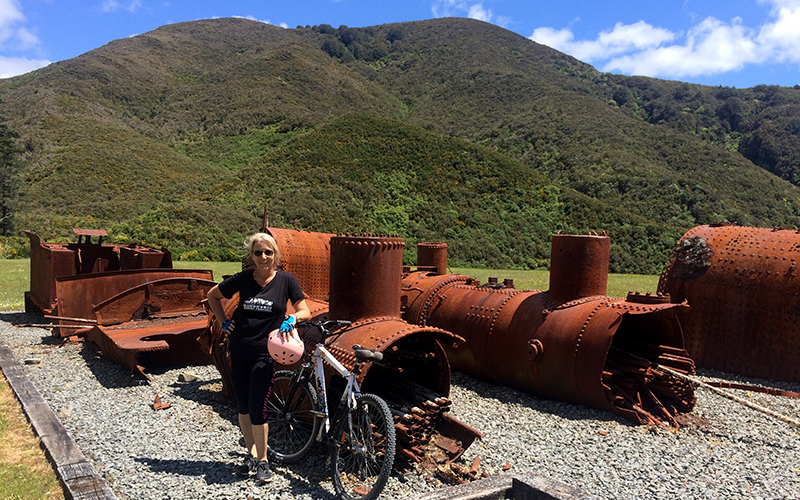
I rode alongside Lars’s ghost up through the lush Pakaratahi Valley over his 1870s bridges and culverts to the Summit, where we stopped, as he did, for water and a sandwich. When Lars sheltered from my imaginary wild storm of ’78 there was the beginnings of a settlement bursting with pioneering potential. Not for us – we walked among the rusty remains of long abandoned steam engines, discarded over the years and left to decompose in splendid ruin on the peaceful plateau.

In the icy Summit tunnel the third rail begins and the track descends steeply towards Cross Creek. Here I checked the logistics of my story, imagining the danger of exposure on the stretch they call Siberia where the winds (later, in 1880) were so strong they blew a passenger carriage and goods vans off the rails and down into the valley below.

For us on our bikes, it was an unusually still day. Half of my head was tripping along the raised rail with the gangers battling an historic gale, the other half enjoying a calm bike ride, almost 140 years later, stopping in the sunshine to read the old stories on the plaques posted along the route.

Ladle Bend creek bridge
Ladle Bend creek bridge on the Rimutaka Trail, c1891

“My father occasionally took my sister and me for a ride on a three-wheel railway jigger. As we all sat on one side of the jigger, it had a tendancy to upturn when passing around the many curves … I was always frightened going over Ladle Bend Creek Bridge as it was rather high and had no sides.” Ron Mitchell, child at Summit 1933-40

Ferry gliding – rafting the Mohaka

And ferry gliding old New Zealand style

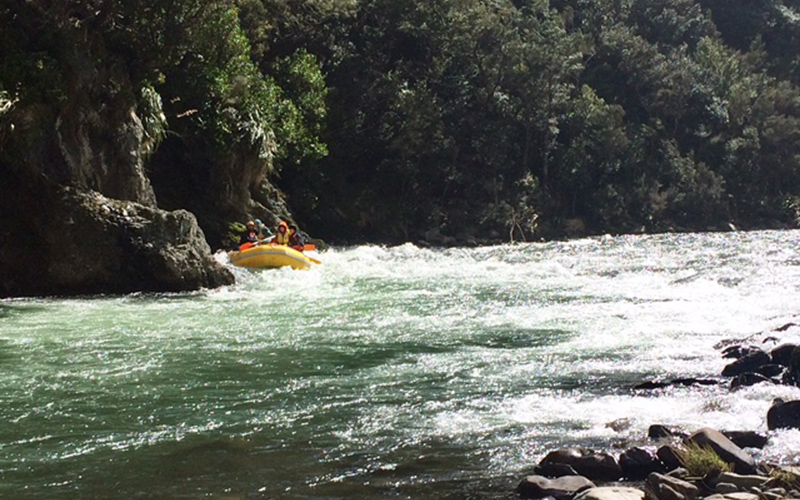
Rafting the Mohaka river is one of my great joys. Even on the cold and wet days, there’s a chance of a hot pool at a campsite.  On a good day, there’s sparkling water and picnics on the banks,  pirates and cliff jumping. And it’s always an education.

Last trip I battled against a new captain (sorry Barry!) for half a day before one of the other paddlers told me to relax and follow orders. Barry was “ferry gliding”, a technique I hadn’t seen before.

Rather than head the raft down the current, he kept the raft on an angle and let the power of the water push the boat across the flow from one eddy to another, crossing bank to bank with very smooth control.

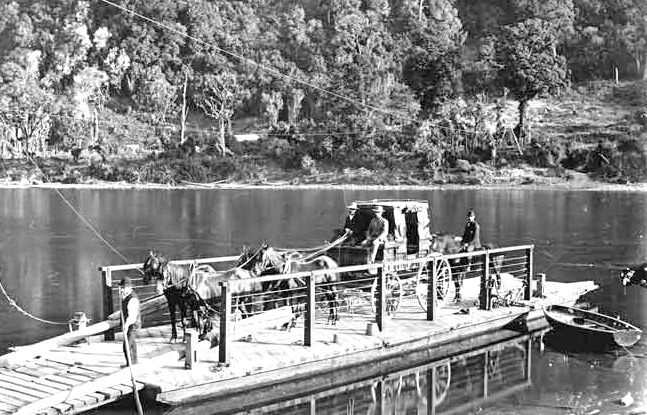
Barry told us ferry gliding was a technique used extensively in colonial days for ferry crossings (hence the name). In the 1800s New Zealand rivers were crossed – in order of sophistication – on foot, on horseback, by canoe, by punt or a larger ferry and very occasionally by a bridge. Early colonial bridges were often pretty makeshift and were regularly washed away.

The punts were attached by a pully wire to a high cable hung across a river, and, as with our ferry gliding across the Mohaka, the flow of the river (or the pull of the tide) worked with the angle of the ferry punt to push passengers across the water.

Ferry punt on Buller River
Horse and carriage crossing the Buller River, South Island New Zealand in the 1880s

We willingly throw ourselves down the rapids in an inflatable raft with our life jackets, helmets, wetsuits, PLBs, maps & compass, the car and the trailer parked up at the end with a change of clothes, a thermos of hot tea and a comfortable ride home.   And we call ourselves adventurers.

Here’s an evocative extract from Wanganui Herald, Volume I, Issue 177, 26 December 1867, Page 2. It’s typical reading from the period!

An inquest was held this morning in the Exchange Hotel [Wanganui], before H. J. Perham, Esq., Coroner, and a jury of twelve, on the body of John CONROY, who was drowned off a punt on Friday morning. James HORNE said I am a soldier on leave I belong to the Royal Artillery; the last time I saw the deceased was on Friday morning about 7 o’clock on a punt going up to Waipakaka; when we got to Walker’s, at Aramaho, the deceased and I went ashore; I got a bottle of rum and we went aboard again, we then started up the river; we had got about thirty chains from Walker’s; Conroy said, boys, we’ll have a jolly dinner to-day. Conroy was at the bow of the boat; I was lighting my pipe, and had my back to him, when I heard a splash in the water; I rose to my feet, and saw Conroy about the length of the punt behind we then tried to back the punt, but he drifted faster than we could in about two minutes he went down with his arms up.