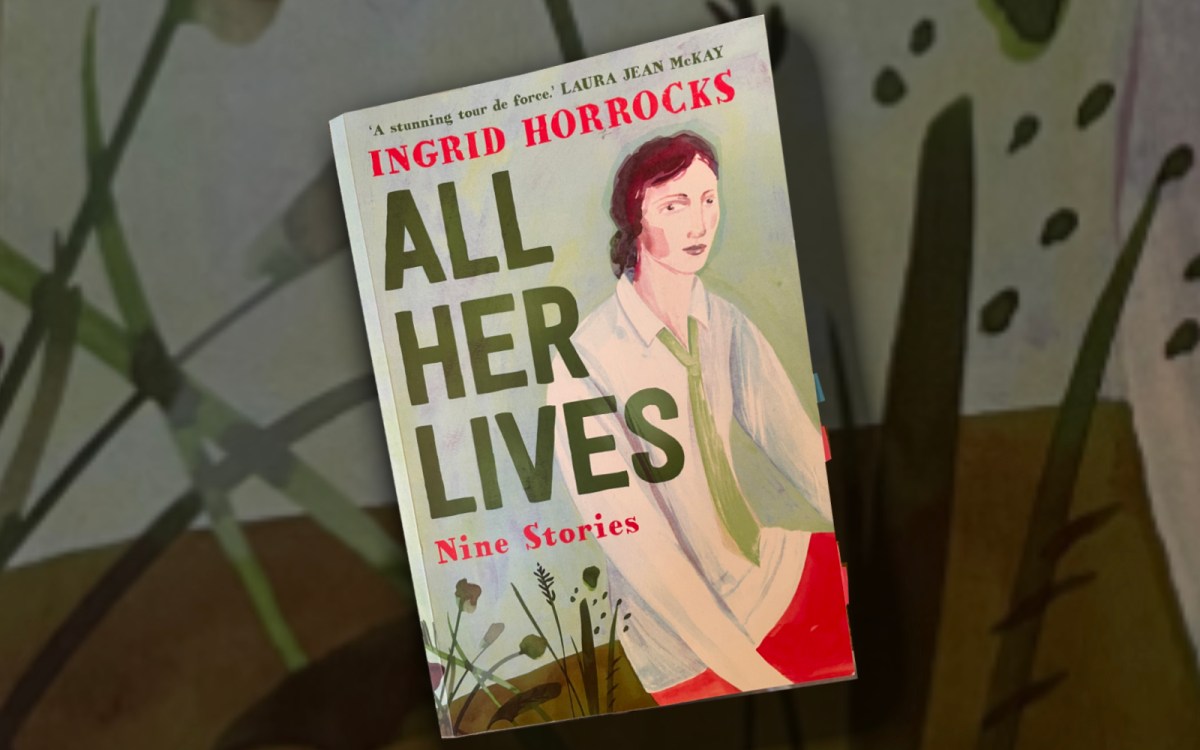
Ingrid Horrocks’ book, All her Lives, currently shortlisted for the Jann Medlicott Acorn Prize for Fiction, contains nine short stories of women across different generations. The stories span from a tenacious woman chasing stolen silver on the Norwegian coast in 1795 via a Berlin nightclub in 2005 to a woman who visits her son in prison, today. The stories are elegantly constructed, totally different but all the same, each telling of a woman negotiating her place to stand amongst the men around her. If you’re looking for the voice of the Universal Woman she’s here, in these collected works, in a consideration that runs through all these lives like a subcutaneous layer of fat. Simply: How must I, as a woman, best approach this communication with a man?
In Evie on a Branch, Evie returns to the family farm from WWI. She has served at Amiens. Her brother, disabled by injury, stayed home. She is careful with his feelings, plays down her war and is proud of what he has achieved on the farm, married now, with a child. Marvellous Instruments is set in the garden of Truby King who is training Plunket nurses on the dangers of women with leaking breasts overfeeding their babies. They ache for their children but accept that he knows best. In Unusual Spiel a girl is found passed-out on a hay bale at a party. She’s been marked in chalk by some boys. It’s what they do to ewes when they’ve been serviced. How does anyone negotiate any relationship after such a thing? Then there is the bi-woman deliberating an open relationship with her boyfriend; in another story a woman is protesting nuclear free in Auckland and dancing on eggshells when hubby comes home from the navy base. Out of context with these New Zealand stories and 160 years earlier is The Silver Ship where the (real life) bold Mary Wollstonecraft chases down a pirate who has purloined her man’s stolen silver. But the question is the same: how does she, as a woman, best negotiate this? Carefully, obviously, aware of the gender bias. Why did she possibly imagine it would go well? The decades pass. The power imbalance is still there.
Ingrid Horrocks is the queen of ‘show don’t tell’. There’s no author’s voice here, no explanations required, we just jump right in with the characters and read between the lines. “Hazel slid off the bonnet, and Sophie unlocked the driver’s door, got in, and leaned across to flick the lock open on the passenger side.” I can feel the hot vinyl, smell that 1990’s car. In another story, Alna wants a pair of shoes.“She selects a pair of the newer high heels, laughing at me as she squeezes her stockinged toes into a pair, insisting this is how they are meant to fit.” Alna’s a woman wanting to be looked at by men and her sister is curious. The protest story gives a dose of the ‘feels’ of the era: “Guitar chords reached us from the club, and a woman’s voice, that Joan Baez song about straying into a lover’s arms, being lost at sea. I liked the thought of the song rising from the grey fortifications like a plant pushing through concrete“. Say no more. Welcome to the ’80s, babe.
These are individual short stories but some characters carry across. This is New Zealand, after all, and your mum’s best friend may well be a sister-in-law of someone else you may have met. They represent all our lives.
I’m probably the perfect audience for this book. I think maybe Ingrid Horrocks wrote it specially for me. It felt precious, to find all those unarticulated niggling feelings given to other women who also leave them unacknowledged. Glad to know it’s not just me, then. I feel among friends.

 Cristina Sanders' blog