Mr Peacock’s Possessions – book review

Mr Peacock’s possessions, by Lydia Syson

Lydia Syson’s Mr Peacock’s Possessions sets the characters and the scene slowly – you need to understand the background before you can follow the story. So don’t be impatient, sit quietly as the curious and impulsive Kalala introduces you to his life in the Pacific, his brother, the pastor Solomona, and their small group of god fearing men who are shipped to an island where a white man and his family are struggling to settle.

Lizzie’s story comes next, she tells of family life on an isolated island, the difficulties faced by her mother and many children as they live castaway style, and the struggles of her delicate older brother, who is a disappointment to their very physical and driven father. Lizzie is her father’s favourite and she loves him unreservedly. Until she has to confront a truth that questions all she believes of him.

The family are swindled by a ship’s captain, they suffer rats and weevils and have some small successes, but there is an undercurrent of suspense growing. There are bones on the island, pigs’ bones, says Mr Peacock, as he hastily buries them.  Kalala and the Islanders arrive, Lizzie’s brother goes missing and they all spread out over the island to search for him.

Mr Peacock is a possessive man. Lydia Syson makes his frustrations seem understandable in the rough and rugged man’s world scattered around the very edges of Victoria’s imperial petticoats. Peacock had struggled for years, as many did, slowly realising through constant failures that the dream of owning colonial land was not a promise for everyone. He owned his wife and his children and when the opportunity came to buy and island he owned that, too.  Our main story begins when he brings in his “Kanaka boys,” to work his land and gradually young Lizzie and the rest of the family begin to question her father’s possessive attitudes.

Kalala and the Islanders’ story merges with Lizzie’s and a story that has gone before them on the island, and the mystery of the missing brother hangs over them all.

The reading just gets better and better and the story becomes utterly compelling.  My advice is to set aside a good chunk of time when you get near the end, there are some things that need to be finished.

Mr Peacock’s Possessions is a terrific book for a book club read, there are lots of questions around possessiveness and ownership, success and failure, compassion. You can discuss colonial attitudes to women, race, land, the power of religion. I don’t think I’m giving anything away by saying Monday Island, where the Peacock’s live, is in fact Raoul Island in the Kermadecs, and now a marine reserve and a place of extraordinary biodiversity. It featured on the migration route for early Pacific voyagers and for those of us who love islands it has a fascinating history all of its own.

Head’s up for my book club – this one is my next choice.


Pocket sexism

How to wear a mobile phone

So much for unisex clothing. Discrimination is rampant, and it is apparent in the pocket.

And I’m not talking about the price of women’s clothing compared to men’s. I’m really talking about pockets.

I’ve gone out in the evening and discovered my husband has seven pockets and I have none. Summer dresses with a pocket? Nope. Work skirts? Nope. Fashionable leggings? No pocket.  Those jackets with the little lapel thing that looks like a pocket but is stitched over so you can’t put your hand in, who’s that for?  I have the odd shirt with a silly little flip of a pocket right over the breast bulge, I’m not sure what is designed to go there, but not wallet or keys.

Jeans? Don’t get me started. A phone in your pocket is asking for trouble.  Pick me! it says. Let me fall out when you sit down. Please, let me slide from that precarious little flap of fabric and dive with a splash into the toilet bowl.

Women’s clothing designers, if you’re reading this, do us a favour!  Women no longer want to carry a wee handbag where ever we go. Like the blokes, we like to be hands free. Design us clothes that look good, feel comfortable and have pockets.  And make them big enough for a phone, keys and cards.

In the meantime, ladies, here’s a work around for the jeans:

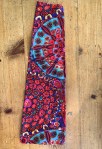
Voila! You have a bit of swank in your back pocket and your phone’s not going anywhere.

Farm Holiday

New Zealand farm stay in Mahia

I haven’t been on a farm holiday since I was a kid and Kathleen and I walked a long way across the hills and the farmer’s son gave us a lift home in the helicopter. These things stay with you.

So last week instead of our pre-Christmas family long weekend blobbed by a lake, this year I thought we’d go for some kiwi action and booked three days on a farm in Mahia and it was everything a farm holiday should be.

There was a good looking and friendly young farmer in stubbies and a rugby shirt – a bit of confusion when my son said he was saving to go the world cup next year – World cup’s not next year? Oh, soccer? The football/rugby divide. It’s real.

His most hospitable wife wandered past, with baby farmers in tow (the blondie dressed like her dad and keeping those dogs in line) to check we had everything we needed in the glampy shearers’ quarters which were spanking clean, very basic, and just perfect for a family of 6 unloading a stack of books, a football, a few board games and a well stocked chilli bin.

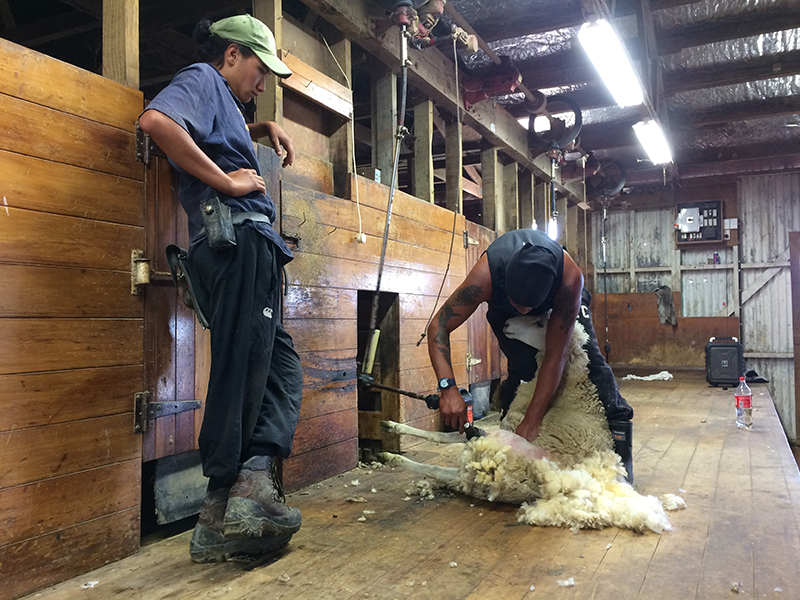
We “helped” sort and drench the lambs,  watched sheep shearing and the rounding up of the cows. There were smart dogs doing their thing at the shrill whistle of the shepherd and pet pigs, a pony. We rode trail bikes up hill tracks for breathtaking views.

The same things I did on a farm holiday as a kid and I thought nothing had changed, until our 2017 farmer explained the native bush replanting in the gullys, the erosion protection, the focus on environmental care.  I think slash and burn was still in fashion when I was young.

We had Uncle Ted along from Canada for a bit of a kiwi experience, so on the rainy day while the grass got drunk we walked the Nikau rainforest and soaked in Morere Hot Springs and the following day, with all the leaves sparkling, we walked the circuit at Kinikini, in lush native bush.

I reckon a farm holiday should be on every family’s list.  I’m a Wellington city girl and have spent limited time on farms – childhood visits, a few friends on farms growing up, an occasional horse trek, thistle pulling jobs  – but there have always been hills with dots in the background calling me closer. It comes with being a New Zealander.

Standing in the sheep sheds with the dogs and the farmers felt like finding my roots.


Sheep shearing New Zealand.jpg
Fast, expert sheep shearing on Mahia farm
Native Bush.jpg
Kinikini loop track, Mahia Peninsula scenic reserve

http://www.doc.govt.nz/parks-and-recreation/places-to-go/east-coast/places/mahia-peninsula-scenic-reserve/things-to-do/mahia-peninsula-scenic-reserve-track/


Biking the Rimutaka Rail Trail

Where historical research takes you

We put our trail bikes on the 11.01 from Featherston. It’s an old fashioned station, where they hand write the tickets and the guard helps lifts the bikes aboard (and he’s as cheerful as they come).  We get off through the tunnel at Maymorn Station and are back 5 hours later after a glorious day cycling the historic Rimutaka Rail Trail. This is the track the railway took before they cut the tunnel through the hill in 1955. It’s a fairly easy ride with lots of stops, packed with bush and mountain scenery and haunted with history.

There was once a steam railway here, linking the Wairarapa and Wellington.

Completed in 1878, the Rimutaka Incline on the Wairarapa side is famous for the Fell Engines that chugged up the hill for 55 years, negotiating the steep 1:15 gradient, clenched to a third, middle rail. The line was built and maintained by a remarkable group of engineers, navvies and gangers.  It’s the ghosts of the gangers I’ve come to find.

I’m writing a novel set in 1878 and one of my characters, Lars, works on the Incline.  He walks in from Kaitoke one day with a companion and doesn’t come back. It is blowing a gale on the tops and the mud slides down over the track, leaving ugly scars of exposed greywacke on the unstable slopes.

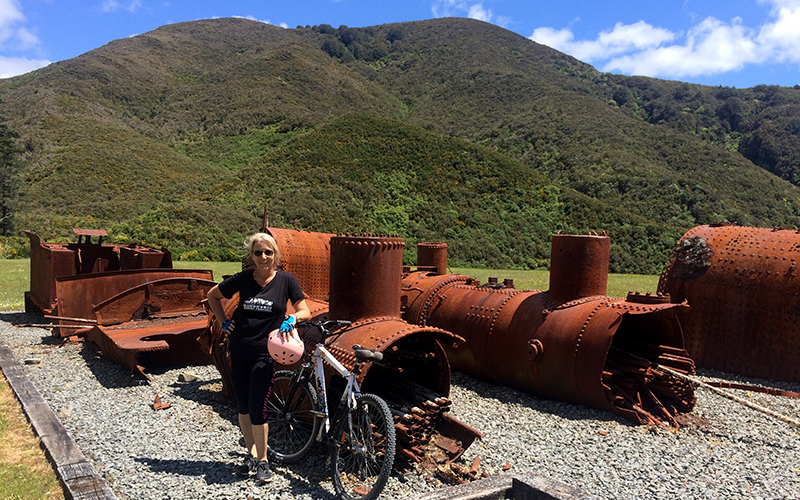
I rode alongside Lars’s ghost up through the lush Pakaratahi Valley over his 1870s bridges and culverts to the Summit, where we stopped, as he did, for water and a sandwich. When Lars sheltered from my imaginary wild storm of ’78 there was the beginnings of a settlement bursting with pioneering potential. Not for us – we walked among the rusty remains of long abandoned steam engines, discarded over the years and left to decompose in splendid ruin on the peaceful plateau.

In the icy Summit tunnel the third rail begins and the track descends steeply towards Cross Creek. Here I checked the logistics of my story, imagining the danger of exposure on the stretch they call Siberia where the winds (later, in 1880) were so strong they blew a passenger carriage and goods vans off the rails and down into the valley below.

For us on our bikes, it was an unusually still day. Half of my head was tripping along the raised rail with the gangers battling an historic gale, the other half enjoying a calm bike ride, almost 140 years later, stopping in the sunshine to read the old stories on the plaques posted along the route.

Ladle Bend creek bridge
Ladle Bend creek bridge on the Rimutaka Trail, c1891

“My father occasionally took my sister and me for a ride on a three-wheel railway jigger. As we all sat on one side of the jigger, it had a tendancy to upturn when passing around the many curves … I was always frightened going over Ladle Bend Creek Bridge as it was rather high and had no sides.” Ron Mitchell, child at Summit 1933-40

Ferry gliding – rafting the Mohaka

And ferry gliding old New Zealand style

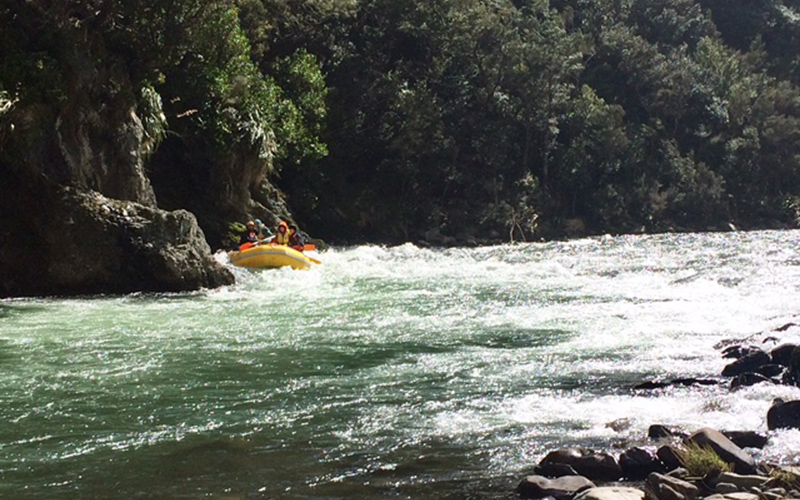
Rafting the Mohaka river is one of my great joys. Even on the cold and wet days, there’s a chance of a hot pool at a campsite.  On a good day, there’s sparkling water and picnics on the banks,  pirates and cliff jumping. And it’s always an education.

Last trip I battled against a new captain (sorry Barry!) for half a day before one of the other paddlers told me to relax and follow orders. Barry was “ferry gliding”, a technique I hadn’t seen before.

Rather than head the raft down the current, he kept the raft on an angle and let the power of the water push the boat across the flow from one eddy to another, crossing bank to bank with very smooth control.

Barry told us ferry gliding was a technique used extensively in colonial days for ferry crossings (hence the name). In the 1800s New Zealand rivers were crossed – in order of sophistication – on foot, on horseback, by canoe, by punt or a larger ferry and very occasionally by a bridge. Early colonial bridges were often pretty makeshift and were regularly washed away.

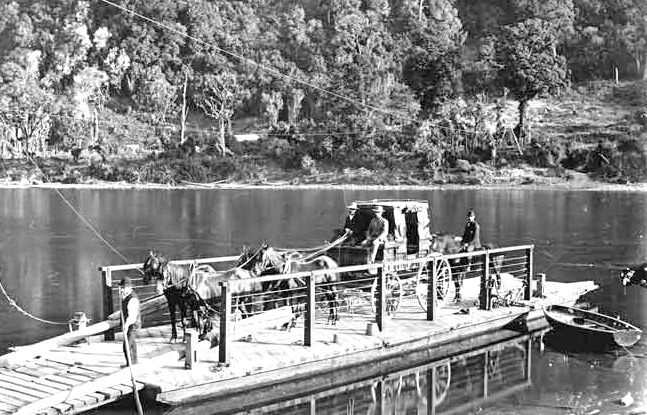
The punts were attached by a pully wire to a high cable hung across a river, and, as with our ferry gliding across the Mohaka, the flow of the river (or the pull of the tide) worked with the angle of the ferry punt to push passengers across the water.

Ferry punt on Buller River
Horse and carriage crossing the Buller River, South Island New Zealand in the 1880s

We willingly throw ourselves down the rapids in an inflatable raft with our life jackets, helmets, wetsuits, PLBs, maps & compass, the car and the trailer parked up at the end with a change of clothes, a thermos of hot tea and a comfortable ride home.   And we call ourselves adventurers.

Here’s an evocative extract from Wanganui Herald, Volume I, Issue 177, 26 December 1867, Page 2. It’s typical reading from the period!

An inquest was held this morning in the Exchange Hotel [Wanganui], before H. J. Perham, Esq., Coroner, and a jury of twelve, on the body of John CONROY, who was drowned off a punt on Friday morning. James HORNE said I am a soldier on leave I belong to the Royal Artillery; the last time I saw the deceased was on Friday morning about 7 o’clock on a punt going up to Waipakaka; when we got to Walker’s, at Aramaho, the deceased and I went ashore; I got a bottle of rum and we went aboard again, we then started up the river; we had got about thirty chains from Walker’s; Conroy said, boys, we’ll have a jolly dinner to-day. Conroy was at the bow of the boat; I was lighting my pipe, and had my back to him, when I heard a splash in the water; I rose to my feet, and saw Conroy about the length of the punt behind we then tried to back the punt, but he drifted faster than we could in about two minutes he went down with his arms up.

Toronto, streets and jazz

Impressions of Toronto walking by day, jazz by night

Toronto sprawls flat and is scratched with expressways, to the north of a great lake that is pretty much invisible from the city behind a barrier of industrial land, rail and roads.

It is mostly devoid of geographical features other than the gash of the Don Valley. This is crossed by a wonderful viaduct whose story comes alive in Michael Ondaatje’s passionate book In the Skin of a Lion, though this doesn’t feel like a city for authors.

We drove around similar looking suburbs for hours behind huge gas guzzling vehicles with single occupants (and wondered about their compensation issues) on busy four lane highways that swoop through Toronto’s grid of streets, past bunches of high rise condos and stores selling stacked cheap goods and through dirty, dispirited neighbourhoods. The occasional group of brick facade terraces – old houses which have been kept for their historical value – just served to emphasise what the city might have looked like if it hadn’t sold its soul to growth and convenience.

Public transport is accessible but old fashioned, and locals complain not joined up – city, district, state, national.  Take a metro ride just to witness the wonderful diversity of faces. Toronto’s trams are famous, they do the job of a subway above the ground and we jolted through the nicer part of town around Dundas and Yonge before a pleasant walk through the leafy and quiet University of Toronto. There’s old money and designer shops here. Some grand buildings from the early days of the city remain – they looked straight out of Glasgow, heavy squat stone churches, civic buildings and an old museum with a sharp glass extrusion sicking painfully out of its side, as risky as the glass pyramid in front of the Louvre in Paris and less successful. All framed by the towering glassy skyscrapers that cluster all over the skyline here. We explored the more youthful Spadina Ave by foot, the miles of poor shop fronts relieved by some hip fashion spots, through one of Toronto’s China Town’s (there are a few) and we sat on a trendy roof top bar in the muggy, late summer heat with a vibrant, smart crowd of after work drinkers.

Later, we went to The Rex and lucked out with the best of the city’s jazz – the Pat LaBarbera and Kirt Macdonald Quintet playing their annual birthday tribute to John Coltrane. Neil Swainson on the Bass was something else. A charming elderly bloke squeezed on our table and had an entourage passing all evening to greet him. He’d taught them all to play the sax. They’re friendly in Toronto.

We’ll make the effort to cross the tracks and see Lake Ontario and the city islands tomorrow.

Ortegia

and Syracuse in Sicily

The thin ribbon of tourists ripples from the bridge up the main shopping street to the Cathedral and down Via Roma right across the island. We are in Otrigia, the small island which is the historical centre of Siracuse in Sicily. This is the birthplace of Archimedes, and one of the prettiest tourist towns I’ve ever visited.

The first thing you notice, especially after a weekend in rather grubby Catania, is that this little island town is absolutely spanking clean. It is built of white marble and rubbed smooth, not only with the passing of so many feet but professionally scrubbed and polished. There is no graffiti, where the occasional ancient stone work joins brick and plaster the transition is smooth. The crumbling bits are shabby chic.

It is early September and tourists are sparse compared to the hordes of Rome and Sorrento. Step away from the main trail and the small alleys winding the gully between whitewashed houses are full of large leafed pot plants but empty of people. You get that ridiculous tourist thrill of thinking you have discovered the real, old Italy, but the locals pull up on scooters and unload their shopping in bulging plastic bags and look at you as if to say – your patch is the main road, why are you here?

We go looking for authenticity, but of course there is no real Ortigia, no original people, you can go back through the layers of time to trace a tide of invaders, settled until the next lot arrived. The current invasion of tourists spend in the restaurants and shops and marvel at the Cathedral, where the Roman stones mould around the Doric columns of the earlier Greek Temple, there are echoes of Arabs, Jews and centuries of other worshippers here.

At the point of the island, cannonballs are strewn around the castle like balls of ice cream, dropped on the ground thousands of years ago.

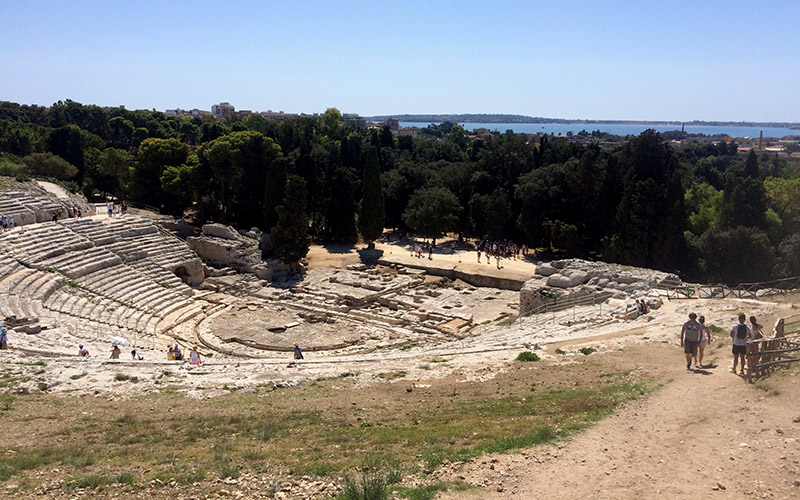
We walk the circumference of the island one day, and the next go over to the main city of Syracuse where the Greek and Roman amphitheatres lie side by side on the hill. It’s wonderful to imagine the intelligent Greek orators in this vast open space informing and entertaining the theatre goers. It’s very different feel to the Roman ruins where the crowds were entertained by brutal gladiators spurting blood.

Greek ampitheatre

Walking the Amalfi Coast

Thousands of steps

The Amalfi coast consists of battered marble stairs that thread around and under houses and go up: irregular, steep, connecting across the winding roads and hundreds high, then a corner, and another hundred and a corner and a few hundred more until you collapse, exhausted at the top of the world with far more sea than you could ever view from the ground.

Everywhere is a walk down or up – hard on the knees but good for the heart, and what starts as breath talking surprises becomes the expectation: whitewashed houses built into outward leaning cliff faces, a ledge of rock holding an exquisitely proportioned church, a scrap of near vertical land terraced with lemons, a view that reaches from Capri along the whole stretch of the Amalfi Coast.

From a height, the towns are rustic and their history obvious, goods flowed down to the port for trade. Olives, figs, lemons, tomatoes. On this coast there is no flat land, so the little villages fill the crevices in the steep hills upwards from the sea. The stone steps of the original paths have remained, too steep to evolve into roads, and the narrow roads overlaid, following the contours, stuck into a crack of a cliff, best driven at speed in an Aston Martin with dark glasses and a movie star smile.

Close up, the towns are now a setting for tourists and the mishmash of joined houses clustering the port sell sandals and cool linen clothing, jewellery, pottery painted with lemons and sun hats to an international crowd. If your idea of heaven is a restaurant with a fine sea view and fresh basil, tomato and mozzarella on the menu, go to Positano, Amalfi, Praiano, Atrani, Minori, you’ll dine with the gods every day.

If you’re walking (do some hills before you go), take the Sunflower Guide and follow their descriptions of the paths, there is no detailed map that can guide you along the path in the direction of the single island and up the narrow pathway to the left of the church until you find the wooden fence by the olive grove. You need that level of detail and it helps, as you’re climbing, to imagine a future life when your job is a full time checker of Sunflower Travel Guides. We didn’t see anyone else with packs walking from town to town – busses are everywhere, but I would do the same again. Felt like a pilgrim.

Amalfi to Ravello is at least 1500 steps with long steep paths. Most people take the bus but the very few of us on the path recognised fellow heroes. There’s a beautiful pause when you reach the shelf that holds the gardens of the the Villa Cimbrone on the edge (very edge) of Ravello. A step further and you’re flying. Ravello is an impressive, established town that looks, from the coast, like a couple of houses, but the town unfolds as you crest the peak to a thriving hub with several large churches, a sunny piazza and busy streets. Ghosts of Virginia Wolf, Gore Vidal, DH Lawrence, Wagner give a good, boho vibe.

We kept walking inland, up yet another 300m staircase when we were already on top of the world, and skirted the Lattari mountains on a mule track back to Amalfi, inside the deep limestone bowl of towering cliff faces.

The most famous track, with tourists to match, is the Path of the Gods, which starts with a bus trip up the cliffs to Bomerano and ends, several gods later, in a million steps (not really a million) down to Positano.

My absolute number one walk was from Colle di Fontanelle to Sorento via Sant’ Agata, a glorious ramble on the rugged land’s edge where cliff meets high pasture and terraces, right across the peninsula with occasional views on both sides and no other tourists. The path led through a couple of small towns where kids played football in the square and ancient three wheeled vehicles laboured up the hills.

This wasn’t on my bucket list but I am ticking it off anyway. You feel the Gods all across this region, but on this track “ZEUS WAS HERE” is carved into the stone.


Storms and busses on Capri

Long drops to the sea

There’s a funicular in Capri from the marina to the town. The island has no flat coastal land, everything is up. To a kiwi the funicular is a cable car, and their cable car up the mountain a chair lift, but it is a cheap and fun way to get around so up we go.

Capri town is white and fluid, one holistic shell with alleys and tunnels running off the central piazza with no straight lines. The interlocking spaces are cleanly whitewashed, with chic boutiques selling international brands to beautiful people. You can watch them while you eat bitingly fresh tomato salad and guess who is buying and who is wishing. I used to think white clothes separated the money from the backpackers, but white dresses and shirts are everywhere here.

Anacapri, the other town on the island, is further up again. There is one road. It cuts across a sheer cliff face, and if I say it is the width of two busses wide, even with the truncated mini busses of the island, it sounds more generous than it feels. Passengers have to suck in their stomachs and even then there is barely a millimetre between passing vehicles. It is a jaw drop to the valley below. In the bus you are standing above the parapet and the camber of the road leans you out into space. This mountaineering by bus is quite normal and is done at speed.

I’m getting better at heights, but felt physically ill on that bus.

We walked from Faro along the length of the west coast to the Grotta Azzura, and left the tourists behind. We passed only one guy on the walk and he was from New Plymouth. On the road less travelled, it often is a kiwi. It’s an easy 10km walk on an ancient stone path between olive groves and baked terraces and rocks of extraordinary knoblieness, with history, geography and always the Mediterranean Sea and vast sky. There’s a kiln where they burned the marble of evil Tiberius’s palaces to make white wash. And good riddance to him (I’ve just read Robert Graves’ I Claudius. Haven’t eaten a mushroom since). It hadn’t rained here for 100 days (I could fill a travel book on places I have been that haven’t rained for 100 days) but we got hit by a torrential downpour that had us cowering for fear of the lightening directly overhead. Under the tree or away from the tree? Couldn’t remember. We dried off as we walked and watched the second hit come across the sea to smash the island, forked lightening and instantly booming thunder and such water that turned the stone paths into storm channels and the road into a river.

A bus came through the deluge and picked us up as we clung to the rails on a stone wall.

Drowned rats, mad dogs, happy humans.

Faro Lightbouse Capri


Travelling light (makes me smug)

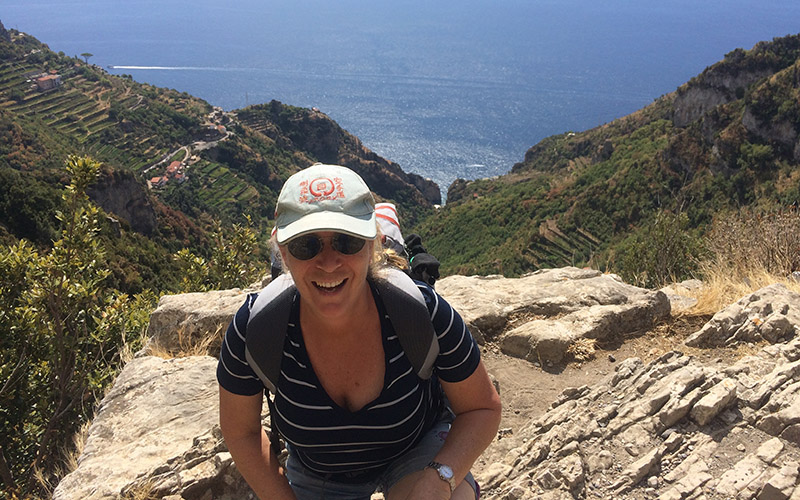
On the way to Amalfi

The kids are impressed. They’ve travelled Eastern European winter, South America, Thailand with cheap school bags, but I still get the nod for my small back pack.

Three socks, three knickers ( surprising the number of people who ask this), three light shirts, one each of sundress, shorts, mini, nighty, cap. Towel, swimsuit, sarong (more on the sarong later!). Tiny bag of moisturiser, sunblock toothbrush & paste, hairbands, deodorant. Laptop, phone (with books downloaded), passport, card.

I meet a friend at the airport who congratulates me for my frugal packing and I’ve taken a photo of my Kathmandu day bag sitting, cute, on the chair beside me. Hope smug still feels good when I’m hand washing every night.

I am off to the Amalfi Coast to walk The Path of the Gods, a narrow trail of volcanic rock that goes from village to village high above the Mediterranean Sea. Thousands of steps to look forward to.  So, no wheels on the bag then – they wont be going round and round on that terrain. Light as possible.

There’s a balance between travelling light, and only having one pair of shoes to go from mountain to restaurant.  But I figure if I need more than trainers,  they have pretty sandals in Italy.