
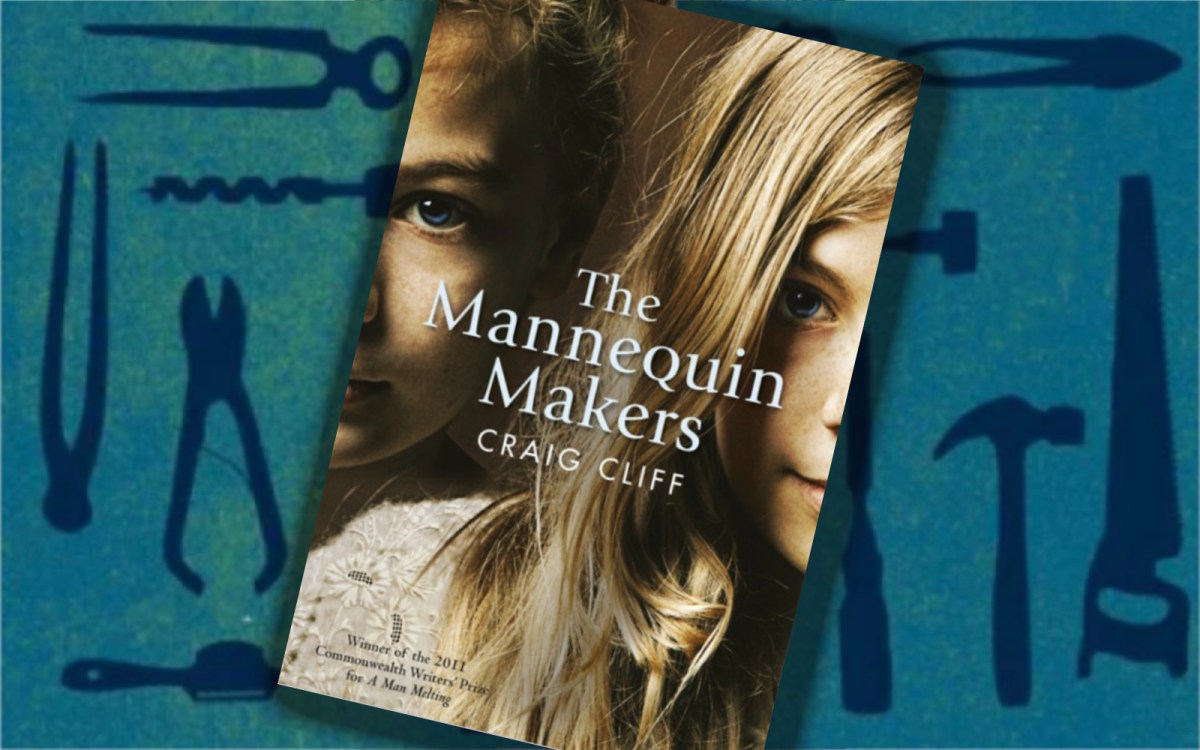
I’m always delighted when I find a terrific New Zealand historical fiction from the past that I’ve missed. The Mannequin Makers was published in 2013 by Penguin and now on my list of top NZ hist fict to recommend. This is no sweeping saga of real events, rather a strange small town rivalry that mostly takes place in a shop window. With mannequins. Sounds quirky? Well, yes, in the sense that the story is unconventional and miles away from the usual immigrant saga, but it thankfully misses all the usual shit that comes with ‘quirky’, there is no manufactured cheesiness or forced charm, no ‘found family’ of misfits. Craig Cliff soars above all that.
Our mannequin makers, Colton Kemp and a newly arrived man called The Carpenter, are rivals in a country town called Marumaru in the early 1900s, dressing windows on opposite sides of the street.
Kemp is full of despair after losing his wife with the birth of twins. He closes his house to the world, declaring the babies dead and, with his strangly docile sister-in-law as a co-conspirator, raises the children in an alternative reality. Realising the mannequins he makes will always be inferior to the more skilled Carpenter’s beautiful woodworks, he trains his secret children to pose, inspired by a circus strongman who comes to town with an act of controlled and developed muscle power.
The story switches to Kemp’s daughter Avis, who believes the fiction that all children must prepare for their time in the window in total seclusion and only then will they reach maturity. She and her brother are exercised and groomed together and taught not to blink. Unfortunately for Avis, maturity comes early.
We switch again now to the view of our other mannequin maker, a carver of ship’s figureheads living on the docks of a town on the Clyde in Scotland. This backstory is a big diversion, possibly a detraction from the gripping main story but I thought an excellent tale, beginning with a man shipwrecked (as many good stories do).
A mass of canvas was washed over me, covering me like a bed sheet. The topsail and its spars must have come away with this section of mast. The sail was pulled back as the mast swung slowly to leeward. I managed to lift my head and catch one last glimpse of the ship as it tottered near the horizon before I closed my eyes and lowered my head to the mast.
An excellent start to all our man’s trials at home, some wonderful passages at sea, on a remote island with no one to talk to but the ship’s figurehead, which is one of his own. He calls her Vengance. He is rescued by the Hinemoa, a historic NZ ship that wandered the Sub Antarctic at the century’s turn looking for shipwreck survivors. He ends up walking into Marumaru with his chisel, and we’re back where the story begins.
This is a story full of weird contrast: inanimate objects that have life and real children who pose as objects. No wonder The Carpenter is confused. “I knew when I started talking to Vengeance that it was all in my head. But since I had lost my voice, my thoughts were all I had. Then there was the question of Vengeance’s unlikely reappearance in my life. The inkling that she was more than met the eye. That she had a spirit or a spirit dwelt within her. She never let me catch her blinking or scratching her nose, but she seemed to be engaged in mischief. Her expression of stern forbearance and poorly suppressed rage had softened until it was almost a smirk.” Later he stands in front of the window where Kemp’s children pose for hours as mannequins. Did she blink? Did he tremble?
This is one of those stories where it is so strange it feels like it has to be true; why would someone make this up? And yet, Craig Cliff has. Bizarre and totally wonderful, one of the most original stories I’ve read in a long time.

 Cristina Sanders' blog