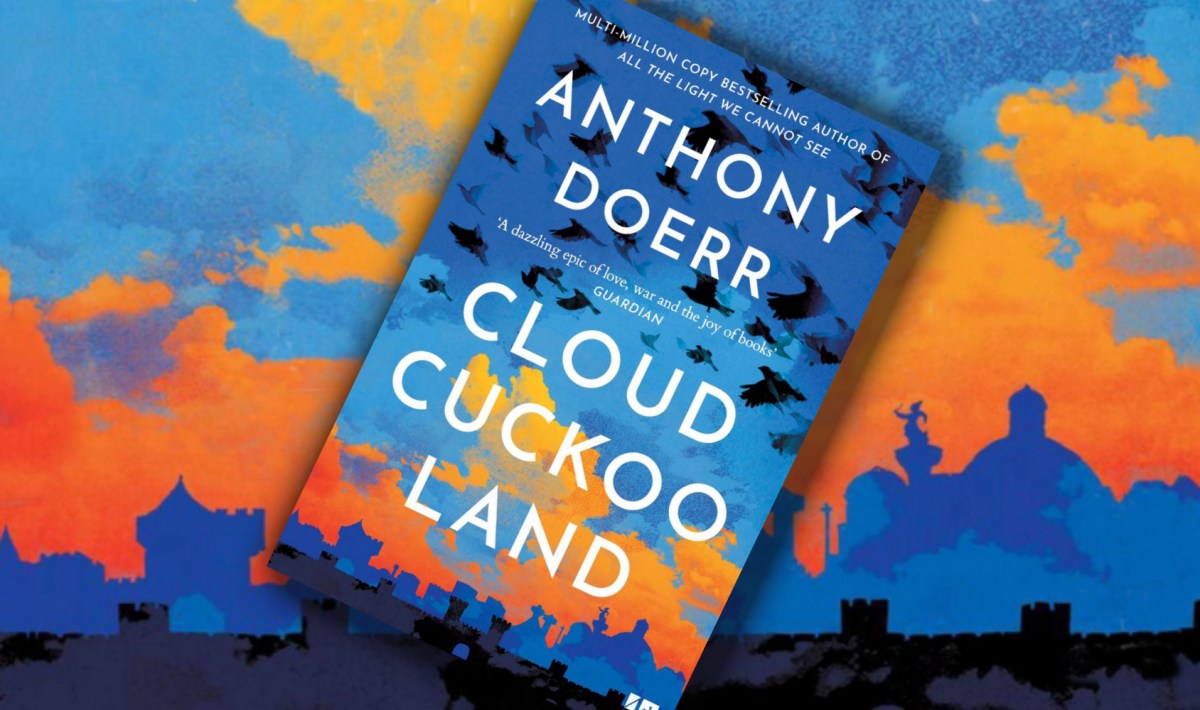
It took me a couple of attempts to get into Cloud Cuckoo Land, and I feel no shame in giving up initially after the first few chapters because there are half a dozen seemingly unrelated stories going forward or backward in different times and vastly different locations. If you want a put-down-and-pick-up story, this is not the right book for now. I came back with more patience, reread from the start and was slowly hooked. It’s absolutely worth the effort, but…
I’ll explain.
There are six individual stories in this book. Well, five stories and a background fable that they all relate to in some way. More on the fable later. They’re kind of short stories with a main character and good plot involving challenges and complications and developments and a resolution. And all terrific. They’re told in short chunks, one switching to another every few pages so you need to keep your wits about you – as I say it’s a book you need to read in long sittings unless you have a very smart head.
It would have helped me enormously if the publishers had thought to put a quick precis at the start with characters and era, like you get for War and Peace when you’re trying to work out the nicknames of all those Russian nobles.
So here you go, I’ve done it for you:
Zeno (present day Idaho) is an old man putting on a play (of our fable) with a bunch of young children in a public library. His story jumps around a bit, childhood in a sad home with step-mother, youth as a POW in the Korean war. He’s obsessed with translating the old Greek text.
Seymour (present day Idaho) is an engaging youth with a social disorder and anxiety, but we meet him planting a bomb in the Idaho library. His story takes us back to the build up to this event.
Anna (15th Century Constantinople) is a charismatic young girl in an embroidery workshop with lots of spunk and street smarts. She hunts old manuscripts for money.
Omeir (15th Century Bulgaria) is a boy with a harelip, loved by his family but shunned by suspicious outsiders, who gets conscripted into the Ottoman army on their way to sack Constantinople. He travels with his two beautiful oxen, Moonlight and Tree (oh, my heart!).
Konstance (Somewhere, sometime in the future) is a young girl aboard the spaceship Argos, heading for a colony generations away, living with her mother and father, with access to an AI library, under the omnipresent AI, Sibyl. No spoilers here.
Keep that for reference and you can jump straight in to the stories and not get too lost.
But, back to our background fable, which is cleverly strung along within each story, and every character playing a part in saving the text from oblivion. Here, our bumbling hero, Aethon, is on a quest to find a mythical city in the sky. His story is slowly revealed in scraps here and there, much as a battered up old manuscript might be carefully unearthed and reconstituted, fragment by fragment. It’s as silly as ancient legends are apt to be, about a boy who is turned into a donkey and then a fish and a bird, but charming, for all that.
Now I might get shot down for this and if you don’t want criticism of a book you love then look away now. But when the story strands all started coming together and I realised what Doerr was doing with his plot-weaving and fable, I felt a little contrary. I came out of the story and saw the mechanics behind it, a bit of a Wizard of Oz moment. I began thinking about what an author does after an enormous success (All the Light We Cannot See sold 15+ million copies) with the next book, which has to be big and bold and clever. It has to mean something. The idea of a fable surviving, against all odds, down the centuries is a good one. But, by turning the fable into a kind of relic, we get a bit of the hackneyed ‘all stories are magic’ theme which simply feels sightly platitudinous. The holy power of libraries is central in four of the five sub-stories. Doerr even dedicates the book: For the librarians then, now, and in the years to come. It’s a bit of a lesson, dear reader, with the moral of the story spelled out in case we missed it. Yep, stories open up new worlds and libraries are good.
Perhaps what is bothering me, also, is that like All The Light We Cannot See, the plot and characters are so tightly contrived and worked that we lose a bit of the joy of the story. I like stories where the writing feels a bit out of control sometimes. A character who goes off script.
Enough of the negative, I really did find this a fascinating book and the stories it contains are compelling. I feel a book with this high a profile can take a bit of critical analysis. Other friends all loved it.

 Cristina Sanders' blog