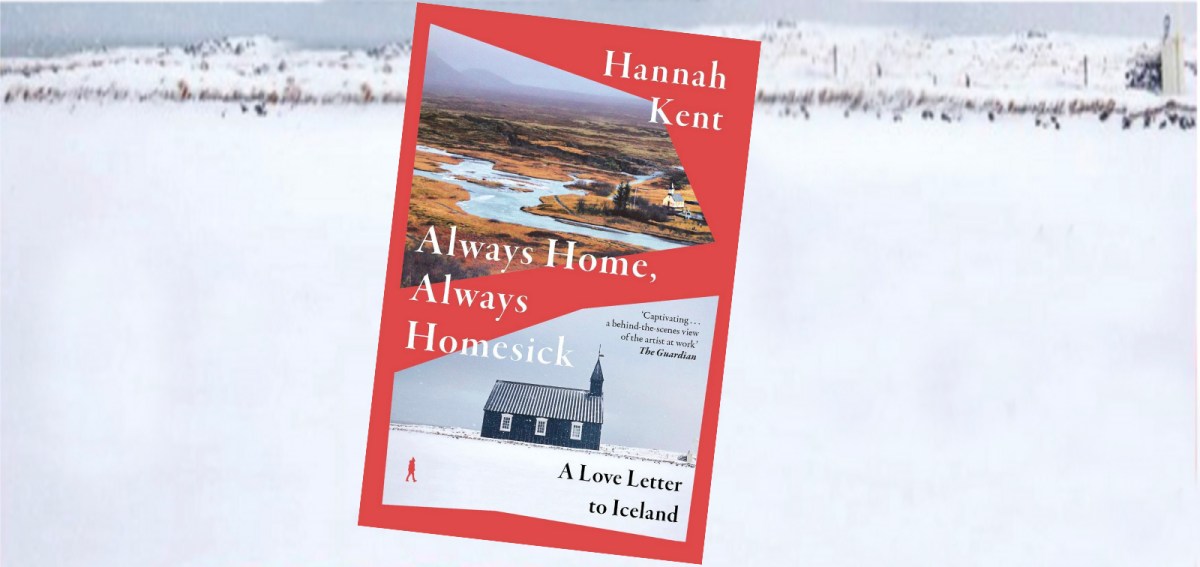
Why fall in love with Iceland? Hannah Kent counts the ways. As a young Australian woman she picks up the default option of a Rotary exchange to Iceland, spends the first few months in a cold house with a cold family and an inhospitable frozen land, but after a while, both Hannah an Iceland thaw. She works hard to learn the language “my conversation has always been pockmarked with grammatical error and the foreigner’s manner of jamming in known vocabulary at the expense of clarity and precision”, makes some friends, and moves in with a new family who became her greatest support and friends for life. She falls in love with Iceland itself.
The first thing I should mention is I love the texture of Kent’s writing. It rubs up against you purring and then leaps off to play. It flies. She talks of her growing love for the culture and the land. “I look out to the town below, glittering in the darkness, then the soaring mountains behind me. My bones have knitted with this place. There is a quiet exchange of marrow between us now. I wonder if I will ever come back.” She does, of course. “When I walk down to the shoreline I see puffins on the water. Later that evening I see the lights of Knútur’s tractor harvesting late into the night under a sky emerald with aurora.“
This is more than a holiday romance. There is real passion here.
Long and short, Hannah Kent returns to Australia and writes a book. Burial Rites. Its about a murder in the early 1800s on a remote farm in Iceland, and the condemned woman who waits a year in a small community until she is beheaded in the country’s last public execution. It’s full of Iceland in winter, a compelling story made superb by the tight, atmospheric writing of place.
So, what does it mean for a young Australian woman to take on such a dramatic and important piece of national history and to dig so deeply into a culture not her own? It is, we discover, not a step easily taken. In this descriptive memoir Always Home, Always Homesick, Kent examines her credentials and her doubts that lead to the writing of Burial Rites, and how she negotiates the success, author tours and discussions that come afterwards. It is a fascinating process, thoughtful and balanced. An important book, I think, for writers tackling stories outside their born culture, a consideration of the complex concepts of who owns stories and how they can be approached from different angles with authenticity and the angst that comes with giving yourself permission to step into another’s head.
Some of it is academic and she references Margaret Atwood and other writers who step across boarders. She doesn’t give any magic answers. You get the impression this is, as of course it must be, an ongoing process. “The idea that one might, through creative dedication, enable one’s own belonging is much more interesting to me. I know there are things I will never write about – boundaries exist and must be respected; I am not, nor should I be able to speak to all spheres of experience – but I quite like troubling any binary categorisation.”
Mostly, this is a story of a young woman being utterly absorbed by a foreign culture. A kind of coming of age though the learning a new language and total immersion in friendships and stories so alien to those she would find at home. I’m left with the feeling that in making these efforts she has doubled her capacity to understand the world. She is at home in two places, so different geographically, historically, culturally. Lots to love in this book.

 Cristina Sanders' blog