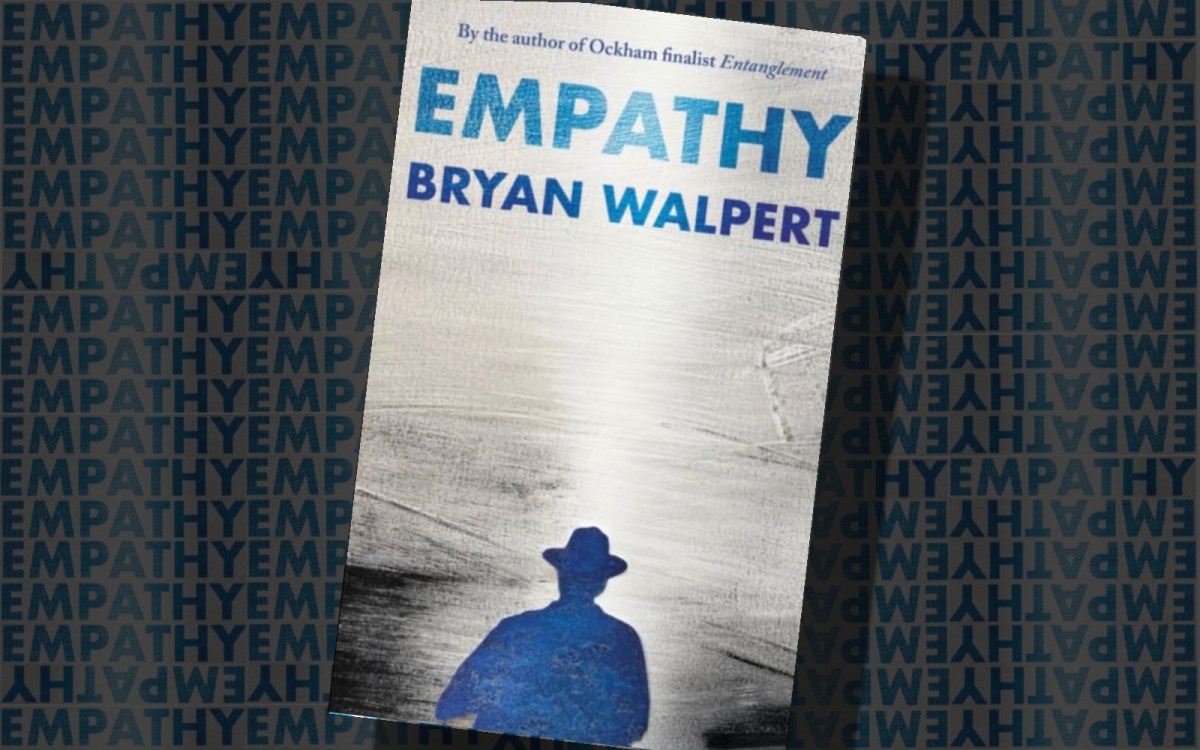
Empathy, I think, is one of those words that is overused and misused. It’s often used to express feelings of compassion or pity, though is not the same thing at all. Empathy is not a matter of expressing how you, too, have strong emotions that are similar to another’s. It’s a vicarious thing, it’s about letting go of your feelings and experiencing those of another person. And empathy applies to more that just pity, as Bryan Walpert explores in his intriguing new book, Empathy.
This book starts with a bloke getting shoved into the boot of a car. He’s elderly and taken by surprise, but clear-thinking enough to work out how to leave his DNA behind. Edward is a chemist. He works with perfumes. He doesn’t seem the type to be a victim of foul play. When he doesn’t come home after a few days, his son, a widowed solo-dad, has to chase up the lackadaisical police. His home has been broken into, he’s been threatened. And his dad isn’t some doddery old bloke who would walk off and get lost.
Son David has lost his wife, but Molly is constantly in his mind, reminders of her everywhere, their empathy still strong. He imagines what she might think or do in any given situation. It’s a compelling portrait of grief, of a man getting on with raising his two kids, working and holding it all together but unable to let go. His kids are struggling, too. The search for his father leads David to a perfume house for which his father was doing some product development.
The perfume house is a shambles. We switch narrators again to Alison, who’s not a likeable character, cynical and frustrated with misogyny in the workplace and her husband who is not, she feels, pulling his weight. There’s no sign of the intoxicating glamour the perfume bottles promise, either in Alison or the perfumery. There is bitterness and bullying and resignation as the staff sit around trying to come up with a name for a new perfume. It’s a perfume for men and women to share, a promise that with this scent, a couple will come together. Perky names like ‘Affinity’, ‘Empathy’, ‘Alliance’ are all taken. Alison, bored and unimaginative, comes up with ‘Forbearance’, perhaps reflecting on her own marriage. Surprisingly, her colleagues take notice. She’s promoted (probably beyond her competence) and given the remit to create something special, to turn the perfumery’s prospects around.
Alison is supporting a husband who has given up a dull job to follow his dreams of creating computer games. They’re struggling for cash. Like Alison’s perfume, he wants to create something that brings people together. His game relies on one player trying to read the other, success comes through empathy. I like the concept, a challenge that escapes the competitive schadenfreude of almost every other game every invented. And although the game (to me) feels derivative and still features baddies offering violence, it catches on. Building empathy with a stranger through a computer game is a strange concept, as is finding empathy in a scent. Can empathy be manufactured?
Back at the perfume house, they are spinning a story around ‘Forbearance’, trying to make the word sound sexy and compelling. Vanilla, coffee, jasmine notes – there’s a wonderful under-fragrance that permeates this whole story. But ‘Forbearance’ needs an edge. And Alison finds it. It’s just a little addition to the formula – not a drug as such, they’re not drugging people – but a chemical formula that, when smelled, induces feelings of empathy. There’s science here: “In one study, the scent of lavender promoted participants to give more money to someone than other scents or no scents did. Hexadecanol, an undetectable part of body odour, reduced anxiety. And hexanol–found in both body odour and lavender (and which can be undetected or, when detected, smell like cut grass)–was fund to increase trusting behaviour.” Alison’s colleagues agree. “If it’s feasible, it could be kind of brilliant.”
I love the thought of magic potions – the ingredient in so many fairy stories – just one sip and the first person you see will love you forever.
I need to be careful not to give spoilers here, but the story picks up thriller-style with the unfolding of what Edward the chemist creates on Alison’s specification and the consequences. We all know that magic potions work as instructed, but never as anticipated. How does empathy play out when positioned against compassion, pity and love? When used as a power? Be careful what you wish for.
I have to admit to feeling emotionally exhausted after reading this book! Great read.

 Cristina Sanders' blog