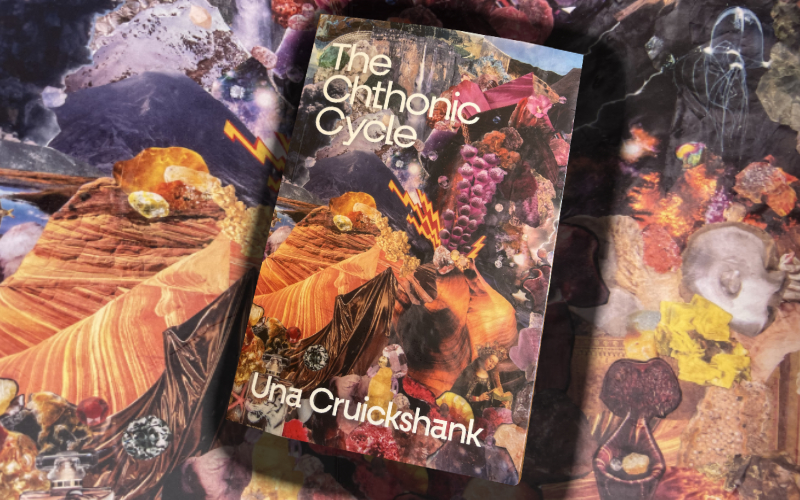
First a huge congratulations for the presentation of this book and it’s glorious fold out covers, featuring Sasha Francis’s artistic impression of its themes. It sums them up, natural forces, re-birth, jewels, fossils, water, all strewn together across the page, interconnected and tantalising. Most of the stuff pictured I don’t recognise and nor would I if it were under my feet – how many of us have walked past a lump of ambergris in the sand or sat on a rock hiding a small fortune of ammonites? This book is full of things you may have missed.
I thought initially that, despite its pretty cover, this was a science book. The ammonites get early billing and we learn how they were molluscs whose soft bodies were protected by a distinctive coiled shell. Already I’m on their side. Cruickshank explains how they become fossilised, and how very few things do turn into fossils so it’s amazing we know any of our distant past at all. Then the philosophy and the poetic language kick in to lift the text and it becomes more of a poetical story (in a good way), wandering through natural science and wondering about the meaning of things. We are told that most of the book of life was destroyed before we arrived, just to put us in our place, ie. not special. Learning to think in millions of years is described as a vertiginous experience. We look at fossils history past those who have previously handled the rocks to much, much further back in time, both ammonites are swimming, propelling themselves through the sunlit epipelagic zone of a long-vanished ocean, in search of prey or mates. Hello cousins.
Who picked up the first piece of ambergris and thought, horrible smell, maybe we can use it for perfume, or as an aphrodisiac? I’ve always been fascinated by the idea of ambergris, such unlikely extreme wealth, like black tulips. Apparently it is basically whale shit, formed from mucus and backed up faeces in the whale’s intestine wrapping around the indigestible parts of a squid. Eventually the whale either passes the blockage or dies of an intestinal rupture; the result is ambergris, and it’s ‘worth’ between 10,000 and 14,000 euros per kilogram. Cruickshank compares ambergris and amber, both substances that wash up on the shore, often historically mistakenly related and misunderstood. A Chinese writer in the mid-13th century, Chao Ju-kua, stated that ambergris was the hardened drool of dragons who slept on rocks in certain seas. History, science and legend fascinatingly entwine.
There is a weird religious story about a genderless reborn preacher; a lovely story of the science and history of jet (ingredients: wood of the araucaria tree, salt water, shale, petroleum, epochs); the birth, life and death of the Crystal Palace; pearls and their creation, history, trade, and how to colour and value them; Jacques Cousteau; corals. Cruickshank went to see coral in Egypt.
The Blue Hole was the most beautiful nothing I’ve ever seen. I still think of it sometimes when I hear the word mystery.
There are questions asked about animals without brains – does the violence done to polyps cause emotional distress? How hard it is to empathise with something so alien. Which leads on to bigger questions:
What is a mind, and why can’t anybody figure that out after centuries of trying? Can you have a mind without a brain? Senses without organs? Is it true that humans have brain cells in their stomachs and that octopuses have them in their arms? Do I even care what it’s like to be a bat?
I love these kinds of questions and I empathise completely when Cruickshank talks about her writing, starting with a small ambition leading to ruin as ideas spiral and grow only to find the Blue Hole is limitless. She’s exactly the sort of brain you want to be holed up with in a tramping hut with a long evening ahead, a hip flask and rain outside. Who’s got a question to spark a conversation? I’ll bet Una Cruickshank has.

 Cristina Sanders' blog