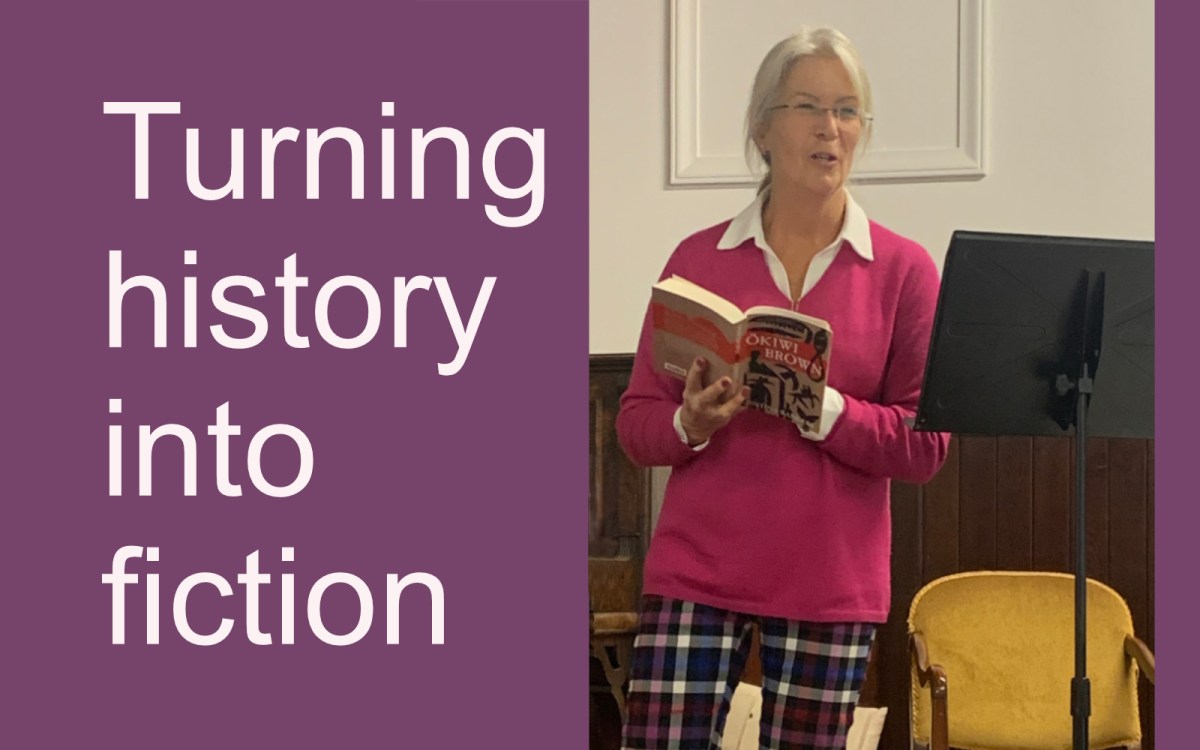
I was delighted (slightly nervous) to be invited as the guest speaker at the Historical Society of Eastbourne AGM, 24 August 2024. Thanks to Julia Stuart and Dennis Davidson for the opportunity. The text of my presentation ‘Turning History into Fiction‘ follows.
I have been very encouraged by the interest into my story of Ōkiwi Brown. I am always delighted when people want to explore different ways to connect with their history. Today I’ll go behind the scenes on the concept of turning history into fiction.
Before I address the main topic, I want to talk briefly about the spark at the start of all historical research, the impulse to take an event, a person and dig deeper. Why this topic?
Ernest Hemmingway asked of writers: what are you curious about?
If this were at a sci-fi convention, or a fantasy gig I guess the answer would concern the rules of physics, about portals or time travel or other dimensions. If you were Romance writers you’d be curious about the concept and the mechanics of falling in love. Mystery and crime writers are curious about order and patterns. I think I’d rather not know what horror writers are curious about.
But history. You’re all historians here – or historically adjacent….What is it specifically that sparks your curiosity in a piece of history? What sets you off down your particular rabbit hole – chasing a story?
Many people are curious about ancestry and whakapapa, which can help them find meaning and connection to wrap around their lives. Or, your spark might be geographical – a story on your local beach. There might be an area of study that has fascinated you for years, since school perhaps, when your curiosity was first piqued by military history, or polar exploration. You might light up with a whiff of political history –women’s suffrage, indigenous stories?
For people interested in history – and I feel I have a bit of a captive audience here – you’ll probably have this frame of historical interest, and will light up when something comes inside your orbit; your curiosity immediately wondering how you can make sense of some new information, how it gels with what you already know of that time and place.
For me, my ‘framework of historic curiosity’ if you like, was formed by a coming together of two things. I grew up in a bookshop as Julia mentioned– my parents had the Gateway Children’s Bookshop in Wellington – and in the 70s they were importing books directly from England and most stories seemed to be about Dickensian London. In my head I really was a Victorian orphan. Then about fifteen years ago, unsolicited I was sent our family tree, which opened up this new interest in New Zealand colonisation and I was a bit surprised, but thrilled to find we had a Victorian era here, too. All those weird Victorian social attitudes, plus cobbled streets and gas lights and orphans! were now combined with whalers and Māori and harbours that I knew personality, with a backdrop of bush and mountains I had tramped through…
I can’t help wondering what Dickens would have made of this place?
But then Victorian men, who were in charge of recording the stories, were supreme spin doctors and I am by nature, a bit of a cynic. My curiosity is often sparked when a piece of history I am trying to fit into my frame of understanding sounds a bit off. I often think: really? How true is this story, who told it, and what might we be missing in this telling? How would it feel told through another lens? What would give the story a very different connotation?
For example:
- The colonisation of Wellington told through the eyes of the company’s book keeper. [Jerningham]
- A shipwreck from the perspective of a Victorian woman. [Mrs Jewell and the Wreck of the General Grant]
- A man implicated in two murders who may belong to another, even more horrific story. [Ōkiwi Brown]
With that addition and with those altered perspectives, the story changes.
I am curious about historical events that might have been written into a rut, and wondering if, imagined through a different frame of reference, they might jump out of the rut and tell us something new. That is something that historical fiction can do very well. Sometimes I think getting a different perspective on an event is the whole POINT of historical fiction
My Õkiwi Brown adventure began for me when Julia Stuart sent me her research notes on the trial of our man, and I got that feeling again: there’s something more to this. I felt the urge to dig a little deeper.
So I came down to meet her and she took me for a walk, and introduced me to murderer’s rock. Do you know it, along the coast here? Who was this murderer, and where did he come from? Creepy. I think if something’s going to make you curious about a story, climbing over a lump of stone called ‘murderer’s rock’ might do it. Perhaps she knew that. Thank you Julia, for spiking my curiosity about your local history, that led me to being here today with my book.
I want to talk briefly now about the culture of stories – specifically historical fiction.
One way that we, as humans, organise our experiences, make sense of them and make them memorable – is to craft facts into stories. Even if there is no inkling of any kind of structure to go with our facts: if we just have some relics with no corresponding witness reports or even a time-line or context, we will try to invent an account of what happened.
As soon as we have a bunch of human-related facts – a collection of old bones or something, we try to create a story around them. Who owned these bones? What culture did they belong to, how did they live, what did they eat, what did they believe? We’re trying to find empathy with them, to discover: in what ways were they – the person who stood up in these bones – in what way were they like us?
Bundles of bones aside, most modern-era history comes from stories we are told by people who were engaged in, or witnesses to an event.
History, back in the days before it became ‘history’, was just ‘lived experience’ for someone with a bias for what they were witnessing or experiencing – it’s their point of view obviously. They might have a particular agenda…a bit of spin…(it wasn’t my fault…he was asking for it)
Or our witness might have had dodgy eyesight, possibly they were stressed or sleep-deprived at the time and unable to witness carefully…a witness might a bit dull or drunk or otherwise not in full control of their already limited faculties. So then our witness’s experience (of this piece of history) is communicated in words – written or oral and probably not organised very coherently at first telling – it could be a blurt to a friends, or a formal testimonial. They may retell the story so many times the truth becomes stretched. Their framing of the event, then, is put out there in the world, to be misinterpreted, reimagined, discussed, altered and retold by others until a historian gets their hands on the material and manipulates the story to fit the parameters of an historical publication, which again will have a bias, an agenda etc etc.
We are a long way from the original experience now. Then, finally, a film is made of the event featuring Mel Gibson. Somewhere along that continuum, history turns into fiction and I would suggest that the corruption begins right at the start.
Because who is the perfect, omniscient witness to any event? How many of you – who I can tell are unwaveringly focused on me and this talk – have failed to notice the gorilla going past behind me bouncing the basketball? Modern research into witness statements in court has proven that eye-witness reports are notoriously unreliable.
What I’m getting at here is that there are flaws in the way we witness, and also in the way we remember, record and curate history. History is not fact.
I realised, in a case like this, my story of Ōkiwi Brown, we may never separate historical truth from the legend that has grown up around the man. This does, perhaps, free up a fiction writer to reinterpret the facts and fill in the gaps in a more creative way that a more structured and corroborated history might.
So, with all these problems with historical truth and fact, why would we deliberately misrepresent history as fiction?
I’d argue that we do this without even thinking about it. At the most basic, giving history a narrative structure satisfies our need to have facts organised in a recognisable pattern. If I ask you what you did in your holidays I’m not expecting an itemised account with proof. I want a story. We went to the Sounds, to a bach in the bush, Billy caught a big fish, I swam right across the bay every day, weather was lovely, we came home yesterday.
You’ve layered your history over a conventional structure: beginning middle end, setting, characters, some plot points, probably exaggerated. Maybe the fish was a tiddler. Maybe you didn’t swim all the way across the bay. Not every day. But you’ve turned your history into a satisfying, narrative story and met my expectations. I am unlikely to say to you … that’s not true.
History is usually told like this, with a beginning in a known world, an inciting incident, drama and difficulties that characters overcome to progress through to a conclusion. The exciting bits are stretched out and the dull bits skipped over. Anyone who has done a creative writing course will be familiar with the Hero’s Journey, and nearly all stories of human history can fit around this structure of a journey – either physical or emotional.
There is no one correct history – it looks different to everyone depending on where they’re standing. Historians gather and reinterpret presumed facts and present them in an easily digestible manner, and as readers we favour the historians who write to our reference frame.
But, I admit, historical fiction is taking the interpretation a step further.
And to be clear – I’m not talking about the kind of novel here where you use history as a backdrop – a colourful, clichéd setting on which to spice up a romance or drama. I mean a story where a writer attempts to interrogate accepted historical events to find some new perspective on people who lived through them.
Hillary Mantel creates stories of Cromwell and Tudor Britain. She invents dialogue and scenes that I would argue give us a better understanding of the workings of the era than any history book could ever do. She explains: The task of historical fiction is to take the past out of the archive and relocate it in a body.
Isn’t she brilliant? … take the past out of the archive and relocate it in a body
We take a piece of history and recreate it in fiction so we can empathise with those involved, and see the world (experience the world) through their eyes.
Burke and Hare. People in New Zealand don’t seem to know them, but anyone from the UK will. They were a pair of Irish men living in Edinburgh, who, over a terrifying year in the late 1820s, took people home to Hare’s accommodation house, murdered them by suffocation (to leave no incriminating marks), and sold the bodies to the anatomists for dissection. Yay for the advancement of medical science.
If you are walking in the shoes of a Tudor woman, for example, everything you do – everything – is overlooked firstly by God. Overlooked and judged. And secondly by men: your father, husband, brothers, your entire male community. That’s a huge step for a modern reader to accept and yet Mantel manages to give you that lens so you never expect anything else, you see the world through a Tudor woman’s eyes. And from her perspective, the whole crazy Tudor world begins to make sense. If you believe God is literally watching and judging you, it changes everything.
Fiction’s role here is not merely to reproduce or rearrange the existing facts in a more exciting way, but to come at the whole thing from a different angle to try to get some understanding of a bigger picture. Not so much what people did as why they did it. It gives emotional motive to things that seem inexplicable. It’s taking everything we know of the era, interpretating and extrapolating and blending to make a coherent experience so the reader is able inhabit this body, this world we create.
Anyway, all of these concepts, this primordial soup if you like, about fiction and history was guiding my direction when I began considering, researching and writing the story of Ōkiwi Brown.
And I think my interpretation of Ōkiwi Brown is what some people here might be anxious about, worried, perhaps, I have misrepresented a history to which you feel attached. And I understand that this is your local story and of course you feel a kind of ownership. But I think it is bigger than a local story, it’s a story of colonial New Zealand and the people who came here, who weren’t all missionaries or Government officials or honest settlers perhaps duped by the NZ company.
They might imagine another powerless life, that of the woman known as Nan, possibly Moriori, taken from her home, possibly Rēkohu (the Chathams) by whalers and left on the beach for Ōkiwi Brown to pick up and take home like some piece of flotsam.
Ōkiwi represents all of those who could, and did, slip ashore in those confused and lawless early colonial years and set themselves up with a new life. Who took a new name, perhaps. Escaped to the colony because they had queered the pitch at home. The bankrupt, the morally corrupt. The lost, the dispossessed. The noose dodgers. Off to the colonies with them.
This make-up of Aotearoa New Zealand is something I am very curious about. It is our history. I’ve met a lot of descendants of early settlers who tell me with great pride the ship their forebears arrived on and how hard they worked to break in the land and make a living, bring up their families – and that’s my story, too, we were early Norwegian immigrants, an indentured labour force who tore down trees, for which we, their wussy pale ancestors – are apologetic. But there are a few brushstrokes missing from that painting of our early settlers, so many stories that aren’t told, the details of which were probably deliberately missed from the archives. Perhaps we have little smudges in our own family trees that our ancestors chose to ignore. All the other Ōkiwis, with lives not celebrated in the community, because the men who were busy selling the idea of the colony back home – (the people with power who could read and write and who curated the stories) – perhaps polished the truth a bit. Disregarded the miscreants, kept it rosy.
I grew up in Wellington, I feel this is my tūrangawaewae. I have a sense of belonging to this harbour, these hills. And for me it is a joy to add to the collection of stories of the place and the people who came here, all kinds of stories, and to share those stories further afield. Ōkiwi is a local story to you, but it translates into a much wider context.
And I do believe that a book of historical fiction comes with a kind of understood contract between writer and reader. Readers will understand that with this novel, history has been creatively interpreted. A reader brings their own lens to any story. They have their own curiosity, their own frame of historical knowledge and preconceived ideas. If you know this history, if you have a personal attachment to the history, you’ll read the book in a much more personal way than someone for whom the whole thing is new. You can get inside the pages and argue with it. “I imagined that differently” is a wonderful response to an historical story.
So. Every interviewer so far has asked me: in my story of Õkiwi Brown,
how much is true ?
Well, given all that stuff I’ve just talked about, it’s hard to say. Nearly all the characters are real people, for a start, including the peripheral ones I use for backdrop – the judge and the barristers, the policeman, the local merchants and residents. Samuel Revans, for example, who ducks in and out of the story, I know from my Jerningham research. These minor characters may have descendants I don’t know about – there may be some here today – so I am careful with how I use them to carry the story forward. Unless I have a documented reason to assume a man had a bad character (as in the policeman McDonogh), I tend to write them kindly.
Without giving too much of the plot away, I can tell you that I chose to give this story to the witnesses at a murder trial, so they all come together at the crucial time and you get many perspectives on this one event.
For these main characters, I did try to find as much primary source information as possible. And their voices do come out in their testimonies and in newspaper reports of the trial.
With father and daughter William and Mary Leckie, I had a stroke of luck, their descendant Carolyn Lane was very generous with her time, and she shared the research she has done into the Leckies, and the wider family history. She has read the book now, and wrote last week to say (phew) that she enjoyed the story I wove around her tipuna, and she’s put the book onto the reading list for the family.
Soldiers Patrick Spolan and James Meney, (to whom I have given the task of comic relief in the book – because otherwise the story would be pretty relentlessly bleak) , they were difficult to find. They have no known descendants. Again, I have to thank Julia Stuart for her investigative work in tracing these two down for me. Spolan, Spolen, Scanlon, Spillane. Meney, Maney, Mainey, Milly Molly Mandy. There are so many versions of each of their names. They were in the 99th and 65th regiments who were split up all over the country and discharged by reduction at various times and I lost the plot with coordinating them, but Julia is a tenacious researcher. She nailed them for me. We know only a little bit about of their characters, not a lot to go on. But that is where the fiction comes in, to build plausible men out of the shells. Hillary Mantel’s idea of relocating the past in a body.
Nan Brown, also known as Hannah Brownie, Hannah Walka, was the character who challenged me the most to write. There is talk about her in the records but it seems no one ever took the trouble to understand her or her history. She’s referred to as Õkiwi’s ‘native wife’, but native of where? And, were they married, and if so, why? There’s a niggle in my mind about the fact that then, a woman could not testify against her husband in a court of law.
The local Māori appeared to have no connection with Nan at all. History tells us she was abandoned, by whalers, on Õkiwi’s beach. Talk about out of the frying pan into the fire.
In recreating or imagining any character, a writer needs to be careful of appropriation. We should take particular care with this, especially in taking stories from an indigenous culture – it needs to be done mindfully and respectfully, with a clear purpose. I connected with a researcher on the Chatham Islands Council, who talked to me about Nan’s possible Moriori heritage and the history of women lost from their islands in those colonial days. She agreed this was an obvious possibility for Nan, that she might be one of their “lost voices”. I ran by her the dislocated characteristics I wanted to give to Nan, which, sadly, are likely to be historically accurate.
It was quite a big step to write Nan’s point of view, even from a third-person perspective, looking through the eyes of a severly traumatised Moriori woman; and believe me, I didn’t do that lightly. You’ll see if you read the book there are lots of forces that combine shape her character and it is mostly her response to trauma that defines her.
But Õkiwi Brown himself! and that question: is what you’ve written true?
He was a real man, of course, his name recorded as William Brown on his application for his bush pub license. He lived on your doorstep in the mid 1800s, in a bay from which he took his name: Ōkiwi, originally named for a Rangitane chief called Kiwi, who was killed there.
(The bay itself has also been known as Makoromiko, Okiwi-iti, Rails Bay, Raits Bay, Brown’s Bay, Russo Bay, and now called Rona Bay), which makes it a bit of a researcher’s nightmare.
Most of what we know of Ōkiwi Brown is by reputation.
Ōkiwi was a miserable looking bastard – everyone says so –about whom rumours ran around in circles like Chinese whispers. He turns up as a bogey-man character in a few historical recollections.
Local man N E Bendall describes Brown as a ‘ most villainous looking scoundrel’ He had, apparently, an extraordinary physiognomy his lower jaw being abnomally deep and prominent, the head very long and narrow and added to these, had brown, wrinkled skin and deep sunk black eyes. This is in a piece published nearly 30 years after Ōkiwi died and is a child’s memory of an old man, which may possibly have been influenced by the photograph I have reproduced at the back of the book. Bendall describes him as a former whaler who was believed to be involved in the Burke and Hare murders in Edinburgh in 1828, hence the name “Murderer Brown.”
George Andrews Hill Hall agrees that Brown was the “ugliest man I have ever seen…he had a long drawn face, small bleak eyes, immense ears and a singularly hollow complexion which gave him a hideous appearance. A Doctor told me that it was quite certain that Brown was one of the gang of Burke and Hare body snatchers.”
Nearly every report mentions this scowling countenance – these reports of course are from a century when the physiognomists really believed goodness or evil was written by God on someone’s face. A mid-century Italian doctor and scientist (I use those terms lightly) championed this notion that, as well as reading the expression on someone’s face, and I quote: “criminals could be identified by physical attributes such as hawk-like noses and deep set eyes.” (take a look around your companions, my friends!)
Poor old Ōkiwi. His scowl may merely have indicated that he’d had a poor and miserable life, but when paired with his long nose and sunken eyes, he was perpetually damned as a devil, no matter what.
The rumours that his wife Nan regularly showed nasty bruises might add evidence to his wicked soul, but then again, maybe she was a particularly clumsy woman.
The point is, we weren’t there and we don’t know.
And there is another thing we don’t know.
Is there any truth to these rumors that Ōkiwi Brown was one of the infamous Burke & Hare body snatchers of Edinburgh? These rumors also, may be totally unfounded. But they are pretty extraordinary if true!
They piqued my curiosity enough to take me to Scotland. Researching a rabbit hole, perhaps.
Eventually they were discovered, but the police struggled to make a conviction (no marks on the bodies and anatomists cremated the remains fast), so they offered Hare immunity if he would turn King’s evidence against his partner. He confessed all, as did Burke, later. Burke was very publicly hanged, and Hare was dropped off a cart at night, north of the English border and told to cross to England and never return. Then he disappears from history.
So, after reading the confessions of both men in the British Library in London, I went to Scotland, to walk that stretch of road south of Dumfries, at the spot where William Hare was set down off the cart.
There is an old stone bridge there, near where he disappeared, over a good river, and the small town of Annan with a now mud-encrusted derelict port. But in the 1820s boats went downstream from there and along the coast to Liverpool where Norwegian whalers would came in for repairs and supplies. Sometimes they picked up sailors. What are the odds that our man jumped on a boat?
So this is something I considered.
Is our murderer there, the violent Irish innkeeper in Edinburgh, the same man as our murderer here, the violent Irish inn keeper in Eastbourne? Two men or one man? It’s a bit of a Shrödingers cat question – without the ability to open that particular history box, both scenarios are true.
I’ll tell you what I think in this case.
No, hang on, you can buy the book.
I hope, that after reading this story, people will come to Eastbourne with a little bit of curiosity aroused in the history of the place, that they might walk along the shore of Days Bay and imagine the time when there was one family here – the Days – who chopped firewood to supply the fires of the Wellington colony.
I hope they look at the shoreline and imagine the early drovers taking their livestock around the coast to Wairarapa, before the earthquake lifted the beach and they had to wait for the tide, so they could pass around the points, and imagine the life of a little girl who walked that way with her drunken father.
They might spare a thought for the orphan boy given as a ‘cadet’ – little more than a slave – to Ōkiwi, who was found brutally murdered, and wonder why, when the police had a violent white man at the scene with motive and opportunity, they chose instead to point the finger at a Māori man who happened to be walking past at the time and about whom all we really know was that he appeared to befriend the boy.
Cultural change doesn’t often happen fast; but slow progress is still progress. Next time you are in Day’s Bay in the sunshine, with the kids eating ice-creams in the park and doing manus off the wharf, you may be forgiven for looking back and feeling pride at how much our civilisation has changed. How our empathy levels have grown and evolved over the last 180 years, how we feel outrage at mistreatment of our fellows, such as happened to the characters in this story.
And then, of course, rather than feeling smug, we should imagine this same scenario in another 180 years’ time when we have become ‘fictionalised history’ and our descendants – (who may still be curious about the same things we are curious about: the human condition and how we are in the world) – our descendants may look back and judge us, shake their heads and think – man, we’ve come a long way since 2024.
I’ll leave you with a quote from Rudyard Kipling, who said:– “If history were taught in the form of stories, it would never be forgotten.”
Thanks to Maggy Rainey-Smith for the photograph!
 Cristina Sanders' blog