
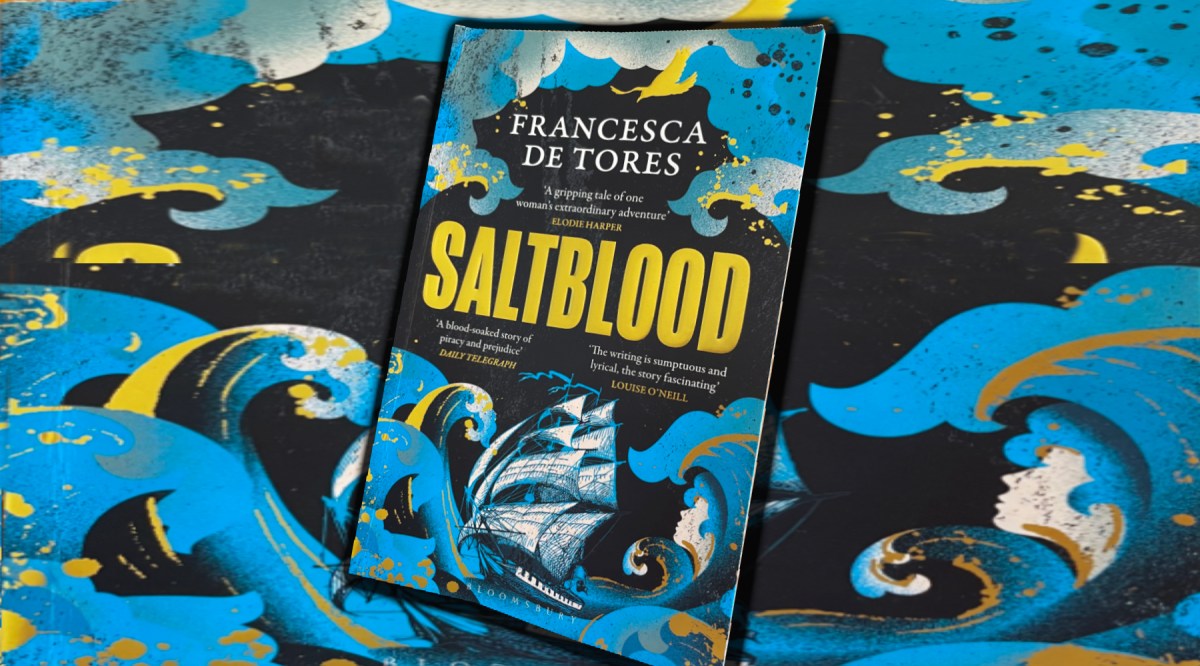
The cover has a tall ship under sail in a stormy sea, SALTBLOOD written in bold gold strapped across the middle and a promise of ‘A blood soaked story of piracy and prejudice’. Its a story of a girl brought up as a boy who runs away to sea and ends up as a pirate. Can a book get any more inviting than that? Well yes, it can, because I happen to know that the story is based on fact. How cool is that?
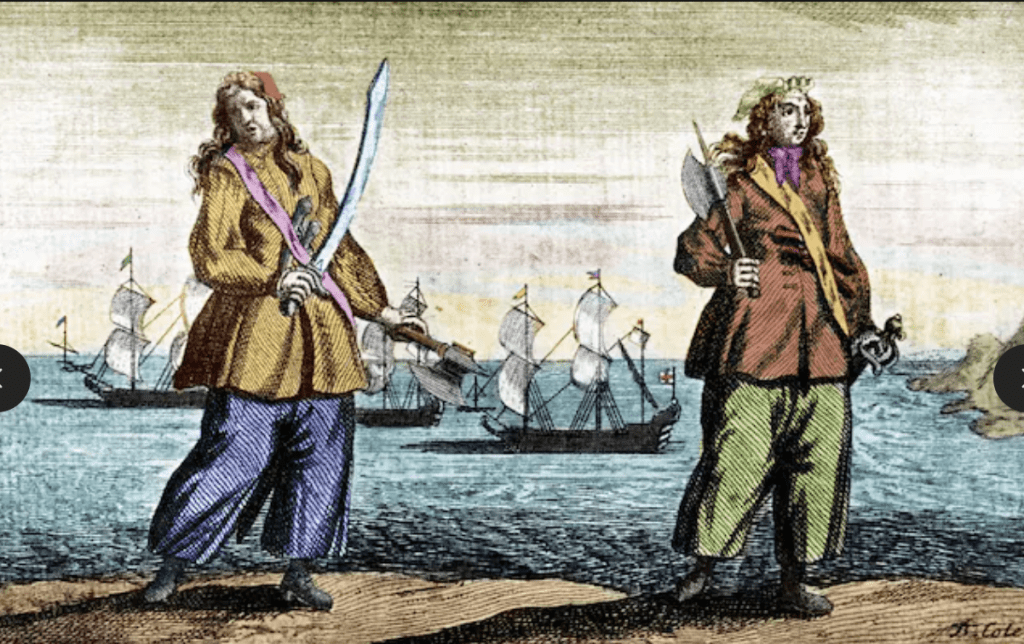
In the Maritime Museum in Greenwich a decade or so ago I found an engraving: ‘Female pirates Anne Bonny and Mary Read’ by B. Cole (early 18th century). Two cutlass-bearing, fierce-faced women pose before a sea of pirate ships. A shiver ran down me timbers. I wasn’t even a sailor back then but I never forgot the feeling it gave me. They cut their skirts into trousers and joined the marauding and plundering during the Golden Age of Piracy. What a story that would make! And here it is, given to me by the kids for my birthday (a parents’ job is to teach children to make good choices. Tick) told with great gusto by the piratey sounding Francesca de Tores.
Mary Read’s mother had son who died, so she dresses his half-sister up as a boy to continue collecting an inheritance. Mary becomes Mark. As a youth she goes into service as a footman and then runs off to join the navy, who are fighting endless wars against Spain. It’s the 1680s and life, as they say, was nasty, brutish and short, nowhere more so than at sea. Mary/Mark has learned to walk as a boy, to piss off the bowsprit like a boy (still not convinced about that one but no denying it would be useful) and on sailors rations and hard work grows up wiry and flat chested. She’s too scrawny to bleed. She lives wholeheartedly as a boy and you get the sense that yes, she’s cross-dressing to earn a living, but there’s a strong sense that this is her real identity. She is Mark.
And she loves it! She’s fast and nimble, easily as strong as the other young boys and when she climbs to the top of the foremast and looks out at the sea and (I know because I’ve done it) feels that there is no place on earth more wonderful. When they send a body overboard and she is asked if she regrets signing up, “No,” she replies, for the only way to love the sea is recklessly. She’s a powder monkey, sees active service and still manages to keep her secret. Next, when the war ships come in she joins the army in Flanders – more battles, more blood and mud and death. It’s here that one of the other soldiers, a young man she has taken a shine to, realises that Mark is a woman. To their comrades great surprise Mark puts on a skirt and the pair marry. Anyway, more adventures and then she is on her own again and pining for the sea. Merchant ships and pirating follow and in the Bahamas, the Pirate Republic, she meets fellow lady pirate, Anne Bonny, who joins the crew.
Wonderful research shines out of this story. I don’t know how many of the pirating stories are actually true but they are true to pirate lore. Mary and Anne sail with Callico Jack Rackham, Vane and Blackbeard are on the horizon and Governor Rogers issues his pardon and starts hanging pirates who don’t comply. But more than the pirate stories, what caught me in this book is the call of the sea and the detail of shipboard life. It’s always there and Mary has the saltblood. She sees the promise in every ship, hears that each has its own song. [The Walcheren‘s] song is harder to make out than the great orchestral groaning of the Resolve or the Expedition. When she sings it is the single, bright note of her square rigged mainsail ringing with the wind, or the busy hum of her headstay.
There is lots of action in this book and fantastically evocative writing – its very visual and ran like a film in my head – and themes of survival and friendship, how identity is tied to a name, gender fluidity, shifting sexuality, immorality. Not much consideration is giving to the morality of what Mary and her pirates do. Their terrifying ship chases down anything on the water and shoots whoever doesn’t give quarter. They either steal the ship or incapacitate it. These are a pack of seriously brutal marauders and Mary is one of the crew. She doesn’t shirk from whipping out her pistol on the unfortunates. And yet there is the pirates’ code of how the prizes are shared out fairly and how the man (woman) who spies the target can claim the best pair of pistols. Pirates of the Caribbean vibes hang over the story like gibbets at the entrance to a harbour.
There’s also a crow that follows Mary to witnesses her life. Not a friend, because you can’t befriend a crow, but a marker of continuity. It follows her all the way to jail. Perhaps it symbolises freedom to live the life you want, the way you want, and take the consequences. Sounds very piratey.
Terrific book.

 Cristina Sanders' blog