
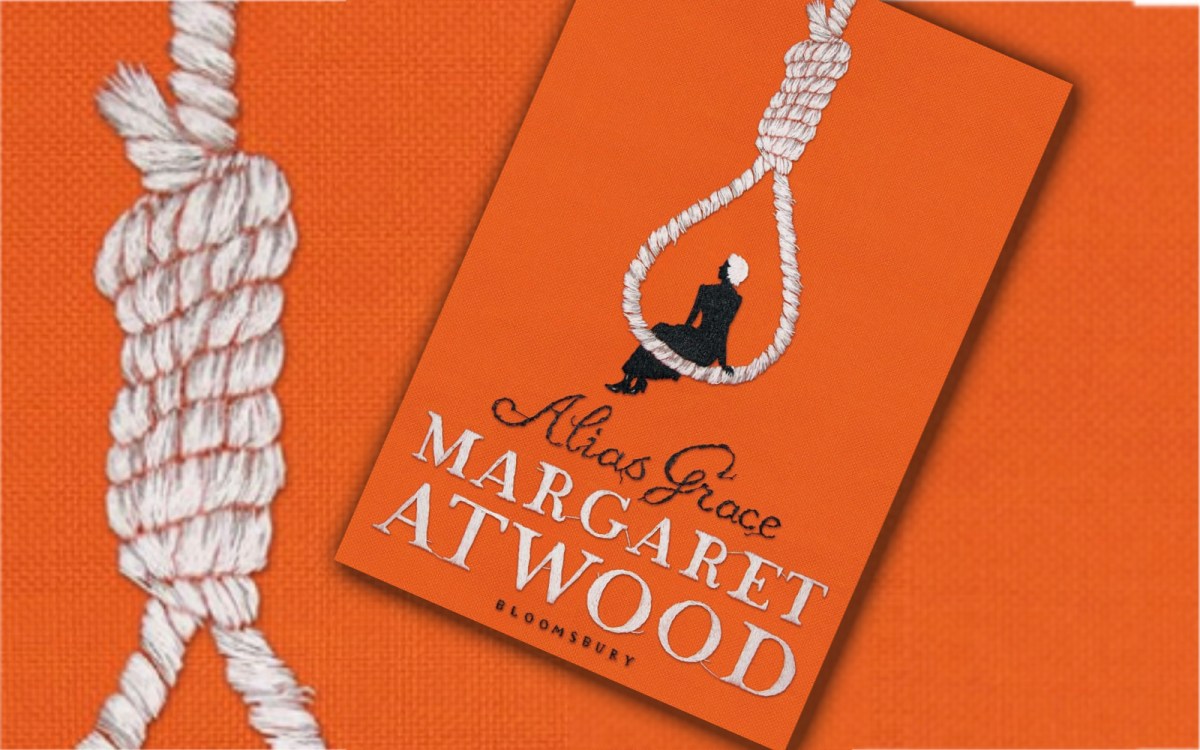
Wow. This is a hell of a book. Designed to throw you off balance and make you think, chapter after dense chapter of revelations that leave you uncomfortably challenging your assumptions and prejudices. Those weird Victorians and their strange ‘scientific’ beliefs – right on the cusp of modern thinking and at the same time waaay back in the Dark Ages. Well? Do you believe that sweet Grace Marks brutally murdered her master and the housekeeper?
Grace Marks was a real life ‘celebrated murderess’ in the early 1800s, incarcerated first in the Provincial Lunatic Asylum in Toronto and later in the Kingston Penitentiary. Atwood presents Marks to us after she has been jailed for fifteen years, now on day-release to work for the prison governor. She is a remarkably self-possessed and calm woman, clean and neat, demure and respectful, an ideal servant. I wonder how such a woman could possibly survive Victorian institutions like these. Lunatic asylums and jails in the 1800s were not for the faint of heart. But there we are.
Atwood, who apparently has been working around ways to tell this story for years, here invents a character who gives Grace the opportunity to tell her history in her own words. Atwood imagines a doctor, Simon Jordan, who is interested in the emerging field of psychology and bent on setting up his own asylum for lunatics. It is Dr Jordan’s ambition to win the truth from Grace during a series of interviews that drives the narrative. Dr Jordan studies Grace as she recounts her history for him. She has exceptional recall and clarity of thought, her confessions are full of anecdotes and detail from her childhood, immigration from Ireland to Canada, life with a dysfunctional family and then in service. There is nothing of the recollections of a potential madwoman or murderess here. Always she paints herself as an innocent, a bit of a prude. A naivety that surely would have been bashed out of her in prison? But no, she remains gentle and calm. Mostly.
Occasionally we get a glimpse that she knows the power she holds, spooling out her story over long afternoons with the attentive doctor. Dr. Jordan is writing eagerly, as if his hand can scarcely keep up, and I have never seen him so animated before. It does my heart good to feel I can bring a little pleasure into a fellow-being’s life; and I think to myself, I wonder what he will make of all that.
It’s a terrific story she tells. There are some gaps, some things she ether can’t or won’t remember. Is she a reliable narrator?
Simon tells himself to stop being so extreme and histrionic. It may well be that Grace is a true amnesiac. Or simply contrary. Or simply guilty. She could of course be insane, with the astonishingly devious plausibility of the experienced maniac. Some of her memories, especially those of the day of the murders, would suggest a fanaticism of the religious variety. However, those same recollections could as easily be interpreted as the naive superstitions and fears of a simple soul. What he wants is certainty, one way or the other; and that is precisely what she’s withholding from him.
The poor confused bloke. We are all in his boat.
His research gets stuck and things get whacky, in a fabulously Victorianesque way, with hauntings and hypnosis and personality disorders up for grabs. He witnesses: such a blatant piece of charlatanism and preposterous tomfoolery as a ‘Neuro-hypnotic trance,’ which is second in imbecility only to Spiritism, Universal Suffrage, and similar drivel. Modern psychotherapy had a very painful birth and I do wonder if we’re quite free of the whacky yet.
It’s Grace’s voice in this narrative I find so mesmerising. There’s a feel of “out of the mouths of babes” with her words and phrasing, the things she chooses to tell, the sweetness of the quilt sewing, milking the cow, and the friendship of maids. Is there is something underneath, a faint base note, a bit discordant, just out of reach?
The fascination for me is the way Margaret Atwood has taken what she can of the story and tried to find a truth in the remnants. In her notes she says : I have of course fictionalized historical events (as did many commentators on this case who claimed to be writing history). I have not changed any known facts, although the written accounts are so contradictory that few facts emerge as unequivocally ‘known.’ … When in doubt, I have tried to choose the most likely possibility, while accommodating all possibilities wherever feasible. Where mere hints and outright gaps exist in the records, I have felt free to invent.
This is clever historical fiction. Atwood has done her research and no one can prove her wrong in her rendition of the Grace Marks story. We don’t know what happened, we will probably never know any more. This is as likely a truth as any other.

 Cristina Sanders' blog