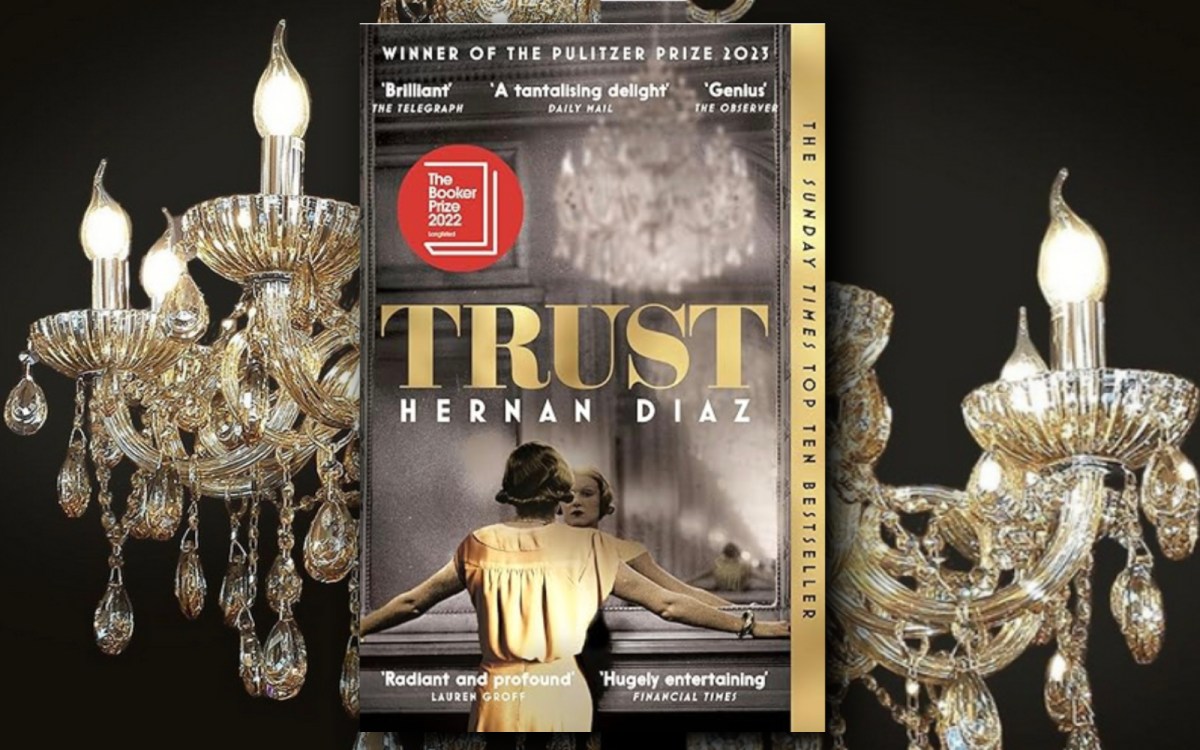
‘I am a financier in a city ruled by financiers. My father was a financier in a city ruled by industrialists. His father was a financier in a city ruled by merchants. His father was a financier in a city ruled by a tight-knit society, indolent and priggish, like most provincial aristocracies. These four cities are one and the same, New York.’ And here’s me trying to boycott all American culture until they get themselves a decent president! It was a book club choice, inescapable. Interesting book, though and a topic that’s resonating, so it gets a review.
Trust is in four parts, four tellings of the same couple’s story from different points of view. It took me a while to work out what was going on, especially as there are assumed names and sometimes the lives don’t match at all. This concept of mismatched lives I am particularly interested in having experienced it myself: my brother and I have such wildly divergent memories of childhood that my husband believes we grew up in completely different households. The ballet/rugby divide is deep and the twain did not meet (though as adults we get on very well). People look through their own lens and curate the story they want to tell of themselves, often subconsciously, and will remember anecdotes accordingly.
In Diaz’s book Trust, the story is of a fabulously wealthy but weird man, a financier, and his wife. Actually, no matter which way you look at them, they are both weird. Or perhaps they’re NFNY*. They’re both introverted, not in the way shy people are often portrayed in stories so readers can witness them bloom as they grow in confidence. Confidence is not what’s missing here. Are we meant to pity them for the fact they are simply too arrogant to form friendships?
Using the structure of different lenses (through a novel, a biography, a ghost memoir, a journal), the storytelling presents a wonderful mystery of history. Whose tale is the closest to the truth and what can we really know about the past? Who is the best authority on a person’s motivations, should we trust the person themselves, what their nearest and dearest say, what a researcher might come up with, looking to make sense of all the contradictions of a marriage, a life? As the story of the money, power, influence and brains behind it all is knitted up in a few alternative patterns, it’s hard to maintain confidence in the truth of any of them. Who’s scamming whom?
It’s set in America’s boom and bust years and these capitalist speculators of course make money in both. The story is told in long sentences of the complexities of wealth, how to get it (inheriting it is a good suggestion), how to keep it, and how to give it away. Only give tiny bits of it, obviously, and do so without having to engage with other people any more than absolutely necessary. The couple hold select concerts to show off their fabulously appointed home where “some of the guests were businessmen who had to suffer through Brahms so that their host did not have to suffer through chitchat.“
It’s a set up for a film (ah, just googled to find Kate Winslet is a step ahead of me here and already at work). Lots of glam and psychological twisting. It’ll probably be great. It’s just way too American for me.
“Perhaps this book will help my fellow countrymen remember that it is through the sum of daring individual actions that this nation has risen above all others and that our greatness comes only from the free interplay of singular wills.”
This all takes place long before the Trump years, obviously, but already there is a feeling they’re heading towards the apocalypse.
Hernan Diaz’s Trust won the 2023 Pulitzer Prize for Fiction. The Pulitzer is for distinguished fictional work by an American author, preferably dealing with American life. Yep.
*Normal For New York

 Cristina Sanders' blog