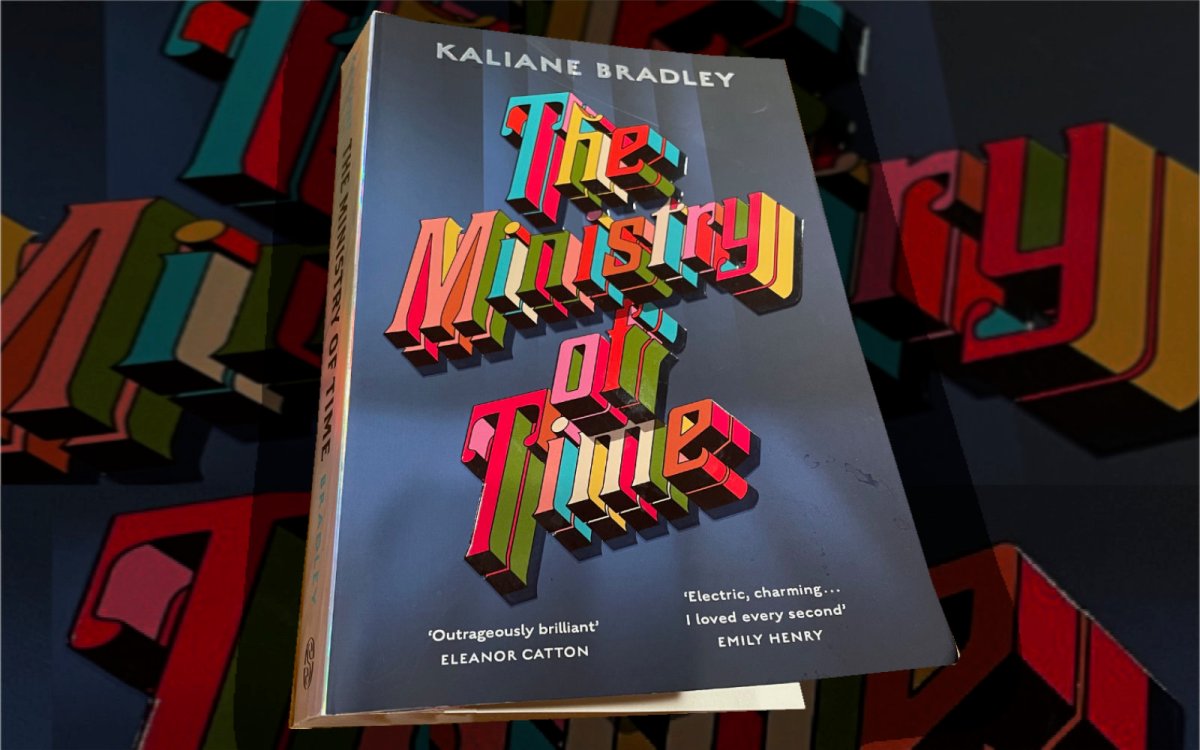
Yes, it’s only June, but The Ministry of Time by Kaliane Bradley gets my book of the year so far. It’ll be a hard one to beat. Great premise, excellent characters and the hottest sex I’ve read in years. The chap in question has been dragged out of 1845 into the near future, complete with fabulous side-whiskers, a cheeky dimple, and Victorian social attitudes. Our narrator likes his nose. He had a kind of resplendent excess of feature that made him look hyperreal. She is to be his bridge.
This is not a regular time-travel story. No one goes back. Rather we (in the near future) reach back and pull some historic characters forward to meet us, people on the cusp of dying so removing them from the world will not disrupt history. Think back to Catweazel, and his surprise of electrickery! Our man from 1845, the dashing polar explorer Graham Gore, has the same issues.
He was introduced to the washing machine, the gas cooker the radio, the vacuum cleaner.
‘Here are your maids,’ he said.
‘You’re not wrong.’
‘Where are the thousand league boots?’
‘We don’t have those, yet.’
‘Invisibility cloak? Sun-resistant wings of Icarus?’
‘Likewise.’
He smiled. ‘You have enslaved the power of lightening,’ he said, ‘and you’ve used it to avoid the tedium of hiring help.’
A good bit of social commentary runs through the sparkling text as our bridge explains to her charge concepts such as feminism, racial equality, on-line etiquette, bicycles. The over-complicated and fumbling government bureaucracy they work within he already is familiar with. Some things never change.
We learn about Gore’s last voyage with the doomed Franklin expedition as an officer on the Erebus, snatches of horror in mini-chapters that interrupt our modern story. You know the advice, that when someone reacts irrationally to something seemingly innocuous, you should never presume to know what they’ve been through? There are large traces of that lesson in this story.
The time-travellers are called ex-pats ‘from history’. There are a couple of shell-shocked soldiers from the English Civil War and WWI, an outspoken it-girl snatched from London’s plague; a refugee from the French Revolution. These new arrivals in 21st century England run an interesting parallel with our narrator, whose mother was a refugee from Pol Pot’s Cambodia. ‘She would never refer to herself as a refugee,’ our girl says, and waits for the ‘genocide-adjacent follow up’. This sense of a person not-quite belonging, although clearly belonging nowhere else, is an underlying tension that adds depth to the story. How do we relate to people not-quite-us?
There are flashes of lit through the book, nothing to slow the plot but enough to feel in good hands. Our girl is sitting on a park bench: The air was bisected by an iron hinge of autumn cold. Sparrows gusted along the kerb, waltzing with the limp yellow leaves. Sure feels like London to me.
My only wee disappointments about this otherwise wonderful book was that the start was a bit clunky and the end leaped from charmingly domestic to full Jason Bourne, in a similar type of trajectory Eleanor Catton used in Birnam Wood. Though an OTT macho ending doesn’t seem to do a book any harm, obviously.
Perhaps the ending is setting up for a sequel. Hope so.

 Cristina Sanders' blog