
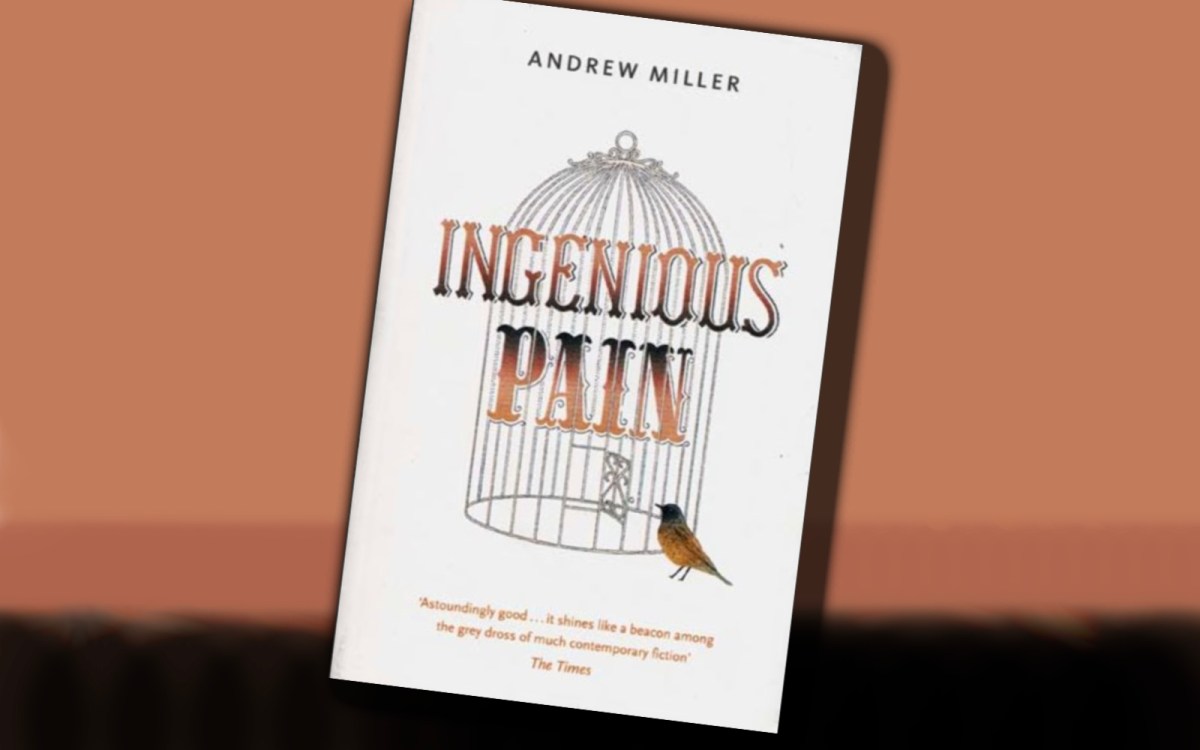
This book was recommended by a good reader to me, one with a shared love of historical fiction. It’s by Andrew Miller, who later wrote the fabulous but misnamed Pure about the stink of a cemetery in Paris in 1785, which I thoroughly recommend for a wallow in atmospheric history. Ingenious Pain not so much. There are flashes of writing that evoke time and place brilliantly, like: “Candlemas, 1767. The streets perfumed with coal smoke and frost, the night sky richly hammered with stars.” Perfect. A whole description in fifteen words. But these word-riches are not as frequently distributed as in Pure, and don’t flow as easily. I will still recommend Ingenious Pain, but if you’re only going to read one Miller, make it Pure, for sure.
This is the story of James Dyer who has ingenious pain, I think. Well, to begin with he feels no pain, either of body or mind. He’s an odd little boy. His family die of the pox and he wanders off with a circus, who exploit his lack of feeling to sell quacky pain-killing medicine. ‘Look, the boy feels no pain when stabbed through the hand with a pin!’ His hand heals remarkably quickly. I know of people who feel no physical pain (I once crawled under the table to test this by bashing the leg of a friend of my mother’s and found her lack of response pretty spooky). But why does our boy James not look like a used pincushion after a few months of this abuse? He is still flesh and blood, ableit an icy wee thing. Anyway, he is stolen by a gentleman with a house of curios and lives with a mermaid and Siamese twins. There is science and quackery all through this book, medical experimentation and superstition. The gentleman arranges for the separation of the twins. Things don’t go well. James escapes back to his old master and they are shanghaied into the king’s navy.
Here the story takes a turn. Our James has always been fascinated by surgery, and apprentices himself (and soon outshines) the ship’s doctor. Back on land he teams up with a practicing doctor and soon takes over his surgery (and his wife). Over the years he becomes famous for his skill and the steadiness of his knife. He feels nothing, his patients are just physical problems to be solved. He portrays a definite lack of bedside manner and is a strange contradiction – a doctor with no heart. He is an arrogant and unlikeable man.
I was never sure where the story was going. It starts at the end with this strange man, though we don’t get much of a sense of him or what makes him special. Then we go back and trace his life to find what brought him to this nondescript end. The tale seems to lack directional drive; I never feel any sense of wanting things to happen. Anyway, things do happen. The plot picks up a bit when James joins a race of doctors travelling to Russia to inoculate Catherine the Great against smallpox. On the way he joins with another party of English voyagers, meets a random woman who is being chased through the snow in a wood, and shortly after this, something tumultuous happens, which I couldn’t quite work out, that swamps him, finally, in the feelings he has been missing all his life, physical and emotional. Overwhelmed – as you would be, imagine it! Like a blind man suddenly viewing the whole world at once – he goes insane, and we struggle with him through the asylum.
I feel this story, with it’s bitty episodes and mix of mysticism and pseudo-science, gullibility and weirdness in daily life, might have been written for a reader from the 18th Century. It’s odd and very clever in parts. I do think it needs something more to hold it together, a bit more structure, perhaps, in a novel read for enjoyment. But definitely a good chocie for an analytical book club as everyone may have different interpretations on what, exactly, is going on.

 Cristina Sanders' blog