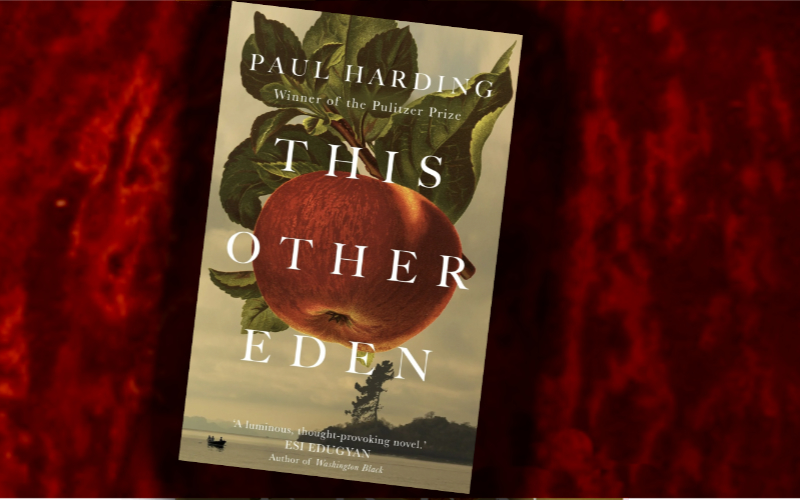
Such an interesting book, such a dive into the lives of people ostensibly at the very bottom of the pile. The story has its roots at the end of the 1700s, when Apple Island is settled by an escaped slave called Benjamin Honey, and his Irish wife. A hundred years later their descendants and a smattering of other (often a bit too closely) related families still shamble through their lives in this place. They’re a stone’s throw from the coast of Maine, close enough that they can forage on the mainland but, in the eyes of the mainlanders, who consider the islanders an inbred, mixed-race of starving, ignorant, degenerate squatters, they’re too close for comfort. The islanders are an amorphous blight, a problem in need of some kind of resolution. We learn that each islander is, of course, an individual, with different wants and needs and talents.
Matthew Diamond comes daily from the mainland. He believes himself ordained to help these poor unfortunates, even though he feels ‘a visceral, involuntary repulsion’ to black people. He holds lessons for the children and teaches them the bible, geometry and Latin, history and hieroglyphics – useful subjects when there’s not been a decent meal on the table for generations. They wear clothing patched from rags their ancestors wore, smoke the wild mugwort and drink black tea (it’s not really tea) ‘to nip morning, noon and suppertime pangs’. Thank God for the Latin, then.
There’s quite a cast of characters. Honey matriarch, Esther, has a son by her father and deals with this horror in the way that comes to hand. There are three grandchildren. There’s a family that lives in a washed up boat and a hermit called ‘Zachary Hand to God Proverbs’ (great name!) who lives in a tree and carves intricate bible scenes that no one will ever see. Some islanders are more black than others. The Lark children are so pale they can’t go out in the day but are ghostly nocturnal scavengers. Their parents are siblings. Esther’s grandson, Ethan, could pass as white. His grandfather (who was also his great-grandfather) was white. Ethan is a promising artist, something Matthew Diamond encourages, and he persuades Esther to let the boy go away to be properly tutored. Esther fears for him out in the world, a well founded fear as it turns out.
But there is no safety back on the island. Science has arrived, in the form of local politicians and their so-called doctors and scientists, who measure and investigate these odd specimens of humanity and declare them feeble-minded and in need of state intervention and, in 1912, the Islanders are evicted: some to asylums, some escape with their meagre possessions. It seems unlikely that they will survive another generation.
This is a sorry tale but beautifully told, and full of descriptions to make your heart sing. To read it is a full sensory experience. ‘The short path Esther knew so well seemed deeper, quieter, fuller with shadows and sharp new light, more densely trimmed with lush overhanging sea grass, intricately laid with mineral schist, purple and gold sand and purple and cream lozenges of seashells, sifting layers, and the rank smell of ocean and grass.’ There are short, poetical phrases and long, languid descriptions. ‘Matthew Diamond says nothing. The spring breezes rise and fall outside the open window. The stool he sits on is spare and hard. The shack smells of bodies and shellfish and animals and tobacco smoke. He is thirsty. He is exhausted from his insomnia and he is sickened by his incurable aversion to these people he truly believes he has been ordained to help.‘ There is an elegant rhythm to the prose that stands out in the descriptions of ordinary things and rough living.
It’s the boy, Ethan, who enables some commentary from a future looking back, his surviving drawings allow some of the history of his people to be saved, showing them in a way the scientific studies missed, not as great unfortunates but just as people, going about their lives, working, learning, getting along. Finding joy in the natural environment. Same as people everywhere. Just terribly poor.
Like I said, an interesting story, full of censorious judgement on an undoubted problem. Leaving us the question, of course, of given the society of the time and place, what might have been done differently? And, given similar circumstances, how do we judge and deal with similar situations today?
This Other Eden would be a hit for a book club, I reckon, with lots to discuss, and lovely to read aloud.

 Cristina Sanders' blog